
 Worksheets
Plate Tectonic Quiz
Total questions: 30
Worksheet time: 19mins
Name
Class
Date
1.
The type of plate boundary where two plates come together is a .....
a)
Convergent Boundary
b)
Divergent Boundary
c)
Transform Boundary
d)
Plate Boundary
2.
Which of the following causes Earth's tectonic plates to move?
a)
Energy from the Sun
b)
Magnetic Pole Reversal
c)
Convection currents in the mantle
d)
Faults in Mountain Ranges
3.
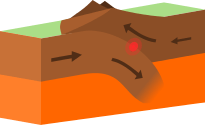
What type of plate boundary is this?
a)
Plate
b)
Divergent
c)
Convergent
d)
Transform
4.

What type of event will occur at this boundary?
a)
Earthquake
b)
Volcano Eruption
c)
Tornado
d)
Mountain Building
5.
A divergent boundary occurs when plates ....
a)
Pull apart
b)
Come together
c)
Slide past each other
d)
subducting
6.
Which of the following is the name of the ancient supercontinent formed 28 Million Years ago.
a)
Pangea
b)
Gondwanda
c)
Laurasia
d)
Neverland
7.
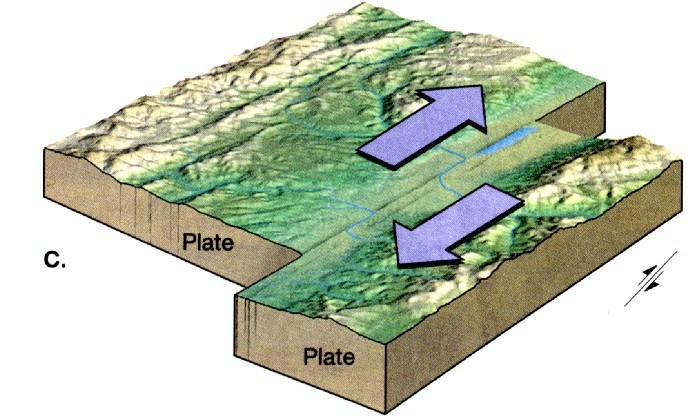
What type of plate boundary is this?
a)
Transform
b)
Convergent
c)
Divergent
d)
Plate
8.
The theory that says Earth's continents once made up an ancient supercontinent, and have been drifting apart ever since, is called the theory of...
a)
Pangea
b)
Plate Tectonics
c)
Natural Selection
d)
Gravity
9.
Mountains are created when....
a)
Two continental plates collide
b)
Two oceanic plates pull apart
c)
An Oceanic plate subducts under a Continental Plate
d)
Two continental plates pull apart
10.
The part of the earth that includes the crust and the upper mantle and is split into tectonic plates is the
a)
lithosphere
b)
crust
c)
asthenosphere
d)
mantle
11.
This layer is completely liquid
a)
crust
b)
inner core
c)
mantle
d)
outer core
12.
This layer is completely solid due to the intense pressure it is under
a)
crust
b)
inner core
c)
mantle
d)
outer core
13.
Supporting Evidence: fossils, continent shape, landforms
a)
Continental Drift
b)
Seafloor Spreading
c)
Plate Tectonics
14.
The theory stating the continents were once joined in a large mass that broke apart.
a)
Continental Drift
b)
Seafloor Spreading
c)
Plate Tectonics
d)
Pangaea
15.
Ocean trenches always form at subduction zones where dense oceanic crust subducts.
a)
True
b)
False
16.
Volcanoes never form along subduction zones.
a)
True
b)
False
17.
Faults and tectonic plate boundaries are the same thing.
a)
True
b)
False
18.
Volcanoes are most often formed at this boundary.
a)
Divergent
b)
Convergent
c)
Normal
d)
Transform
19.
The Mid-Atlantic Ridge is formed at this boundary.
a)
Divergent
b)
Convergent
c)
Normal
d)
Transform
20.
There are 3 types of crust.
a)
True
b)
False
21.
Continental crust is more dense than oceanic crust.
a)
True
b)
False
22.

What are the two types of crust
a)
continental and oceanic
b)
ocean and upper
c)
lower and upper
d)
pizza and subway
23.

The presence of the same ________ on several continents supports the idea of continental drift.
a)
rocks
b)
fossils
c)
both fossils and rocks
d)
neither fossils nor rocks
24.

The theory of continental drift was first proposed by __________.
a)
Thomas Edison
b)
Alfred Wegener
c)
Benjamin Franklin
d)
Harry Hess
25.

The theory of seafloor spreading was first proposed by __________.
a)
Thomas Edison
b)
Harry Hess
c)
Benjamin Franklin
d)
Alfred Wegener
26.

Which type of plate boundary occurs at B?
a)
convergent
b)
divergent
c)
transform
d)
country
27.

Which type of plate boundary is shown at A?
a)
transform boundary
b)
convergent boundary
c)
divergent boundary
d)
fractured boundary
28.

Which tectonic plate is Texas part of?
a)
Pacific Plate
b)
Eurasian Plate
c)
North American Plate
d)
South American Plate
29.

What takes place at a mid-ocean ridge?
a)
subduction
b)
sea-floor spreading
c)
rift valleys
30.
True or False. Both mountains and mid-ocean ridges take a long time to form.
a)
True
b)
False
100 %

