
 Worksheets
MASTER Foundational Literary Terms
Total questions: 172
Worksheet time: 2hrs 0mins
This is when an author tells what the senses hear, see, smell, taste, or touch to create a vivid scene or picture for the reader.
imagery
irony
metaphor
simile
What is writing that is drawn from the writer's imagination and not strictly true to real people, places, or events?
fiction
nonfiction
writing that is strictly true to real people, places, or events
fiction
nonfiction
idiom
an over-used yet popular phrase
a reference to something famous in literature, religion, history, etc.
a statement that literally makes no sense, but is culturally understood. E.g. "It's raining cats and dogs."
paradox
use of humor to point out other's stupidity, vices, and mistakes
the main idea of a story
a seemingly absurd or self-contradictory statement, idea, or situation that--when investigated or explained--may prove to be well founded or true.
giving human qualities to an inhuman object
round character
does not change
changes
few character traits
multi-faceted character / traits
flat character
does not change
changes
many character traits
limited range of traits; single-faceted
theme
universal lesson learned or moral of the story about life or human nature; The intended message of the author
events in a story
reocurring idea
character info
attributing human characteristics to inanimate objects, animals, or ideas.
personification
paradox
onomatopeia
simile
the use of words, such as "buzz" or "splash", that imitate the sounds associated with the objects or actions they refer to.
onomatopeia
cliché
irony
personification
He ran like the wind.
simile
metaphor
paradox
irony
William Eno invented the stop sign, crosswalk, traffic circle, one-way street, and taxi stand—but never learned how to drive.
irony
cliché
paradox
simile
Why the characters act the way they do.
Character Traits
Motivations
Protagonist
Conflict
Which part of the plot diagram has the final outcome of the story?
Exposition
Climax
Rising Action
Resolution / Denouement
Actions, dialogue, and narrative description that reveal a character's personality to the reader.
Setting
Characterization
Personalization
Flashback
An example of direct characterization is...
Erin wondered whether their parents were home, and what would happen when they found out what happened.
He wore shabby shoes, and there were holes in his jacket.
He said, "Dude, I've never been into that kind of music!"
She was graceful, like a ballerina, and yet somehow, also, endearingly clumsy.

Which part of the story is represented by this blue blob?
exposition
rising action
climax
resolution


It is possible to have multiple plots within one story.
What type of character is Madison?
Marcy sat in class, drumming her fingers on her desk. Thinking back to that morning, she felt remorse over the way she had talked to her mom.
Mr. Timpelton walked through the airport in his crisp army uniform and duffel bag. After being deployed for a year in Iraq, he was anxious to see is family. He wiped his hands nervously on his pants, breathed a deep sigh, and begin to head to the airport welcoming area.
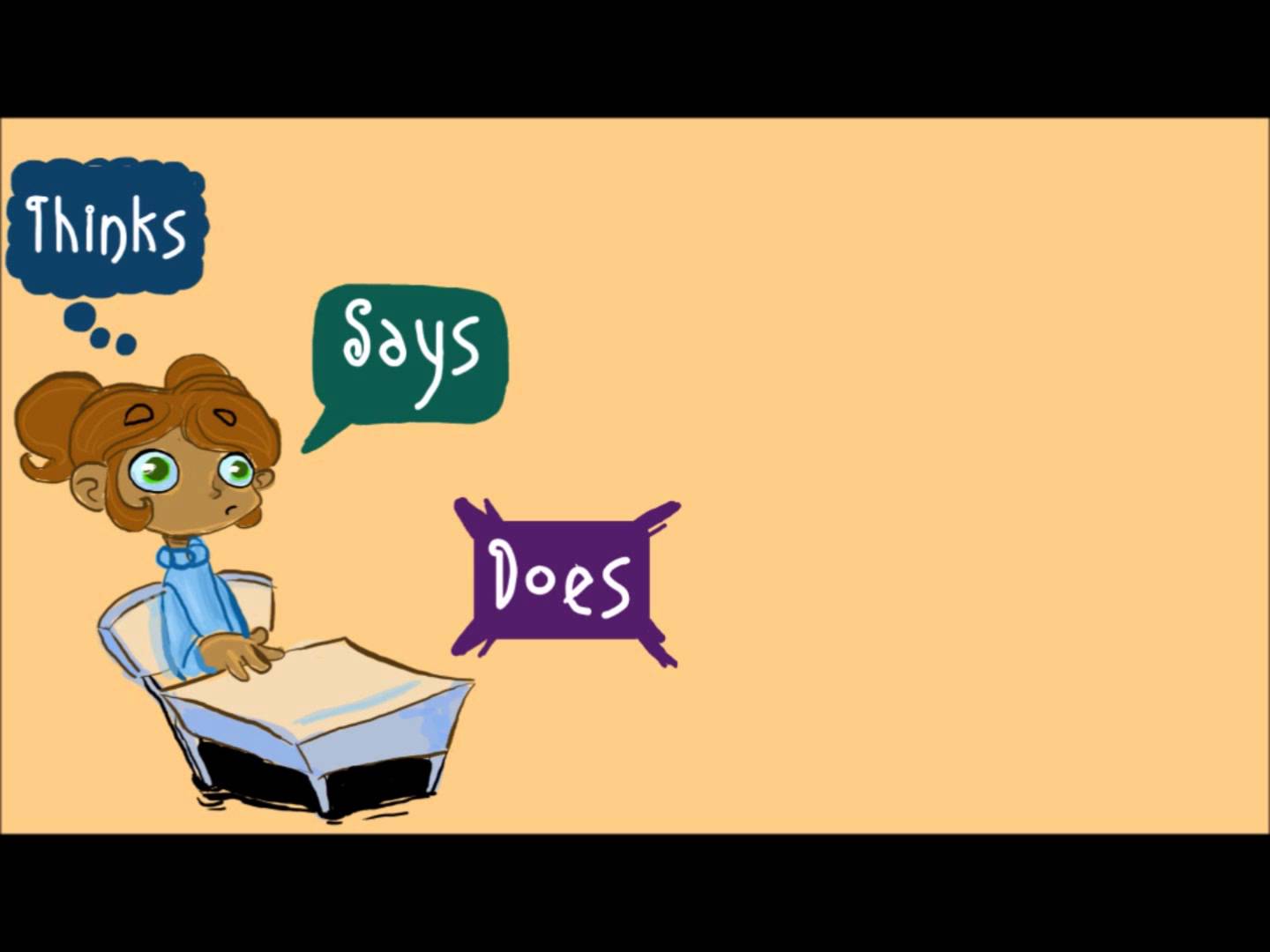
Read the following passage.
“We did it! We did it! We did it!” Mei slapped her hand against the table, knocking aside teaspoons in her zeal.
“Whoa!” her brother exclaimed, startled.
“Congratulations to us!”
Mei stood up and triumphantly strutted around the kitchen.
Her brother laughed, surprised and amused.
“Who are you, and what have you done with my sister?”
Based on the passage, what can you infer about Mei?
Mei is always outgoing and loud.
Mei is timid.
Mei is not very athletic.
Mei is not usually so boastful and energetic.
When the men reached Oregon, they stepped out of their wagons and embraced. The journey was long and dangerous, but they made it. Soon, their families would follow their trail in their own wagons, leaving their homes in the East to meet them in this brand new land: the West.
Poetry uses ____ devices like rhythm and rhyme.
Sound
Sight
Taste
Touch
"Once upon a midnight dreary, while I pondered, weak and weary..."

Rhyme Scheme: ABAB CDCD EFEF GG
characters, etc.)
and director as to what they should be going.
and mood.
lessons learned by the characters.
and excitement
convey meaning
feeling, or personality
performance

When a character talks while other actors are onstage but only the audience or specific characters (not all) can hear, it is called...
Monologue
Soliloquy
Aside
Dialogue
When a character talks while no other actors are onstage and only the audience can hear, it is called...
Monologue
Soliloquy
Aside
Dialogue
An idea, image, or element that is repeated throughout a work and conveys a central idea of the work that can be summarized in one word or phrase is a...
Main idea
Theme
Motif
Symbol
A moment of notable shift in character, plot, or thematic development in a work is called...
Arc
Turning point
Climax
Dynamic
A character or set of characters who can be compared and contrasted in a work to heighten plot and theme development:
Juxtaposition/s
Foil/s
Analogy/s
The use of something related to represent the thing meant:
Synedoche
Metonymy
The use of the part to represent the whole:
Synedoche
Metonymy
A character's fatal or tragic flaw
Hamartia
Hubris
Epiphany
Catharsis
A symbolic story, poem, or picture that can be interpreted to reveal a particular hidden meaning, typically a moral or political one
Analogy
Satire
Parody
Allegory
a humorously exaggerated imitation
Analogy
Satire
Parody
Allegory
the use of humor, irony, exaggeration, or ridicule to expose and criticize people's stupidity or vices, particularly in the context of contemporary politics and other topical issues
Analogy
Satire
Parody
Allegory
an imagined place or state in which everything is unpleasant or bad, typically a totalitarian or environmentally degraded one
Utopia
Satire
Dystopia
Fable
an imagined place or state of things in which everything is perfect
Utopia
Fairy tale
Dystopia
Fable
Art that imagines humans as non-human animals; Art that portrays one species of animal like another species of animal
Anthropomorphism
Personification
Zoomorphism
a single line of poetry
Stanza
Paragraph
Verse
Refrain
A line ending in a full pause, usually indicated with a period or semicolon.
Enjambment
End-stopped line
Punctuated
A line having no end punctuation but running over to the next line.
Enjambment
End-stopped line
Punctuated
The technique of showing that words, phrases, clauses, or larger structures are comparable in content and importance by placing them side by side and making them similar in form.
Repetition
Parallelism
Comparison and contrast
Juxtaposition
smooth, pleasant sound choice and arrangement
Euphony
Cacophony
Symphony
Harsh, discordant, or unpleasant sound choice and arrangement
Euphony
Cacophony
Symphony
dynamic character
many character traits
does not change
changes / evolves
few character traits

