
 Worksheets
Review- Rock, Minerals and the Rock Cycle
Total questions: 37
Worksheet time: 31mins
Name
Class
Date
1.

This rock formed when bits of other rocks became pressed into a solid. What type of rock is it?
a)
Sedimentary Rock
b)
Metamorphic Rock
c)
Igneous Rock
2.

This rock was formed when magma cooled very slowly inside the Earth. What specific type of rock is it?
a)
Intrusive Igneous Rock
b)
Extrusive Igneous Rock
c)
Foliated Metamorphic Rock
d)
Clastic Sedimentary Rock
3.

This rock formed when lava cooled very quickly on Earth's surface. What specific type of rock is it?
a)
Extrusive Igneous Rock
b)
Intrusive Igneous Rock
c)
Non-Foliated Metamorphic Rock
d)
Biochemical Sedimentary Rock
4.
When you watch a volcano erupt molten rock, you are seeing _____
a)
Lava
b)
Magma
c)
Mineral Crystals
d)
Igneous Rocks
5.
When you are describing the sizes of the mineral grains in a rock, you are detailing the rock's _____
a)
Texture
b)
Composition
c)
Sedimentation
d)
Igneous-ness
6.
Which of the words below describe broken up rock?
a)
stalactites
b)
magmas
c)
metamorphs
d)
sediments
7.
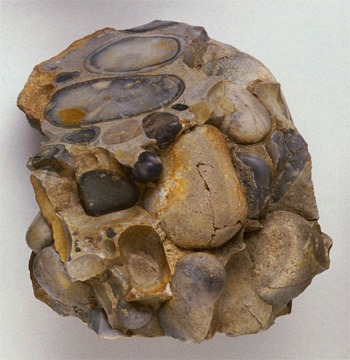
This rock was formed by smaller pieces of rock that settled at the bottom of a lake millions of years ago. What type of rock is this?
a)
Sedimentary
b)
Igneous
c)
Metamorphic
8.
What is deposition?
a)
Dropping off sediment
b)
Movement of sediment
c)
Breaking down of sediment
9.

The process when rocks break into smaller pieces due to exposure to natural elements is called
a)
erosion
b)
weathering
c)
sediments
d)
deposition
10.

Is the following metamorphic rock foliated or non-foliated?
a)
Foliated
b)
Non-foliated
c)
Neither
11.
During the rock cycle, what forms when the magma cools?
a)
igneous rocks
b)
sedimentary rock
c)
metamorphic rock
d)
foliated rock
12.
Metamorphic rock in which minerals are NOT arranged in bands
a)
stratification
b)
non-foliated
c)
extrusive igneous rock
d)
strata
13.
The color of a mineral in powder form is called the mineral's
a)
hardness
b)
specific gravity
c)
luster
d)
streak
14.
How light reflects off of a mineral is called the mineral's
a)
luster
b)
streak
c)
cleavage
d)
fracture
15.
Why is coal not a mineral?
a)
It's not a solid
b)
It is man-made
c)
It is not inorganic
d)
It is made of carbon
16.

The following image shows what mineral property?
a)
Hardness
b)
Streak
c)
Cleavage
d)
Density
17.
Diamond has a hardness of ___ on Mohs Hardness Scale.
a)
1
b)
5
c)
8
d)
10
18.
Dull, silky, waxy, pearly, and earthy are terms that best describe which property of minerals?
a)
luster
b)
color
c)
streak
d)
cleavage
19.

By definition, a mineral has which of the following characteristic(s)?
a)
definite chemical composition
b)
crystal structure
c)
naturally occuring
d)
all of the above
20.
How do you test the hardness of a mineral?
a)
Throw it against a wall
b)
Step on it
c)
Scratch Test
d)
Kick it until it breaks
21.

What mineral is used for pencils?
a)
Graphite
b)
Galena
c)
Magnetite
d)
Quartz
22.

What mineral is salt?
a)
quartz
b)
sulfur
c)
halite
d)
calcite
23.
What mineral is the softest mineral on Moh's Hardness Scale and the main ingredient in baby powder?
a)
feldspar
b)
talc
c)
gypsum
d)
kaolinite
24.
A mineral's resistance to being scratched is called?
a)
streak
b)
luster
c)
hardness
d)
heft
25.
Which mineral smells like rotten eggs?
a)
talc
b)
sulfer
c)
mica
d)
pyrite
26.
When a mineral breaks in an uneven, rough, or jagged way
a)
Luster
b)
Cleavage
c)
Hardness
d)
Fracture
27.
When a mineral breaks smoothly and evenly.
a)
Luster
b)
Cleavage
c)
Hardness
d)
Fracture
28.
What are the two most abundant elements in Earth's Crust?
a)
Nitrogen & Oxygen
b)
Potassium & Silicon
c)
Silicon & Oxygen
d)
Nitrogen & Potassium
29.
What gives a mineral its specific properties?
a)
its hardness
b)
the internal arrangement of atoms
c)
energy released during crystallization
d)
light being reflected
30.

Using this scale, which mineral can scratch fluorite?
a)
Talc
b)
Gypsum
c)
Apatite
d)
Calcite
31.
What does inorganic mean?
a)
Something that is living
b)
Something that is dead, but was once living
c)
Something that was never living
32.
How do you determine the density of a mineral?
a)
D=M/V
b)
D=V/M
c)
D=M x V
d)
D= V x M
33.
What is the relationship between a rock and a mineral?
a)
Rocks are made up of minerals.
b)
Minerals are made up of rocks.
c)
Rocks are on the Earth's surface. Minerals are found underground.
d)
Rocks and minerals are different names for the same thing.
34.
A metamorphic rock changes into an igneous rock by what two processes?
a)
Melting and cooling
b)
Extreme heat and pressure
c)
Compaction and cementation
d)
Weathering and erosion
35.
Which type of rock forms from extreme heat and pressure?
a)
Igneous
b)
Sedimentary
c)
Organic
d)
Metamorphic
36.
True/False: Igneous rocks can only turn into metamorphic rocks.
a)
True
b)
False
37.

When sediments are pressed together tightly, this is called ____________.
a)
Compaction
b)
Cementation
c)
Weathering
d)
Erosion
100 %

