
 Worksheets
ELEMENTS OF ART & PRINCIPLES OF DESIGN
Total questions: 36
Worksheet time: 17mins
Name
Class
Date
1.
The elements of art are:
a)
the way art is arranged
b)
pure chemical substances used in art
c)
the building blocks of art
d)
pens, pencils, paint, ect...
2.
A line is a mark with
a)
length and direction
b)
width and height
c)
dots and squiggles
d)
ink or pencil
3.
The relative lightness or darkness of an object is:
a)
texture
b)
color
c)
contrast
d)
value
4.
The two categories of texture are:
a)
sharp and soft
b)
fluffy and rough
c)
visual and actual
d)
bumpy and smooth
5.
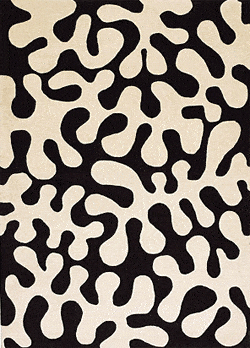
What phrase best describes this image?
a)
geometric forms
b)
geometric shapes
c)
organic shapes
d)
organic forms
6.
The area around, above or inside an object is called:
a)
form
b)
perspective
c)
contrast
d)
space
7.
Which of these is not an example of art media?
a)
clay
b)
oil paint
c)
paint brush
d)
marble
8.
Shapes are
a)
the form of an object
b)
two-dimensional
c)
three-dimensional
d)
open spaces
9.

Which letter shows an example of negative space?
a)
S
b)
H
c)
I
d)
F
10.
A three-dimensional object is called:
a)
a square
b)
a mold
c)
a form
d)
a circle
11.
Lines that follow the outer edges of an object are:
a)
Crispy Lines
b)
Cross-hatching
c)
Contour Lines
d)
Carbon Lines
12.
When you create a blind contour drawing you don't:
a)
look at the paper
b)
look at anything
c)
use your imagination
d)
draw any lines
13.
An element of art that refers to the lightness and darkness of a color.
a)
hue
b)
value
c)
movement
d)
contrast
14.
The element of art that refers to the surface quality of an object or the way something feels such as rough-smooth
a)
shape
b)
texture
c)
color
d)
line
15.
Element of art produced when a wavelength of light strikes an object and reflects back to the eyes.
a)
primary
b)
secondary
c)
teriary
d)
color
16.
Another name for related colors-have one color in common. Colors that appear next to each other on the color wheel.
a)
analogous colors
b)
shape
c)
texture
d)
color
17.
Colors that are directly opposite on the color wheel. When mixed together, they makes neutral gray or brown.
a)
complementary
b)
texture
c)
analogous
d)
color
18.
Area in a work of art that catches and holds the viewers attention.
a)
space
b)
unity
c)
emphasis
d)
balance
19.
The relation of one object to another in size,amount, number.
a)
variety
b)
monochromatic
c)
proportion
d)
triad
20.
How many elements of art are there?
a)
5
b)
3
c)
7
21.
How many tertiary colors are there?
a)
3
b)
6
c)
9
22.
Form is
a)
2 dimensional
b)
3 dimensional
c)
non-existent
23.
If I mix red and orange, what color have I created?
a)
orange-red
b)
red-orange
c)
a really great lipstick
24.
Adding white to a color is called a what?
a)
shade
b)
tint
c)
tone
25.
Two-point perspective has how many vanishing points?
a)
one
b)
two
c)
three
26.
A type of balance in which the two sides of an artwork look equally important even though they are not alike
a)
Symmetrical balance
b)
Asymmetrical balance
c)
Radial balance
d)
Bilateral balance
27.

This image shows an example of:
a)
Exaggerated scale
b)
Juxtaposition
c)
High contrast
d)
Exaggerated proportions
28.

This image shows an example of:
a)
asymmetrical balance
b)
symmetrical balance
c)
radial balance
d)
physical balance
29.
The placement of the elements so that no part of the design overpowers any other part or seems visually heavier is called:
a)
unity
b)
emphasis
c)
balance
d)
principles of design
30.
The way an artwork is arranged is called:
a)
design
b)
composition
c)
frame
d)
photo
31.
The focal point of an artwork is also called:
a)
background
b)
rhythm
c)
emphasis
d)
pattern
32.
The appearance of motion is called:
a)
calibration
b)
animation
c)
design
d)
movement
33.
A repeated design is called a:
a)
principle
b)
pattern
c)
element
d)
shape
34.
The amount of difference between things is called:
a)
contrast
b)
value
c)
variety
d)
unity
35.
The principles of design
a)
are the building blocks of art
b)
are the governors of art
c)
arrange the elements into a composition
d)
are things like clay, pencils, paint, ect...
36.
_______ is created when one or more of the elements of art are used repeatedly to create a feeling of organized movement.
a)
rhythm
b)
balance
c)
unity
d)
variety
100 %

