
 Worksheets
Scientists
Total questions: 20
Worksheet time: 14mins

Who laid the foundations for classical mechanics, explaining the law of gravity and the laws of motion in 1867?
Galileo Galilei
Albert Einstein
Isaac Newton
Antoine Lavoisier

Who developed cures for rabies and anthrax, and made milk safer to drink?
Antoine Lavoisier
Michael Faraday
Dmitri Mendeleev
Louis Pasteur

Who created one of the first modern telescopes, and successfully proved the Earth revolves around the Sun?
Ernest Rutherford
Galileo Galilei
James Clerk Maxwell
Gregor Mendel

Which Polish scientist conducted pioneering research on radioactivity, and won Nobel Prizes in two different sciences?
Marie Curie
Otto Hahn
Lise Meitner
Rosalind Franklin

Who revolutionised modern physics with his general theory of relativity?
Galileo Galilei
Albert Einstein
Stephen Hawking
Niels Bohr

Who collected evidence over 20 years and published his conclusions in On the Origin of Species (1859)?
Nikola Tesla
Michael Faraday
Gregor Mendel
Charles Darwin

Which German chemist discovered nuclear fission and was awarded the Nobel Prize for Chemistry in 1944?
Albert Einstein
Otto Hahn
Antoine Lavoisier
Michael Faraday

Which Serbian-American is known for his contributions to the design of the alternating current (AC) electricity supply system?
Nikola Tesla
Michael Faraday
Louis Pasteur
Dmitri Mendeleev

Which Scottish scientist formulated the classical theory of electromagnetic radiation?
James Prescott Joule
James Watson
James Watt
James Clerk Maxwell

Which English scientist contributed to the study of electromagnetism and electrochemistry?
Francis Crick
Michael Faraday
Alexander Fleming
Charles Darwin

The Scottish biologist Alexander Fleming discovered the world's first antibiotic substance, ___
Penicillin
Phlogiston
Aspirin
Amoxicillin
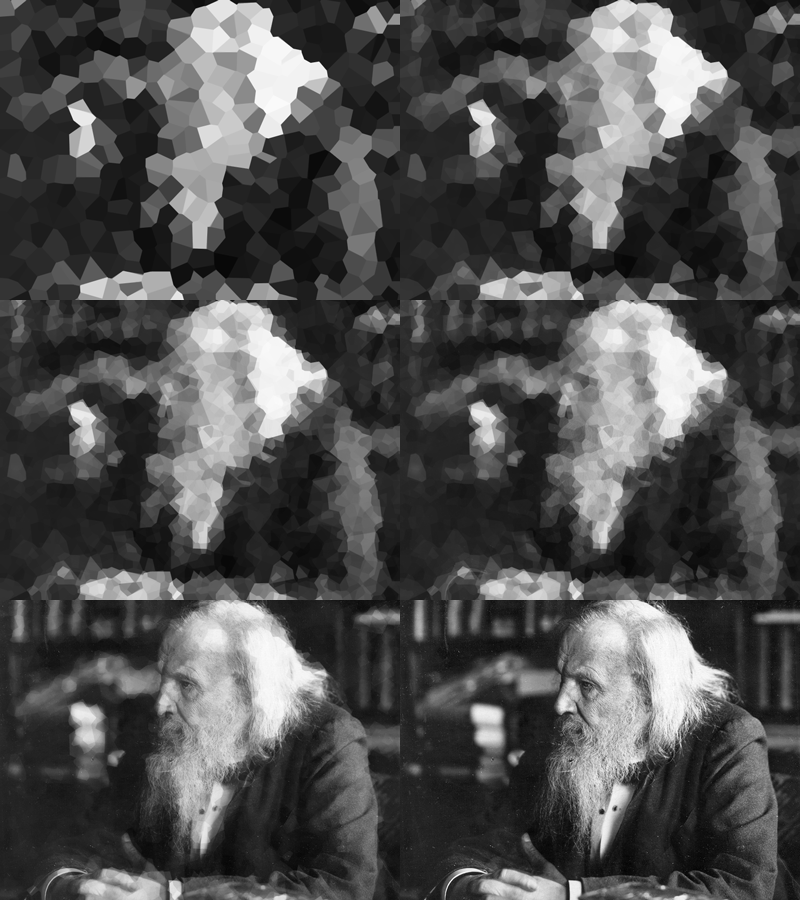
Which Russian chemist is commonly considered to be the developer of the modern Periodic Table of the Elements?
Nikolay Basov
Pavel Cherenkov
Antoine Lavoisier
Dmitri Mendeleev

Which French nobleman is widely considered the "father of modern chemistry"?
Blaise Pascal
Dmitri Mendeleev
Antoine Lavoisier
Louis Pasteur

Gregor Mendel's experiments established many of the rules of heredity. Which plant did he predominantly use?
Peas
Beans
Broccoli
Potatos

Which New Zealand-born British physicist conducted research that led to the first "splitting" of the atom in 1917?
Niels Bohr
Ernest Rutherford
Albert Einstein
Michael Faraday

Which Danish physicist proposed that electrons in atoms jump from one orbit to another?
Niels Bohr
Otto Hahn
James Watson
Nikola Tesla

Which X-ray crystallographer made contributions to the understanding of the molecular structure of DNA?
Marie Curie
Rosalind Franklin
Lise Meitner
Barbara McClintock

Which British molecular biologist is most noted for being a co-discoverer of the structure of the DNA?
Otto Hahn
Francis Crick
Michael Faraday
Alexander Fleming

Which American molecular biologist is best known for being a co-discoverer of the structure of the DNA?
Charles Darwin
Linus Pauling
Enrico Fermi
James Watson

Which English theoretical physicist authored The Theory of Everything, and A Brief History of Time?
Stephen Hawking
Neil deGrasse Tyson
Albert Einstein
Ernest Rutherford

