
 Worksheets
Evolution and Natural Selection
Total questions: 32
Worksheet time: 26mins
Name
Class
Date
1.
Survival of the Fittest and Evolution were proposed by what scientist?
a)
Charles Darwin
b)
Albert Einstein
c)
Steven Hawking
d)
Isaac Newton
2.
When every organism of a species has died.
a)
Evolution
b)
Natural Selection
c)
Extinction
d)
Artificial Selection
3.
Where the better adapted organisms survive to pass traits along to offspring.
a)
Evolution
b)
Natural Selection
c)
Extinction
d)
Artifical Selection
4.
What was the name of the ship Darwin traveled the world on?
a)
HMS Beagle
b)
SS Beagle
c)
HMS Bugle
d)
SS Bugle
5.
What are the most studied animals in the galapagos?
a)
Finches
b)
Tortoises
c)
Turtles
d)
Lizards
6.

What is the advantage of having different shaped beaks?
a)
To look different from other species.
b)
To be able to eat the food readily available in the environment.
c)
To protect itself against predators.
d)
To protect itself against prey.
7.
The theory of evolution by natural selection means that what is changing over time?
a)
The inherited traits of a population.
b)
The acquired traits of a population.
c)
Hair color and eye color
d)
Attractive features.
8.

Why are advantageous traits more likely to be passed onto offspring?
a)
Because they are more likely to survive and reproduce.
b)
Because they come from dominant alleles.
c)
Because they come from recessive alleles.
d)
Because the trait is an acquired phenotype.
9.
Mutations are a change in what?
a)
DNA
b)
tRNA
c)
genotype
d)
phenotype
10.

What word describes a trait that helps an organism survive in its environment?
a)
natural selection
b)
mutation
c)
camouflage
d)
adaptation
11.
All mutations and adaptations usually lead to what process?
a)
selective breeding
b)
behavioral
c)
natural selection
d)
genetic engineering
12.
Why do frogs and other organism reproduce so many eggs or offspring?
a)
so that their babies can have friends to play with
b)
the more offspring the more likely the offspring will survive
c)
the more offspring the less likely offspring will survive
d)
the more offspring the less competition
13.
Which organisms are most likely to survive?
a)
the best adapted
b)
the fastest
c)
the strongest
d)
the most domesticated (tamed)
14.
Almost all adaptations started off as?
a)
selective breeding
b)
physiological
c)
structural
d)
mutation
15.
Any inherited trait that gives an organism an advantage in its environment is called ___.
a)
a mutation
b)
an adaptation
c)
evolution
d)
natural selection
16.
Which of the following means "genetic change over time"
a)
natural selection
b)
speciation
c)
evolution
d)
fitness
17.
Do organisms "decide" to evolve and change?
a)
Yes, they know they need to change to survive
b)
No, they change because of natural selection
18.
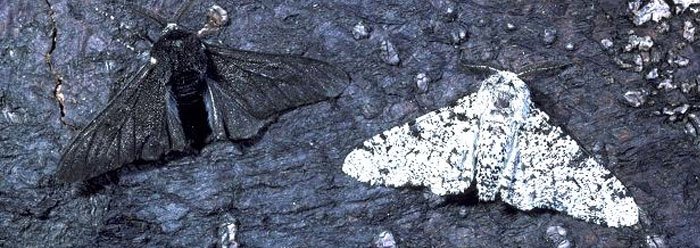
The trees these moths used to live on were white, but have been covered in soot from coal factories. Which moth will be more successful in this environment?
a)
Dark moth
b)
Light moth
c)
Both will be equally successful
d)
Neither will be successful
19.

Since the 1800s humans have stopped burning coal, and the trees have returned to their original color. Which moth will be more successful in this environment?
a)
Dark moth
b)
Light moth
c)
Both will be equally successful
d)
Neither will be successful
20.

What process is being shown in this image?
a)
Variation
b)
Natural Selection
c)
Selective Breeding
d)
Homeostasis
21.
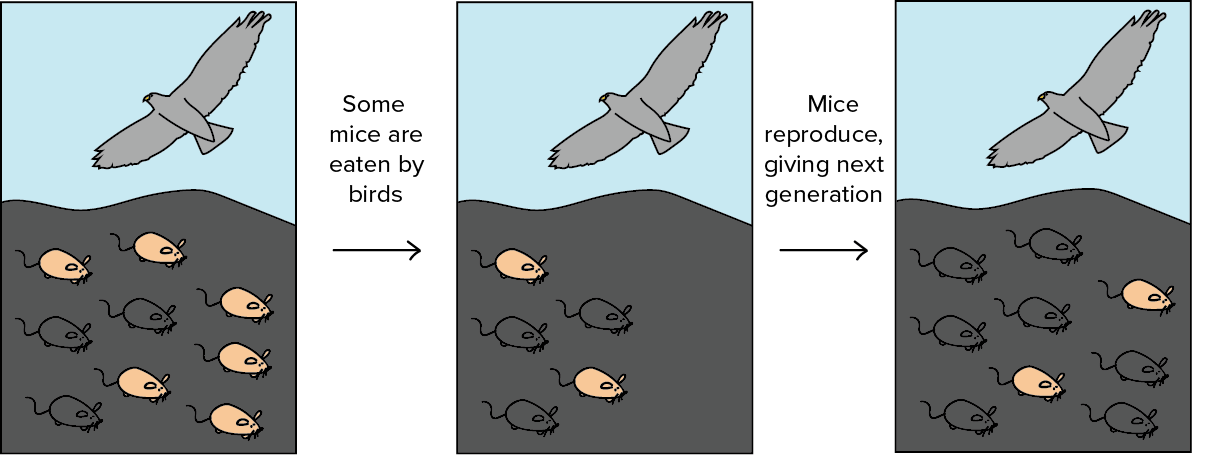
Why is the mouse population changing over time?
a)
The light mice can reproduce more successfully than the dark mice
b)
The hawks eat more dark mice than light mice because the dark mice taste better
c)
The hawks eat more light mice than dark mice because they can see the light mice more easily
d)
The hawks eat more dark mice than light mice because they can see the dark mice more easily
22.
Which term describes a group of the same species that live in the same area?
a)
Population
b)
Community
c)
Biome
d)
Ecosystem
23.
A condition will remain stable
a)
Evolution
b)
Natural Selection
c)
Selective Breeding
d)
Homeostasis
24.
Where do adaptations come from?
a)
The individual organism decides to adapt
b)
Mutations that give an organism an advantage in its environment
25.
Which best describes mutations?
a)
Always helpful
b)
Always harmful
c)
Can be helpful or harmful
d)
Always neutral
26.
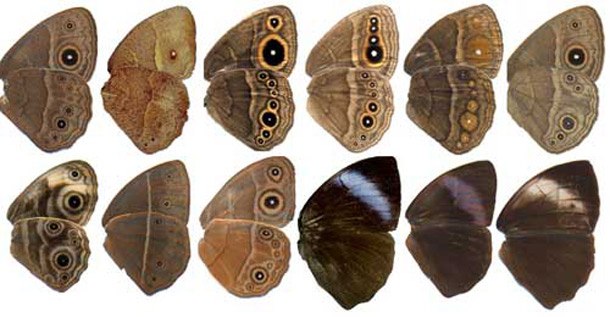
These moths are all the same species. The differences between their wings is an example of ________________
a)
Natural Selection
b)
Variation
c)
Homeostasis
d)
Extinction
27.
Selective breeding is where ___________ decides which traits should be passed on
a)
Nature
b)
A human
c)
Mr. Holt
d)
The illuminati
28.
Natural selection is where ___________ decides which traits should be passed on
a)
Nature
b)
A human
c)
Mr. Holt
d)
The illuminati
29.

Domesticated dogs are an example of:
a)
Natural Selection
b)
Selective Breeding
30.

The long and sharp beak of a woodpecker is an example of:
a)
Natural Selection
b)
Selective Breeding
31.
Only populations can evolve.
Individuals can not evolve.
Individuals can not evolve.
a)
True
b)
False
32.
What is the engine that drives Evolution? (What process creates evolution?)
a)
Adapting
b)
Selective Breeding
c)
Artificial Selection
d)
Natural Selection
100 %

