wayground logo

Free Printable Worksheets

Font size

S
M
L
XL
Worksheets

Auto Tech Chapter 37

Total questions: 84

Worksheet time: 1hrs 7mins

Name
Class
Date
1.

A setting on a DVOM to display the maximum and minimum readings.

a)

High resistance

b)

Min/max setting

c)

Short to power

d)

Probing technique

2.

A term that describes a circuit or components with more resistance than designed.

a)

High resistance

b)

Digital volt-ohmmeter (DVOM)

c)

Short to power

d)

Oscilloscope

3.

A condition in which current flows from one circuit into another

a)

Probing technique

b)

High resistance

c)

short to power

d)

min/max setting

4.

A test instrument that graphs voltage over time and displays the results on a screen.

a)

Digital volt-ohmmeter (DVOM)

b)

high resistance

c)

min/max setting

d)

Oscilloscope

5.

The way in which test probes are connected to a circuit

a)

Oscilloscope

b)

probing technique

c)

short to power

d)

min/max setting

6.

A test instrument with a digital display for measuring votage, resistance, and current

a)

High resistance

b)

min/max setting

c)

Oscilloscope

d)

Digital volt-ohmmeter (DVOM)

7.

A digital volt-ohmmeter is used to measure _____

a)

voltage

b)

amperage

c)

resistance

d)

all of the above

8.

A digital volt-ohmmeter for three-phase fixed equipment and single-phase commercial lighting would have a _____ rating

a)

CAT I

b)

CAT II

c)

CAT III

d)

CAT IV

9.

The _____ setting is often used to measure vehicle battery voltage while the engine is cranking or the battery is charging

a)

hold

b)

sample

c)

min/max

d)

save

10.

The red lead for the DVOM is labeled with the _____ symbol

a)

+

b)

V/Ω

c)

-

d)

±

11.

All of the following are examples of common types of DVOM probes, except:

a)

ground probes

b)

alligator clips

c)

fine-pin probes

d)

insulation piercing probes

12.

The sum of all the ______ in a series circuit equals the supply voltage

a)

resistors

b)

batteries

c)

voltage drops

d)

loads

13.

The ____ is the same in all parts of a properly working series circuit

a)

voltage

b)

current

c)

resistance

d)

all of the above

14.

Ideally the voltage drop across a fuse attached in series with a 12V battery should be _____

a)

24 volts

b)

12 volts

c)

6 volts

d)

0 volts

15.

As the position of the wiper of a potentiometer is changed, so is the ____ to a load connected to the potentiometer

a)

voltage

b)

resistance

c)

current flow

d)

both A and C

16.

_____ can be fitted to the probe leads to reduce the maximum voltage to safe levels for the oscilloscope to measure

a)

Attenuators

b)

Cuffs

c)

Alligator clips

d)

Current clamps

17.

Hybrid vehicles typically require meters and test leads rated as CAT III or CAT IV.

a)

true

b)

false

18.

5208 MV is the same as 5208 millivolts. It could also be called 52.08 volts

a)

true

b)

false

19.

The read lead is the positive lead, and the black lead is the negative lead

a)

true

b)

false

20.

After back-probing always res-insulate the hole that the probe makes with room temperature vulcanizing silicone to prevent any corrosion

a)

true

b)

false

21.

To accurately measure the resistance of a component, you should remove or isolate the component from the circuit

a)

true

b)

false

22.

A DVOM reading of OL means overload and indicates the voltage being read is higher than the maximum allowed for the range.

a)

true

b)

false

23.

Voltage drop can be measured across components, connectors, or cables, but current has to be flowing to get an accurate measurement.

a)

true

b)

false

24.

Parallel circuits are commonly used in the vehicle's electrical system, especially for lights

a)

true

b)

false

25.

Oscilloscopes display time on the vertical axis, and voltage is displayed on the horizontal axis, or from left to right across the screen.

a)

true

b)

false

26.

If the resistance and voltage of a circuit are known, then the theoretical current can be calculated using Ohm's law

a)

true

b)

false

27.
Current is measured in....
a)
Amps 
b)
Volts
c)
Ohms
d)
Coulombs
28.
What 'flows' in a wire?
a)
Protons
b)
Neutrons
c)
Atoms
d)
Electrons
29.
brass is a _____?
a)
insulator
b)
conductor
30.
this is the symbol for a _____?
a)
switch
b)
light 
c)
battery
d)
wires
31.
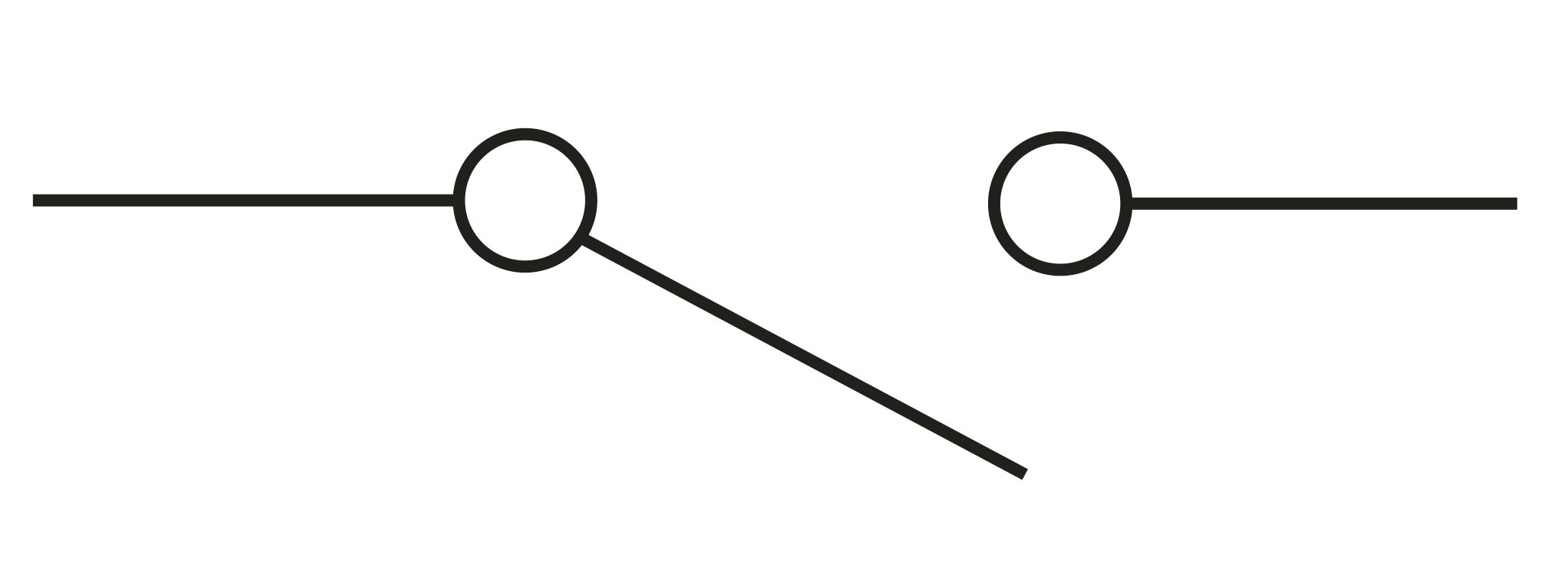
what is this symbol for?
a)
light bulb
b)
switch
c)
battery
d)
resistor
32.
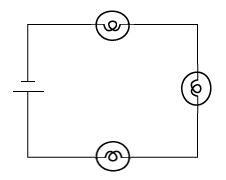
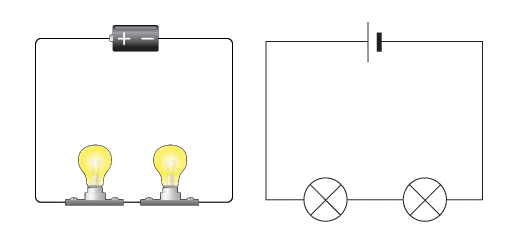
What kind of circuit is this?
a)
Series
b)
Consecutive
c)
Parallel
d)
Training
33.
What kind of circuit is this?
a)
Series
b)
Consecutive
c)
Parallel
d)
Training
34.
In a parallel circuit if one of the light bulbs burns out the rest _________.
a)
stop the flow of electricity
b)
 can still light up
c)
 will go out
d)
of the light bulbs burn out also
35.
How should you put in an Ammeter?
a)
In Parallel
b)
In Series
36.
Which of the two circuits would have the brightest bulbs? 
a)
A
b)
B
37.
In which of these two circuits is the current the same at all points? 
a)
A
b)
B
38.
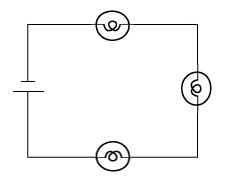
Does this diagram represent a series or parallel circuit?
a)
series circuit
b)
parallel circuit
39.
Does this diagram represent a series or parallel circuit?
a)
series circuit
b)
parallel circuit
40.
Voltage is measured in __.
a)
volts.
b)
watts.
c)
coulombs. 
41.
A voltmeter should be placed ........... in a circuit
a)
in parallel
b)
in series
c)
in order
d)
upside down
42.
What would the voltmeter read
a)
1V
b)
2V
c)
3V
d)
6V
43.
Which Voltmeter will give the lowest reading?
a)
V1
b)
V2
c)
V3
44.
What does this circuit symbol represent?
a)
diode
b)
light-dependent resistor (LDR)
c)
lamp
d)
light-emitting diode
45.
What does this circuit symbol represent?
a)
diode
b)
light-dependent resistor (LDR)
c)
lamp
d)
light-emitting diode
46.
Correctly identify component A, B and C
a)
A = Switch, B= Cell, C= LDR
b)
A= Cell, B= Switch, C= Diode
c)
A= Switch, B= Lamp, C= Diode
d)
A= Switch, B= Cell, C= Diode
47.
What does a fuse do?
a)
Die
b)
Makes sure the volts don't go over a certain point.
c)
Has fun
d)
Give out energy
48.
Resistance is a measure of....
a)
the energy per unit charge in a circuit
b)
how hard it is for electrons to move through the circuit
c)
how hard it is for electrons to move through the battery
d)
the number of charge carriers in a circuit
49.
What are you measuring with your Digital Volt Ohmmeter (DVOM) if there are more electrons on one battery terminal than the other battery terminal?
a)
Amperage
b)
Voltage
c)
Resistance
d)
Piezo-electric conductivity
50.
Which of the following represents the flow of electrons in a circuit?
a)
Amperage
b)
Voltage
c)
Resistance
d)
Piezo-electric conductivity
51.
Which of the following impedes the ability of electrons to flow through a circuit?
a)
Amperage
b)
Voltage
c)
Resistance
d)
Piezo-electric conductivity
52.
How much resistance is this (as a whole number)?  0.204 kΩ
a)
2.040 Ω
b)
20.40 Ω
c)
204 Ω
d)
2,040 Ω
53.
How much resistance is this (as a whole number)?  1.33 MΩ
a)
13.30 Ω
b)
13.30 Ω
c)
1,330 Ω
d)
A.  1,330,000 Ω
54.
The meter below is connected to read:
a)
Voltage
b)
Resistance
c)
Current
d)
AC Voltage
55.
When electrical resistance is added to a series circuit, which of the following takes place?
a)
Voltage increases
b)
Voltage decreases
c)
Amperage increases
d)
Amperage decreases
56.
When the positive side of a series circuit has a short to ground, which of the following takes place?
a)
Current increases
b)
Current decreases
c)
Voltage decreases
d)
Voltage increases
57.
A waveform is BEST described as:
a)
A graphic representation of an electrical signal on a DSO
b)
A graphical representation of an electrical signal on a DVOM
c)
A signal that instantaneously rises and falls
d)
A signal that slowly rises and falls
58.
Amplitude is best described as:
a)
The voltage of a waveform
b)
The duration of a waveform
c)
How often the waveform repeats
d)
The duty cycle of a waveform
59.
Frequency is best described as:
a)
The voltage of a waveform
b)
The duration of a waveform
c)
How often the waveform repeats
d)
The duty cycle of a waveform
60.
In a parallel circuit if one light bulb goes OUT; then they ALL go out. TRUE OR FALSE?
a)
TRUE
b)
FALSE
61.
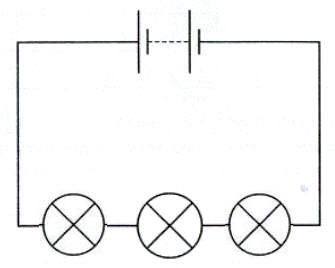
The picture shows an electrical circuit. This circuit is a series circuit because: 
a)
It has 3 light bulbs.
b)
The same current flows through all three light bulbs.
c)
It uses a single battery.
d)
The electrical current has more than one path to flow through
62.
In a Series circuit the more lightbulbs you add the brighter they get 
a)
False 
b)
True 
63.
This is an example of a _______ circuit
a)
open
b)
series
c)
parallel
d)
square
64.
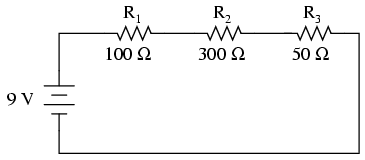
The total current through this circuit is
a)
0.02 amps
b)
0.09 amps
c)
50 amps
d)
9 amps
65.
The total resistance of this circuit is 
a)
25.7 ohms
b)
315 ohms
c)
324 ohms
d)
90 ohms
66.
How many Volts would it take to push 1 Amp through a resistance of 1 Ohm
a)
10 volts
b)
1 volt
c)
48 volts
d)
5 volts
67.
What size resistor would produce a 3 Amp current flow with a 12 Volt battery
a)
1 Ohm
b)
3 Ohms
c)
4 Ohms
d)
12 Ohms
68.
A 9.0-volt battery is connected to a 4.0-ohm resistor and a 5.0-ohm resistor as shown in the diagram below. What is the total resistance
a)
4 ohms
b)
5 ohms
c)
1 ohms
d)
9 ohms
69.
A circuit is shown below. Which of the following is true of this circuit?
a)
It is series and therefore both resistors have the same voltage
b)
It is series and therefore both resistors have the same current
c)
It is parallel and therefore both resistors have the same voltage
d)
It is parallel and therefore both resistors have the same current
70.
What is this symbol for?
a)
light bulb
b)
cell
c)
battery
d)
resistor
71.
The voltage drop across the parallel resistors shown in the figure is?
a)
17.3 volts
b)
20.7 volts
c)
62.1 volts
d)
100 volts
72.
What is the total resistance of the circuit in the figure?
a)
15.32 ohms
b)
24.17 ohms
c)
70.41 ohms
d)
120.12 ohms
73.
How many amps of current would flow through the circuit in the figure?
a)
2
b)
3.24
c)
4.14
d)
5.21
74.
This is an example of a _______ circuit
a)
open
b)
series
c)
parallel
d)
square
75.
This is an example of a ______ circuit
a)
Series
b)
Parallel
c)
Open
d)
Dihexihedral
76.
What kind of circuit is this?
a)
Series
b)
Consecutive
c)
Parallel
d)
Training
77.
The picture shows an electrical circuit. This circuit is a series circuit because: 
a)
It has 3 light bulbs.
b)
The same current flows through all three light bulbs.
c)
It uses a single battery.
d)
The electrical current is divided between the three light bulbs.
78.
What kind of circuit is this?
a)
Series
b)
Consecutive
c)
Parallel
d)
Training
79.
What kind of circuit is this?
a)
series
b)
parallel
80.
what kind of circuit is this?
a)
parallel
b)
series
c)
chris barton
d)
open
81.
this is the symbol for a _____?
a)
switch
b)
light 
c)
battery
d)
wires
82.
The voltage dropped across the 300 ohm resistor is 
a)
6 V
b)
9 V
c)
2 V
d)
30 V
83.
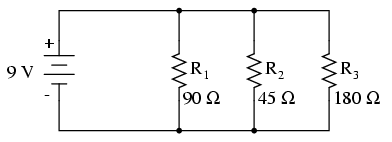
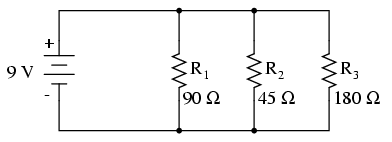
The voltage drop across the 180 ohm resistor is 
a)
9 V
b)
6 V
c)
2 V
d)
12 V
84.
The current going through the 180 ohm resistor is 
a)
0.05 amps
b)
0.2 amps
c)
0.1 amps
d)
20 amps