Wayground logo

Free Printable Worksheets

Font size

S
M
L
XL
Worksheets

Science Review!

Total questions: 200

Worksheet time: 4hrs 29mins

Name
Class
Date
1.
The tool used to measure the mass of a substance or object is a ______________.
a)
balance
b)
graduated cylinder
c)
ruler
d)
thermometer
2.
Which lab tool might you use to measure the volume of a liquid?
a)
electric scale
b)
bunsen burner
c)
test tube
d)
graduated cylinder
3.
What is the volume of Object X?
a)
10.0 cm3
b)
15.0 cm3
c)
20.0 cm3
d)
25.0 cm3
4.
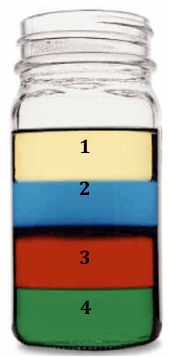
Put the liquids in order from most dense to least dense?
a)
4, 3, 2, 1
b)
1, 2, 3, 4
c)
3, 4, 2, 1, 
d)
4, 3, 1, 2
5.
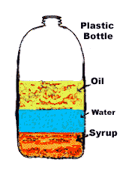
Which liquid is the least dense?
a)
oil
b)
water
c)
syrup 
d)
plastic bottle
6.
Which box has a higher density?  
a)
Box A
b)
Box B
c)
cannot be determined
d)
they are the same
7.
Why do ice cubes float in a  glass of water?
a)
the ice cubes are more dense than the water
b)
the water is more dense than the ice cubes
c)
the water is more dense than the glass
d)
the ice is more dense than the glass
8.
A scientist has four different liquids and pours them all into a bottle.  The silver liquid sinks to the bottom, the red liquid settles on top of the silver one, and the pink liquid stays at the surface. Which liquid has the smallest density?
a)
the pink liquid
b)
the silver liquid
c)
the red liquid
d)
the water
9.
Which liquid has the highest density? 
a)
corn syrup
b)
lamp oil
c)
rubbing alcohol
d)
honey
10.
Which explains why the fork looks different under water?
a)
light can't pass through the glass
b)
the wavelength of light lengthens
c)
the amount of light increases when going through water
d)
light is refracted at an angle
11.
Another name for light bending is ....
a)
Reflaction
b)
Absorbing
c)
Refraction
d)
mirror
12.
The bending of waves as they pass from one substance into another.
a)
Reaction
b)
Reflection
c)
Refraction
d)
Repost
13.
What does light do when it hits an object that it cannot pass through?
a)
It creates a shadow
b)
It passes through anyway
14.
If light strikes a mirror at a 50⁰ angle, what angle will it come off of the mirror?
a)
50⁰
b)
70⁰
c)
45⁰
d)
30⁰
15.
Light is a form of 
a)
energy
b)
radiation
c)
reflection
16.
Light travels in a straight line
a)
True
b)
False
17.
What does refract mean?
a)
To shrink
b)
To bend
c)
To widen
d)
To enlarge
18.
When a sound wave hits the eardrum, what happens to the eardrum to allow the transmission of the sound to the inner ear?
a)
it vibrates 
b)
it ruptures
c)
it fills with liquid
d)
`it remains motionless
19.
Sound is caused by? 
a)
force
b)
vibrations
c)
instruments
20.
A material that does not allow heat to pass through easily is a(n) _______________. 
a)
Friction
b)
Conductor
c)
Insulator
d)
Magnet
21.
Any material that allows heat to move through it easily is a(n) _________________.
a)
conduction
b)
convection
c)
heat
d)
conductor
22.
Fur, cotton, wool, and plastic are examples of____________
a)
Conductors
b)
Insulators
23.
Which color absorbs the most heat?
a)
Light Blue
b)
White
c)
Black
24.
Which is the BEST reason pots are made out of aluminum, copper, and sometimes glass?
a)
They are able to stop the flow of heat.
b)
They are good conductors of heat.
c)
They keep the same amount of heat.
d)
They are good insulators of heat.
25.
Susan has a metal spoon, a rubber spoon, a plastic spoon, and a wooden spoon. Which spoon will get the hottest the quickest?
a)
wooden spoon
b)
rubber spoon
c)
plastic spoon
d)
metal spoon
26.
An animal's fur acts as an __________
a)
conductor
b)
insulator
27.
A good conductor...
a)
transfers heat quickly
b)
transfers heat slowly
c)
doesn't transfer heat at all
d)
always stays the temperature
28.
The _____ is our main source of heat.
a)
sun
b)
moon
c)
fire
d)
lighting
29.
Energy of motion 
a)
Mechanical Energy
b)
Energy
c)
Gravity
d)
Motion
30.
The act of applying force in order to move something away 
a)
Pull
b)
Push
c)
Motion
d)
Force
31.
The act of applying force to move something toward or with you
a)
Push
b)
Force
c)
Pull
d)
Motion
32.
A force that pulls objects toward each other
a)
Energy
b)
Motion
c)
Mechanical Energy
d)
Friction
33.
Energy CAN BE
a)
changed in form
b)
destroyed
c)
eliminated
34.
What is true about all forces?
a)
They are magnetic. 
b)
They push or pull. 
c)
They are very strong. 
d)
They only push.
35.
When you hear music, what is your ear actually detecting?
a)
notes from the speaker
b)
waves created by vibrations
c)
electrical currents traveling through the air
d)
sound atoms coming from the sound
36.
Barbara went bike riding.  Her pedaling caused the bike to move.  Which form of energy allowed the bike to move?
a)
sound
b)
light
c)
thermal
d)
mechanical
37.
A student launches a paper plane during a science investigation.  Which type of energy is observed as the paper plane flies?
a)
light
b)
thermal
c)
electrical
d)
mechanical
38.
Which form of energy below is produced by hitting a drum?
a)
heat
b)
light
c)
sound
d)
solar
39.
How does blowing through a pipe produce a sound?
a)
air is absorbed by the pipe
b)
the pipe speeds up the air
c)
air in the pipe vibrates
d)
the pipe cools the air
40.
What is the MOST reasonable explanation for why you go farther skating on a wood floor than on a thick carpet?
a)
The skates weigh more on the carpet
b)
You weigh more on the floor
c)
The carpet has more resistance
d)
The wood floor has more traction
41.
Anna made a ramp out of some books and a piece of wood. She can change the height by adding more books under the piece of wood. She rolls a marble down each ramp.  At the bottom of which ramp would the marble be traveling the fastest?
a)
1 book
b)
2 books
c)
3 books
d)
4 books
42.
What kind of energy?
a)
Radiant
b)
Electrical
c)
Thermal
d)
Chemical
43.
What form of energy?
a)
Thermal
b)
Electrical
c)
Mechanical
d)
Radiant
44.
The spinning of an object on its axis is called______
a)
orbit
b)
rotation
c)
revolution
d)
tide
45.
Day and night is caused by the _____________ of earth on its axis.
a)
revolution
b)
orbit
c)
rotation
46.
The earth orbits around...
a)
The sun.
b)
the moon
c)
other planets
d)
the Milky Way
47.
The Earth's _______ is an imaginary line that goes from the North Pole to the South Pole.
a)
vernal equinox
b)
axis
c)
solar eclipse
d)
solar flare
48.
1. What is gravity?
a)
A type of rock
b)
A type of plate boundary
c)
When two objects are attracted to each other.
49.
The cycle of the moon lasts about a _.
a)
day
b)
year
c)
week
d)
month
50.
What is at the center of the Solar System?
a)
Earth
b)
Moon
c)
Sun
d)
Jupiter
51.
When the Earth travels all the way around the Sun, it is called a . . .
a)
Day
b)
Rotation
c)
Year
d)
Spin
52.
It takes the Earth _______ days to travel all the way around the Sun.
a)
28
b)
100
c)
24
d)
365
53.
When the Earth spins around its own axis one whole time, it is called a ....
a)
Year
b)
Day
c)
Hemisphere
d)
Seasons
54.
It takes the Earth ___ hours to complete a rotation.
a)
12
b)
24
c)
50
d)
365
55.
The earth is the  ___________ planet from the sun.
a)
1st
b)
2nd
c)
3rd
d)
4th
56.
The rotation of the Earth causes . . .
a)
day & night
b)
summer & winter
c)
fall & spring
d)
Leap Year
57.
Which shows these according to size, biggest to smallest?
a)
Earth, Moon, Sun
b)
Sun, Moon, Earth
c)
Earth, Sun, Moon
d)
Sun, Earth, Moon
58.
Which of the following is a characteristic of both the Earth and the Moon?
a)
Atmosphere containing oxygen
b)
Rocky surface covered with landforms
c)
Flowing water in oceans and rivers
d)
Fossils and fossil fuels under the surface
59.
This is the only planet in the solar system with oceans of liquid water.
a)
Mercury
b)
Mars
c)
Venus
d)
Earth
60.
What are the outer planets made up of?
a)
Gas
b)
Rings
c)
Rocks
d)
Moons
61.
The order of the planets is:
a)
Mars,Venus,Earth,
Mercury,Saturn
Jupiter, Uranus, Neptune
b)
Earth,Venus,Mars
Jupiter, Neptune,
Mercury,Saturn,
Uranus
c)
Mercury,Venus,Earth
Mars,Jupiter,
Saturn,Uranus
Neptune
62.
The earth orbits around...
a)
the sun.
b)
the moon
c)
other planets
d)
the Milky Way
63.
When the Northern Hemisphere of Earth is Leaning away from the Sun, What season is the Southern Hemisphere experiencing?
a)
Summer
b)
Winter
c)
Spring
d)
Fall
64.
A Star and The Objects That Orbit It
a)
Planet
b)
Asteroid Belt
c)
Moon
d)
Solar System
65.
A Natural Object That Orbits A Planet
a)
Asteroid
b)
Comet
c)
Moon
d)
Stars
66.
Why is the Equator warmest?
a)
Because it is closest to the sun.
b)
Because it receives the most direct sunlight
c)
Because no clouds form here.
d)
Because it is far from the sun
67.
Which seasons have an equal amount of daylight and darkness?
a)
Spring and Fall
b)
Winter and Summer
c)
Winter and Spring
d)
Summer and Fall
68.
The cycle of the moon lasts about a _.
a)
day
b)
year
c)
week
d)
month
69.
What Moon phase is this?
a)
Full Moon
b)
Waxing Gibbous
c)
New Moon
d)
Half Moon
70.
As the moon's shape appears to get smaller, we say that the moon is _.
a)
swelling
b)
waxing
c)
waning
d)
disappearing
71.
What Moon phase is this?
a)
Last Quarter
b)
New Moon
c)
Third Quarter
d)
First Quarter
72.
How are Sedimentary Rocks formed?
a)
Cooling and Hardening
b)
Heat and Pressure
c)
Compacting and Cementing
d)
Melting
73.
Where can the oldest layer be found?
a)
The top layer
b)
The middle layer
c)
They are all the same age
d)
The bottom layer
74.
In what kind of rock can fossils be found?
a)
Sedimentary Rocks
b)
Igneous Rocks
c)
Metamorphic Rocks
d)
Granite
75.
What are the 3 main fossil fuels?
a)
Coal, Oil, and Gasoline
b)
Coal, Oil, and Natural Gas
c)
Electricity, Gasoline, Petroleum
d)
Coal, Oil, Non-renewable Resources
76.
Fossil Fuels formed over long periods of time after particles in water settled to the sea floor and formed marine mud.  What kinds of particles needed to be present in the marine mud in order for fossil fuels to form.
a)
Mostly sand and a few small bits of wood
b)
Mostly decaying organisms
c)
Mostly lava and a few sedimentary rocks
d)
Mostly metal minerals
77.
Oil and natural gas were formed from ___________________
a)
marine organisms
b)
dead plants
c)
trees
78.
Petroleum and natural gas form from...
a)
strong winds
b)
cooled magma
c)
radioactive materials
d)
remains of plants and animals 
79.
Which of the following is a fossil fuel?
a)
Wind
b)
Coal
c)
Solar
d)
Biomass
80.
Which of the following is a nonrenewable resource?
a)
milk
b)
coal
c)
biomass
d)
water
81.
What type of fossil fuel is mined from the ground?
a)
wind
b)
coal
c)
biomass
d)
air
82.
Fossil fuels are classified as nonrenewable because they.......
a)
require expensive equipment
b)
take millions of years to replace
c)
can be found all over 
d)
provide all the energy we use
83.
Which of these is not a fossil fuel?
a)
Coal
b)
Oil
c)
Olive Oil
d)
Natural Gas
84.
The Appalachian Mountains used to be pointed like the Rockies. What process lead to the roundedness of their peaks?
a)
Weathering
b)
Deposition
c)
Lightning Strikes
d)
Mining of the rock
85.
What is the definition of a renewable resource?
a)
things that don't run out
b)
things that do run out
c)
stuff that makes things happen
d)
none of the above
86.
Which of the following is not a fossil fuel?
a)
natural gas
b)
electricity
c)
oil
d)
petroleum
87.
What is coal made of?
a)
decomposed animal and plant remains
b)
water
c)
electricity
d)
all of the above
88.
Which layer formed first?
a)
Rock Layer W
b)
Rock Layer X
c)
Rock Layer Y
d)
Rock Layer Z
89.
Fossils give us evidence about which of the following?
a)
plants and animals that lived long ago
b)
how weathering and erosion break down rocks
c)
the other planets in our solar system
d)
the transfer of energy from one form  to another
90.
Why do we depend on fossil fuels? 
a)
Electricity, transportation, and heating
b)
Food
c)
Sunlight
d)
Growing, building muscle, calcium
91.
Why is burning fossil fuels harmful? 
a)
then we won't have any fossil fuels if we burn them all
b)
They can get extremely hot
c)
Increases the amount of greenhouse gases in the air
d)
this would destroy fossils
92.

What can you infer about the word "geothermal?"

a)

It is derived from the words meaning "heat" and "earth"

b)

It is derived from the words meaning "fossil" and "fuel"

c)

It is derived from the words meaning "power" and "energy"

d)

It is derived from the words meaning "sun" and "energy"

93.
Coal often forms where once there was swamps.  What characteristic of swamps is important to the formation of coal?
a)
High Temperature
b)
Abundant Plant Life
c)
Frequent Rains
d)
Reptile Predators
94.
Geothermal energy is energy from 
a)
the sun
b)
heat from deep in the earth
c)
wind
d)
inexhaustable
95.
Wind energy is 
a)
generated from moving water
b)
starts with moving air and generates electricity
c)
starts with the sun
d)
comes from the earth
96.
Alternative energy is
a)
Generated by natural resources and is renewable
b)
man made
c)
nonrenewable
d)
not helpful to us in Texas
97.
Energy from the sun is called
a)
Biofuels
b)
Solar
c)
Geothermal
d)
Hydroelectric
98.
Nonrenewable resources are
a)
man-made resources
b)
cannot be replaced quickly
c)
can be replaced in a short amount of time
d)
never run out
99.
Corn, wheat, and soybeans can be made into a substance called ethanol. In some places, ethanol is part of a mixture used to power cars and trucks. What type of alternative energy resource is ethanol?
a)
Hydroelectric
b)
Geothermal
c)
Biofuels
d)
Solar
100.
All of the following are considered alternative energy sources EXCEPT –
a)
Wind
b)
Coal
c)
Biofuel
d)
Solar
101.
The poster shown below advertises tours of a power plant.
This power plant produces electricity most likely by using-
a)
fossil fuels
b)
biofuels
c)
solar energy
d)
geothermal energy
102.
Which alternative energy source is generated beneath Earth’s crust and can be used to heat buildings?
a)
Hydroelectric energy
b)
Geothermal energy
c)
Wind energy
d)
Solar energy
103.
Biofuel is...
a)
 Energy that comes from harnessing the movement of the air
b)
Energy that comes from the Sun
c)
A source of renewable energy, such as solar, wind, or geothermal energy
d)
Fuel from plant material
104.
As water flows through a dam, a generator is turned and creates enough electricity for thousands of homes. This describes...
a)
biofuels
b)
hydroelectric energy
c)
geothermal energy
d)
solar power
105.
Which type of alternative energy source is shown in this picture?
a)
Wind
b)
Solar
c)
Hydroelectric
d)
Geothermal
106.
Which of the methods of generating electricity does NOT use alternative energy resources? 
a)
Burning coal in a power plant
b)
Turbines spinning in dam
c)
Solar panels taking in light energy 
d)
Drilling wells to reach hot rocks deep inside the earth 
107.
Hydroelectric power produces electricity using.....
a)
Wind
b)
Sunlight
c)
Moving water
d)
Dung
108.
What fossil fuel is in the image?
a)
Coal
b)
Natural Gas
c)
Petroleum
109.
What fossil fuel is in the image?
a)
Natural Gas
b)
Steam
c)
Coal
d)
Petroleum
110.
What is one way wind turbines are annoying?
a)
they generate electricity based on demand
b)
they are quiet
c)
they kill birds
d)
all of the above
111.
What is a fossil fuel?
a)
oil
b)
biomass
c)
wind 
d)
water
112.
Where does the sun rise? 
a)
North
b)
South
c)
East
d)
West
113.
Where does the sun set? 
a)
North 
b)
South
c)
East
d)
West
114.
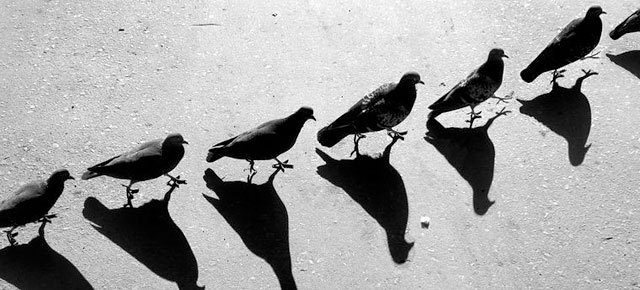
What time of day are shadows the shortest? 
a)
Early morning
b)
Late Morning
c)
Noon
d)
Sunset
115.
North, East, South and West are examples of...
a)
Cardinal Directions
b)
Directions
c)
Compass
116.
Which light source causes shadows in the outdoor environment? 
a)
The Sun
b)
The Lightbulb
c)
The House
d)
The School
117.
True or False: The Sun is revolving around the Earth
a)
True 
b)
False
118.
True or False: The shadows are longest in the early morning and late afternoon. 
a)
True
b)
False
119.
Which organism do the owl and the weasel compete for in the food web?
a)
Hawk
b)
Spider
c)
Grasshopper
d)
Shrew
120.
Which of the following is a herbivore?
a)
cricket
b)
frog
c)
hawk
d)
shrew
121.
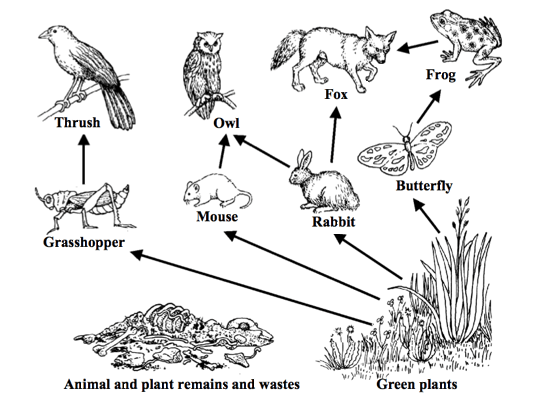
How many carnivores are shown in this food web?
a)
6
b)
4
c)
5
d)
3
122.
What might happen if you remove a primary consumer from the ecosystem?
a)
There would be more food for secondary consumers.
b)
The number of primary consumers would increase.
c)
The number of plants would increase.
d)
The number of secondary consumers would increase.
123.
Which of the following would be the most likely effect, if there were a sudden increase in the cricket population?
a)
There would be a decrease in the small bird population.
b)
There would be a decrease in the grass/flowers population.
c)
There would be a decrease in the mice population.
d)
There would be an increase in the grass/flowers population.
124.
A consumer that hunts is called:
a)
a producer.
b)
an omnivore.
c)
a predator.
d)
a herbivore.
125.
Which of the following best describes the small bird in the food web above?
a)
primary and secondary consumer
b)
secondary and tertiary consumer
c)
primary consumer only
d)
secondary consumer only
126.
A frog eats a fly. The frog and fly are demonstrating ________.
a)
mutualism
b)
competition
c)
predator/prey
d)
parasitism
127.
A symbiotic relationship that involves species having to fight for something they both need or want
a)
competition
b)
predation
c)
commensalism
d)
parasitism
128.
Plants both trying to get sunlight are 
a)
commensalism
b)
mutualism
c)
compeition
d)
parasitism
129.
How many herbivores are in this web?
a)
1
b)
2
c)
3
d)
4
130.
Which of the following organisms is a carnivore.
a)
greenfly
b)
titmouse
c)
mouse
d)
buzzard
131.
Which of the following organisms is a herbivore.
a)
butterfly
b)
snake
c)
fox
d)
ladybird
132.
The owl receives energy from which organisms?
a)
grasshopper and mouse
b)
mouse and rabbit
c)
rabbit and butterfly
d)
butterfly and frog
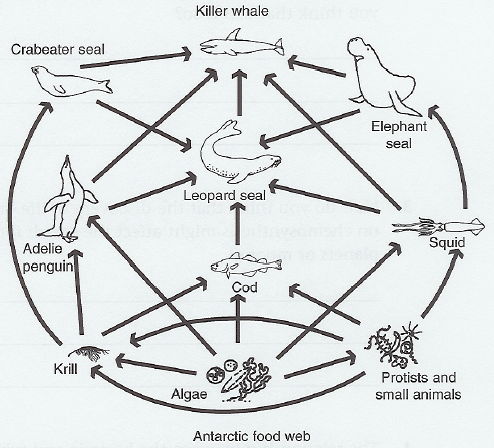
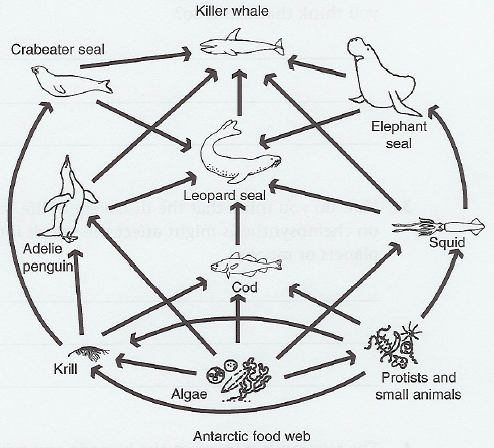
133.
Which organism is the top predator in this food web?
a)
leopard seal
b)
killer whale
c)
elephant seal
d)
crabeater seal
134.
How many predators does the squid have?
a)
1
b)
2
c)
3
d)
4
135.
Grass is considered a ...
a)
consumer
b)
producer
c)
decomposer
d)
composers
136.
Which one is NOT an example of a decomposer?
a)
mushroom
b)
leaves
c)
mold
d)
worm
137.
A __________ includes all living and non-living things in an environment. 
a)
population
b)
niche
c)
abitotic
d)
ecosystem
138.
________ are consumers that eat plants and meat.
a)
Herbivore
b)
Omnivore
c)
Carnivore
139.
Which group do fungi, bacteria, and termites belong to?
a)
decomposers
b)
producers
c)
herbivores
d)
omnivores
140.
Which organism make their own food through the process of photosynthesis? 
a)
decomposer
b)
consumer
c)
herbivore
d)
producer 
141.
Field mice eat corn. Which would most likely happen if the field mouse population grew?
a)
There would be more corn to feed the field mice.
b)
There would be less corn due to the mice eating it.
c)
The habitat would get overpopulated because the mice woudl eat too much.
142.
Examples of how humans negatively affect local ecosystems are
a)
Building dams, deforestation (cutting down trees), adding point sources to nearby streams to allow for run-off, building roads and structures, and salting roads.
b)
Creating laws to prohibit fishing from local streams.
c)
Planting trees and other plants to attract native species.
d)
Removing non-native species from the environment.
143.
What would most likely happen if an ecosystem no longer received sunlight?
a)
The number of herbivores would increase
b)
The number of plants would increase
c)
all organisms would adapt
d)
All living organisms would eventually die
144.
All food chains_____________________
a)
have more consumers than producers
b)
produce and use same amount of energy
c)
begin with a producer
d)
are unhealthy 
145.
How does energy enter an ecosystem? 
a)
sunlight
b)
soil 
c)
animals 
d)
invasive species 
146.
What is an adaptation?
a)
A feature or behavior that helps an animal survie.
b)
The food that an animal eats.
c)
How energy moves in a food web.
147.
How do adaptations help animals?
a)
To escape animals
b)
to hunt for food
c)
to survive in their habitats
d)
All of these are correct
148.
An example of a physical adaptation is...
a)
a turtle hiding inside its shell
b)
The spikes on a porcupine fish
c)
a rabbit burrowing underground
d)
a viper biting when threatened
149.
The main source of energy in the food chain is _________________
a)
the sun
b)
the plants
c)
the consumers
d)
the decomposeres
150.
A species that is in danger of becoming extinct.
a)
Threatened species
b)
out of luck
c)
do do birds
d)
endangered species
151.
A species that needs to be protected but is not in danger of becoming extinct.
a)
endangered species
b)
threatened species
c)
sub species
d)
special species
152.
In which of the following ecosystems can you find fertile, rich soil? 
a)
Grasslands
b)
Wetlands
c)
Oceans
153.

Which part of the ocean receives the LEAST amount of sunlight?

a)

top

b)

middle

c)

bottom

154.
Which of the following ecosystems is AQUATIC?
a)
Wetlands
b)
Oceans
c)
Forests
155.
Which of the following ecosystems is TERRESTRIAL?
a)
Wetlands
b)
Oceans
c)
Lakes and Ponds
156.
What does the term "terrestrial" mean?
a)
Water-based ecosystem
b)
Land-based ecosystem
157.
What does the term "aquatic" mean?
a)
Water-based ecosystem
b)
Land-based ecosystem
158.
Which layer of the rainforest receives the most sunlight?
a)
the canopy
b)
the understory 
c)
the forest floor
159.
Which one is NOT one of the basic needs for all living things?
a)
shelter
b)
sunlight
c)
water
d)
temperature
160.

The first stage in a life cycle.

a)

Egg

b)

Nymph

c)

Adult

d)

Pupa

161.

A fully grown organism.

a)

Adult

b)

Egg

c)

Pupa

d)

Larva

162.

Stage of incomplete metamorphosis during which an insect eats and grows and resembles a smaller version of the adult.

a)

Nymph

b)

Egg

c)

Larva

d)

Pupa

163.

The stages or sequence of events through which an organism grows, reproduces, and dies.

a)

Life Cycle

b)

Complete Metamorphosis

c)

Incomplete Metamorphosis

164.

Type of development consisting of four distinct stages: egg, larva, pupa, and adult.

a)

Life Cycle

b)

Complete Metamorphosis

c)

Incomplete Metamorphosis

165.

Type of development consisting of three stages: eggs, nymph, and adult.

a)

Life Cycle

b)

Complete Metamorphosis

c)

Incomplete Metamorphosis

166.

How many stages are in an incomplete life cycle?

a)

1

b)

2

c)

3

d)

4

167.

Complete or Incomplete Metamorphosis?

a)

Complete because it has 3 stages

b)

Complete because it has 4 stages

c)

Incomplete because it has 3 stages

d)

Incomplete because it has 4 stages

168.
How do you know this insect is undergoing incomplete metamorphosis? 
a)
The insect changes color when it becomes an adult.
b)
The first stage of the insects development is as an egg.
c)
The insect undergoes more than four stages in its development.
d)
The insect has similar body parts throughout its development.
169.
In incomplete metamorphosis which stage doesn't belong?
a)
egg
b)
nymph
c)
pupa
d)
adult
170.
Which 2 stages are in both complete and incomplete metamorphosis?
a)
Egg, larva
b)
Larva, adult
c)
Adult, nymph
d)
Egg, adult
171.
Which stage is worm-like and eats a lot? 
a)
Nymph
b)
Egg
c)
Adult
d)
Larva
172.
Which stage of a butterfly life cycle would eat leaves? 
a)
Pupa
b)
Egg
c)
Adult
d)
Larva
173.
List the four stages of the complete metamorphosis life cycles in the correct order. 
a)
egg, pupa, larva, adult
b)
egg, larva, pupa, adult
c)
adult, egg, larva, pupa
d)
adult, egg, pupa, larva
174.
The diagrams show the life cycle of a frog and of a ladybug.
What do frog and ladybug life cycles have in common? Both frogs and ladybugs spend time as -
a)
tadpole
b)
pupa
c)
larva
d)
eggs
175.
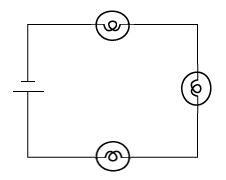
The picture shows an electrical circuit. This circuit is a series circuit because: 
a)
It has 3 light bulbs.
b)
The same current flows through all three light bulbs.
c)
It uses a single battery.
d)
The electrical current has more than one path to flow through
176.
In a Series circuit the more lightbulbs you add the brighter they get 
a)
False 
b)
True 
177.
What is a Parallel circuit? 
a)
Has only one path 
b)
Has more than one path 
c)
Allows energy to travel through easily 
d)
Has only one light bulb
178.
What is a switch's function in a circuit?
a)
to make the current hotter or colder
b)
turn on and off the flow of current
c)
the pathway that current flows
d)
to add more power to the circuit
179.
Which best describes a simple series circuit?
a)
Electricity flows along one pathway.
b)
The flow of electricity comes from the switch.
c)
Electricity flows along many pathways.
d)
The flow of electricity comes from the light bulb.
180.
water is a______?
a)
conductor
b)
insulator
181.
A material in which electrons are able to move easily
a)
Circuit
b)
Insulator 
c)
Resistance 
d)
Conductor 
182.
A material in which electrons are not able to move easily 
a)
Circuit 
b)
Insulator 
c)
Resistance 
d)
Conductor
183.
This circuit has more than one loop. When one light goes out, the others stay on. 
a)
closed circuit
b)
series circuit
c)
parallel circuit
d)
open circuit
184.
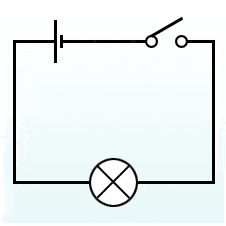
What kind of circuit is this?
a)
series
b)
parallel
185.
this circuit is .....?
a)
open
b)
parallel
c)
closed
d)
The cutest little circuit evah!
186.
If you replace the paper clip with a plastic spoon, what happens?
a)
The bulb doesn't light
b)
The bulb is dimmer
c)
The wires get hot
d)
There is no change
187.
If you replace the paper clip with a plastic spoon, what is the plastic spoon acting as?
a)
A conductor
b)
A diode
c)
An insulator
d)
A switch
188.
A series circuit has ____ path(s) that the electric current can take. 
a)
One
b)
Two 
c)
Three 
d)
Four
189.
Which of these objects is an insulator?
a)
Copper Wire
b)
Paper Clip
c)
Steel Pole
d)
Rubber Gloves
190.
Which statement is true?
a)
The light bulb will light up because the  circuit is complete.
b)
The light bulb will light up because the  circuit is broken.
c)
The light bulb will not light up because the  circuit is complete.
d)
The light bulb will not light up because the  circuit is broken.
191.
Would would best complete this circuit?
a)
A wire
b)
A switch
c)
A battery
d)
A light bulb
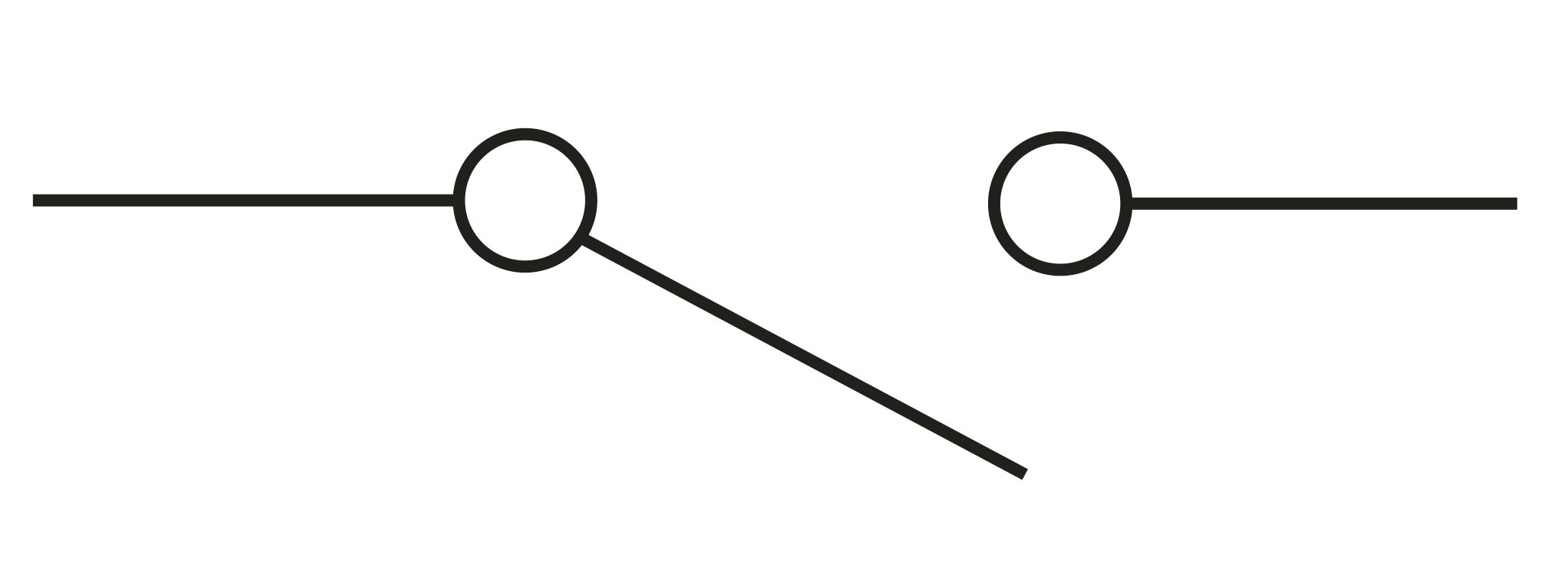
192.
this is the symbol for a _____?
a)
switch
b)
light 
c)
battery
d)
wires
193.
This is an example of a/an:
a)
Open circuit
b)
Closed circuit
194.
This is an example of a/an:
a)
Closed circuit
b)
Open circuit
195.
What happens when two north poles of a magnet are placed together?
a)
they repel
b)
they attract
c)
they cancel each other out
d)
the strength of the magnet is doubled
196.
A north pole and a south pole will attract.
a)
True
b)
False
197.
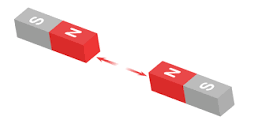
What will happen when these magnets are brought close together?
a)
They will attract each other.
b)
They will repel each other.
c)
Both magnets will turn to the left
d)
Both magnets will turn to the right
198.
True or False:
Most rocks are magnetic.
a)
True
b)
False
199.
What happens when two bar magnets repel each other?
a)
The poles of the magnets pull toward each other.
b)
The poles of the magnets push away from each other.
c)
The centers of the magnets pull toward each other.
d)
The centers o the magnets push away from each other.
200.
True or False: All metals stick to magnets.
a)
True
b)
False