
 Worksheets
Cumulative Weather Test Review
Total questions: 106
Worksheet time: 3hrs 43mins
Name
Class
Date
1.

Does evaporation happen before or after condensation?
a)
before
b)
after
c)
during
2.
What is the weather conditions in an area over a long period of time?
a)
climate
b)
temperature
c)
elevation
d)
precipitation
3.
the climate of a region can be determined by observing, recording, and analyzing the weather for at least
a)
one hour
b)
one day
c)
one week
d)
one season
4.
____ is a low ground level cloud
a)
mist
b)
fog
c)
rain
d)
sunshine
5.
Winters in Maine can reach temperatures below zero.
a)
Climate
b)
Weather
6.
Changes from minute-to-minute, hour-to-hour, day-to-day
a)
Climate
b)
Weather
7.
Texas has long, hot summers.
a)
Climate
b)
Weather
8.
Meteorologists forecast this.
a)
Climate
b)
Weather
9.
What is climate?
a)
What's going on with the atmosphere at any particular time
b)
The type of weather that occurs during a particular season
c)
An area's pattern of weather over a long period of time
d)
How much sunshine an area gets
10.
A front is
a)
where warm air is cooling at earth's surface
b)
a line where hot and cold air are separating
c)
a line where two different air masses meet
d)
where cold air is rising and forming rain clouds
11.

What symbol is this?
a)
warm front
b)
cold front
c)
stationary front
d)
occluded front
12.

What does this symbol indicate on a weather map?
a)
High pressure system
b)
Low pressure system
c)
Cold front
d)
Warm front
13.
Which weather tool measures temperature?
a)
thermometer
b)
barometer
c)
psychrometer
d)
anememeter
14.
This weather tool measures wind speed and direction
a)
thermometer
b)
barometer
c)
anemometer
d)
psychrometer
15.
The amount of moisture (water vapor) in the air
a)
Barometer
b)
Humidity
c)
Rain gauge
d)
Evaporation
16.
_____________ has the same temperature and moisture content throughout.
a)
convection current
b)
front
c)
air mass
17.
Which term describes a circulation of air or water that is caused by uneven heating?
a)
convection current
b)
conduction current
c)
radiation current
d)
emission current
18.
Which statement describe parts of the water cycle and how clouds form? 1. Water evaporates from the earth's surface as it changes from a liquid to a gas. 2. Water vapor rises with rising, warm air. 3. At higher altitudes, where temperatures are cool, vapor (along with dust particles) condenses into drops of water that form clouds. 4. Low-pressure conditions also help clouds form.
a)
1 and 2
b)
1, 2, 4
c)
1 and 3
d)
all of the above
19.
Every few years, an event occurs in which the waters in the eastern Pacific Ocean become warmer. This event changes weather patterns worldwide, causing drought, floods, blizzards, hurricanes and tornadoes. What is the name of this event?
a)
Kuroshio Current
b)
Global conveyor
c)
El Nino
d)
Typhoon
20.
The ozone is in the stratosphere layer of the atmosphere. The purpose of the ozone is
a)
To generate heat for the earth
b)
To protect earth from the harmful solar radiation
c)
To produce weather
d)
To allow satellites to circle the earth
21.
Which of the following are used to study and forecast most weather-related events?
a)
Doppler radar
b)
satellites and satellite images
c)
weather maps
d)
all of the above
22.

Which statement best describes the difference between weather and climate?
a)
Weather is the conditions when you look outside while climate is the conditions you can expect for the next 6 months.
b)
Climate is the current condition outside while weather is what you can expect for the next 6 months.
23.
Rain, sleet, hail, and freezing rain are all...
a)
precipitation
b)
condensation
c)
evaporation
d)
perspiration
24.
Which of the following will heat the fastest?
a)
water
b)
land
c)
both heat at equal rates
25.
____________ air sinks/falls because it is ____________dense.
a)
Cold, More
b)
Warm, Less
c)
Cold, Less
d)
Warm, More
26.
____________ air rises because it is ____________dense.
a)
Cool, Less
b)
Warm, Less
c)
Cold, More
d)
Warm, More
27.
The place where two air masses meet.
a)
air mass
b)
air pressure
c)
water cycle
d)
front
28.

the amount of water vapor in the air
a)
warm front
b)
precipitation
c)
humidity
d)
air pressure
29.

The layer of the atmosphere where weather occurs is the _.
a)
thermosphere
b)
stratosphere
c)
mesosphere
d)
troposphere
30.

White, thin, feathery clouds, usually made of ice crystals are...
a)
Stratus
b)
Cumulus
c)
Cirrus
31.

An anemometer is used to measure...
a)
air pressure
b)
humidity
c)
precipitation
d)
wind speed
32.
Which statement describes why the Earth has seasons?
a)
Its axis is titled as it revolves around the sun.
b)
The distance changes as it revolves around the sun.
c)
The moon revolves around it.
d)
The sun's axis is tilted.
33.
An air mass forms over the Gulf of Mexico and moves northeast across Georgia. What weather conditions are likely to prevail in Georgia?
a)
cool and dry
b)
cool and humid
c)
warm and dry
d)
warm and humid
34.
Which is the warmest climate zone?
a)
Arctic Zone
b)
Temperate Zone
c)
Tropical Zone
d)
Intermediate Zone
35.
Cold air masses that form at high latitudes are called
a)
polar air masses.
b)
continental air masses.
c)
warm air masses.
d)
maritime air masses.
36.
In some years there are more hurricanes than usual. This is probably because
a)
the ocean is warmer than usual.
b)
the ozone layer is very thin.
c)
there are more windy days than usual.
d)
the gravitational pull of the Moon is stronger.
37.
Which of the following is typical of a tropical climate?
a)
cold, dry air
b)
cool, moist air
c)
hot, dry air
d)
warm, moist air
38.
Warm air rising at the equator and cold air sinking at the poles is one reason for which event?
a)
hurricanes
b)
Coriolis force
c)
earth's rotation
d)
convection currents
39.
What characteristic do all renewable resources share?
a)
Produced by waste products
b)
Form underground from dead organisms.
c)
Replaced in a short period of time
d)
Allow energy to pass through them easily
40.
Which of the following is a fossil fuel?
a)
Wind
b)
Coal
c)
Solar
d)
Biomass
41.
Petroleum and natural gas form from...
a)
strong winds
b)
cooled magma
c)
radioactive materials
d)
remains of plants and animals
42.
Hydroelectric power produces electricity using.....
a)
Wind
b)
Sunlight
c)
Moving water
d)
Dung
43.
The careful use of a resource is....
a)
recycling
b)
pollution
c)
depositing
d)
conservation
44.
Energy from the sun is known as.........
a)
hydroelectric energy
b)
geothermal energy
c)
solar energy
d)
wind energy
45.
The energy resource that is most affected by change in weather is_____________?
a)
geothermal
b)
wind
c)
nuclear
d)
natural gas
46.
The cleanest burning fossil fuel is ______.
a)
coal
b)
oil
c)
wind
d)
natural gas
47.
Water is renewable because it.......
a)
can be frozen
b)
important to all life
c)
can be replaced constantly
d)
can evaporate
48.
What are two advantages of geothermal energy?
a)
cheap and a lot pollution
b)
expensive and a lot of pollution
c)
cheap and little pollution
d)
expensive and little pollution
49.
What is a disadvantage to Hydroelectricity?
a)
lots and lots of pollution
b)
Kills wild bird population
c)
Radioactive waste
d)
Increases potential for flooding
50.
Unlimited; Does not produce pollution.
a)
Natural Gas
b)
Geothermal
c)
Biomass
d)
Solar
51.
Requires large areas of farmland and produces smog. This is a disadvantage of ____.
a)
Hydroelectric
b)
Fossil Fuels
c)
Wind
d)
Biomass
52.

Approximately what percentage of Earth's surface is covered by oceans?
a)
40%
b)
50%
c)
60%
d)
70%
53.
Surface ocean currents are generated mostly by
a)
the Coriolis effect
b)
water density
c)
tides
d)
wind
54.

a)
Trough
b)
Crest
c)
Amplitude
d)
Wavelength
55.
Deep-ocean currents are driven by
a)
differences in soil
b)
differences in the water’s density,
c)
differences in nutrients
d)
None of the Above
56.

What is the name for the process by which deep waters rise up when surface currents separate?
a)
upwelling
b)
coriolis effect
c)
thermohaline circulation
d)
gravity
57.
The way Earth's rotation makes the winds curve
a)
Coriolis Effect
b)
Cuticle Effect
c)
Revolution
d)
rotation
58.
A range of mountains that wind through the ocean floor
a)
Abyssal plain
b)
volcanic island
c)
seamount
d)
mid-ocean ridge
59.
A part of the ocean that extends from the low tide line to the edge of the continental shelf
a)
neritic zone
b)
abyssal plain
c)
intertidal zone
d)
deep zone
60.
The area that stretches from the highest high-tide line to the lowest low tide line
a)
neritic zone
b)
intertidal zone
c)
deep zone
d)
coastal plain
61.
The horizontal distance between wave crests
a)
frequency
b)
trough
c)
wavelength
d)
wave height
62.
A large stream of moving water that flows through the ocean
a)
current
b)
tsunami
c)
tide
d)
wave
63.
Which of following is the world's largest ocean?
a)
Indian
b)
Pacific
c)
Artic
d)
Atlantic
64.
What two major regions of the ocean floor divided into?
a)
Continental Shelf &
Abyssal plain
Abyssal plain
b)
Continental Margin & Seamounts
c)
Continental Margin & Deep Ocean Basin
d)
Mid-ocean ridges and deep-ocean basin
65.
The steeply inclined section of the continental margin
a)
Continental Shelf
b)
Continental Slope
c)
Continential Rise
d)
Abyssal Plain
66.
The part of the continental margin that begins a the shoreline
a)
Continental Shelf
b)
Continental Slope
c)
Continential Rise
d)
Abyssal Plain
67.
swim in the actively in the open ocean
a)
plankton
b)
nekton
c)
benthos
d)
pelagic
68.
Pollution that comes from many different places is called______________ pollution.
a)
Desalination
b)
Non-Point Source
c)
Point Source
d)
NonRenewable
69.
Oil spills and trash dumping are examples of ________________pollution
a)
Desalination
b)
Non-Point Source
c)
Point Source
d)
NonRenewable
70.
Garbage, rocks, soil, mud, and branches are carried downstream with water. This is called the...
a)
gravity load
b)
depository
c)
stream load
d)
water waste
71.
A stream that runs into a river is known as a
a)
Porosity
b)
Tributary
c)
Stream Run
d)
Runoff
72.
The process of obtaining fresh water from salt water is called
a)
desalination
b)
filtration
c)
conservation
d)
coagulation
73.
Pesticides are most likely to be found in runoff from
a)
roads
b)
farm fields
c)
homes
d)
factories
74.
Which material would not be good for an aquifer?
a)
sandstone
b)
limestone
c)
clay
d)
gravel
75.

What do all the sources of groundwater contamination shown have in common?
a)
caused by humans so it is preventable
b)
naturally occurring so it cannot be prevented
76.
Wind, water, and ice breaking down rock is called
a)
Erosion
b)
Deposition
c)
Compaction
d)
Weathering
77.
The final step in the rock cycle process in which dissolved minerals crystallize and glue sediment together.
a)
compaction
b)
deposition
c)
organic rock
d)
cementation
78.

When sediments are pressed together tightly, this is called ____________.
a)
Compaction
b)
Cementation
c)
Weathering
d)
Erosion
79.
Fossils are often found in ____________ rock because it is formed from the remains of small particles of soil and once living things.
a)
metamorphic
b)
magma
c)
igneous
d)
sedimentary
80.
Sediment being moved from one area to another is called
a)
erosion
b)
deposition
c)
weathering
d)
compaction
81.
Which type of rock results from melting and cooling of magma?
a)
Igneous
b)
Metamorphic
c)
Sedimentary
d)
Extrusive
82.
Which type of rock forms from extreme heat and pressure?
a)
Igneous
b)
Sedimentary
c)
Organic
d)
Metamorphic
83.
A metamorphic rock changes into an igneous rock by what two processes?
a)
Melting and cooling
b)
Extreme heat and pressure
c)
Compaction and cementation
d)
Weathering and erosion
84.
What is the MAIN way rocks are classified?
a)
Their color and shapes
b)
How they form
c)
Mineral bands
d)
Where they form
85.
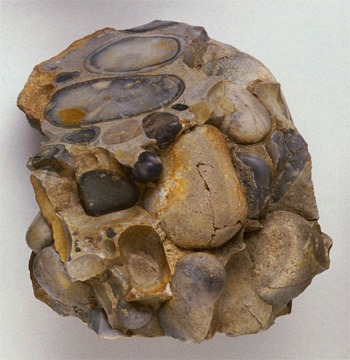
This rock was formed by smaller pieces of rock that settled at the bottom of a lake millions of years ago. What type of rock is this?
a)
Sedimentary
b)
Igneous
c)
Metamorphic
86.
What are the 3 major types of rocks?
a)
Igneous, Metamorphic, Sedimentary
b)
Metamorphic, Igneous, Cementation
c)
Brown, Red, Gray
d)
Streak, Hardness, Breakage
87.
Which type of plate boundary would cause mountains to form?
a)
Transform
b)
Convergent
c)
Divergent
d)
Reform
88.
This layer of Earth is solid Iron and Nickel
a)
Outer Core
b)
Mantle
c)
Inner Core
d)
Crust
89.
The Great Rift Valley in Africa and the Mid-Ocean Ridge were all created by this boundary
a)
Divergent
b)
Convergent
c)
Reform
d)
Transform
90.
This layer of Earth is the thickest part
a)
crust
b)
outer core
c)
mantle
d)
inner core
91.
What are the two types of crust
a)
continental and oceanic
b)
ocean and upper
c)
lower and upper
d)
pizza and subway
92.
Which layer has convection currents?
a)
Inner Core
b)
Outer Core
c)
Mantle
d)
Crust
93.
subduction zones in the ocean can create which features?
a)
islands
b)
volcanoes
c)
earthquakes
d)
all of the above
94.

What is this image...
a)
Revolving boundary
b)
San Andreas (Transform)
c)
Convergent
95.
What is the shaking of the Earth’s crust caused by a release of energy?
a)
Earthquake
b)
Epicenter
c)
Fault
d)
Plate
96.
What is a break in the lithosphere along which movement in an earthquake has first occurred?
a)
Earthquake
b)
Epicenter
c)
Fault
d)
Focus
97.
Where is the point at which the first movement occurs during an earthquake?
a)
Epicenter
b)
Focus
c)
Fault
d)
Plate
98.
Which type of wave is the first to arrive after an earthquake occurs?
a)
P Wave
b)
Rayleigh Wave
c)
S Wave
d)
Shear Wave
99.
Which body waves cause particles of rock material to move at right angles to the direction in which the waves are traveling?
a)
Body Waves
b)
P Waves
c)
S Waves
d)
Surface Waves
100.
What is the principal ingredient to all types of magma?
a)
Iron
b)
Magnesium
c)
Silica
d)
Water
101.
Which type of magma has the lowest amount of silica content?
a)
Andesitic Magma
b)
Basaltic Magma
c)
Rhyolitic Magma
d)
Viscous Lava
102.
What is the resistance of a liquid, such as lava, to flow?
a)
Elasticity
b)
Pyroclasticity
c)
Silica
d)
Viscosity
103.
What are solid rock fragments that are ejected during a volcanic eruption?
a)
Lahar
b)
Magma
c)
Pyroclastic Material
d)
Silica
104.
What type of volcano has steep slopes made of alternating layers of ash and silica rich lava?
a)
Caldera
b)
Cinder Cone
c)
Composite Volcano
d)
Shield Volcano
105.
What type of volcano is made of lava fragments that have been ejected from a volcanic vent?
a)
Caldera
b)
Cinder Cone
c)
Composite Volcano
d)
Shield Volcano
106.
What type of volcano is Kilauea, which is located in Hawaii?
a)
Caldera
b)
Cinder Cone
c)
Composite Volcano
d)
Shield Volcano
100 %

