
NEW
Font size
 Worksheets
Intro to Evolution Review
Total questions: 25
Worksheet time: 47mins
Why are advantageous traits more likely to be passed onto offspring?
Because organisms with them are more likely to survive and reproduce.
Because organisms with them have dominant alleles.
Because organisms with them have recessive alleles.
Because the trait is an acquired phenotype.

A population consisting of brown beetles and green beetles migrate into a grassy field and eat along the grass throughout the day. There are various birds living in the area that consume insects for survival. If you were to come back to this population after several generations, what would you expect to see due to natural selection?
There would be a higher frequency of brown beetles in the population
There would be a higher frequency of green beetles in the population
There would be an equal amount of green and brown beetles in the population
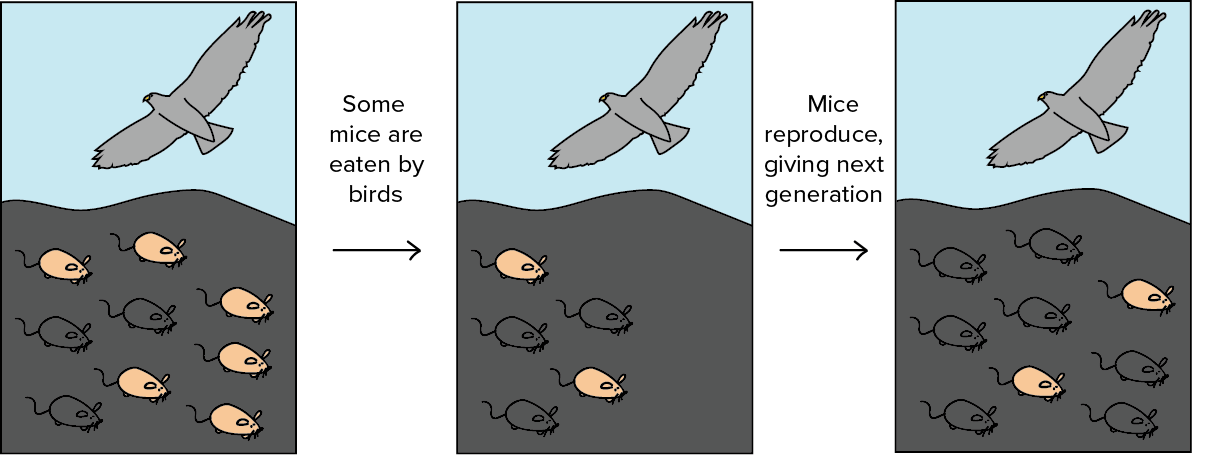
Why is the mouse population changing over time?
The light fur mice can reproduce more successfully than the dark fur mice
The hawks eat more dark fur mice than light mice because they hunt by smell
The hawks eat more light fur mice than dark fur mice because they can see the light fur mice more easily
The hawks eat more dark fur mice than light mice because they can see the dark fur mice more easily

New variations of traits can appear within any population of living things (like you see in the butterfly patterns). Why do these new variations appear?
Natural Selection
Mutations
Different behaviors
Spontaneous generation
Selective breeding/artificial selection is where ___________ decides which traits should be passed on
Nature
Humans
Other predators
The illuminati
Natural selection is where ___________ decides which traits should be passed on
Nature
A human
Other predators
The illuminati

a measure of how often a particular gene (B or b) occurs in a population is known as the
gene pool
allele frequency
mutation rate
phenotype frequency
The more genetic variation a population has,
the more likely it is for some individuals to
evolve
migrate
survive
mutate
Which term describes a group of the same species that live in the same area?
Population
Species
Biome
Ecosystem

The long and sharp beak of a woodpecker is an example of:
Natural Selection
Selective Breeding/Artificial Selection

The altering of corn by farmers to produce more kernels with much more sugar is an example of:
Natural Selection
Selective Breeding/Artificial Selection
The combined alleles for all traits of all individuals in a population is called the population's
evolution collection
gene pool
mutation rate
allele frequency
Which of the following is a true statement about natural selection?
The populations evolving have an end goal
individuals evolve
it results in populations with adaptations
acquired characteristics
Which of the following explains how natural selection causes a trait to become predominant in a population?
Individuals with traits that are favorable to the environment can survive long enough to reproduce
Traits of an individual change in order to adapt to changes in environment.
organisms select which traits they wish to inherit
all of these answers
Which of the following produces variation in traits within a population of mice?
mutations
independent assortment of chromosomes during meiosis
random fertilization of gametes
all of these
Which of the following directly interacts with the environment and selective pressures?
An organism's genotype
An organism's phenotype

What is the frequency of each allele in the current mice population as shown in the image?
Frequency of B = 50% Frequency of b = 50%
Frequency of B = 88% Frequency of b = 13%
Frequency of B = 75% Frequency of b = 25%
Frequency of B = 63% Frequency of b = 37%

Calculate the allele frequencies for the original population and the current population. Is this population evolving?
Yes
No

What does the change in frequency tell you about the traits associated with these alleles?
The B allele results in a trait that helps with survival in this environment
The selective pressure is selecting against the trait controlled by the B allele
The b allele results in a trait that helps with survival in this environment
The selective pressure is selecting for the trait controlled by the b allele
Which scientists explained life evolved through the process of natural selection
Darwin and Lamarck
Lamarck and Wallace
Mendel and Darwin
Darwin and Wallace
How did Darwin and Lamarck differ in their explanations for how populations evolve?
Lamarck proposed that populations of living things do not evolve
Darwin explained that populations evolve by natural selection and Lamarck explained that individuals evolve by acquiring traits throughout their lifetime
Both Lamarck and Darwin agreed that populations evolved by natural selection
Lamarck explained that populations change over time and only traits that are best suited for the environment are passed on to the next generation. Darwin explained that only certain things evolve and that things stop evolving once they are advanced enough.
A population of flowers is only pollinated by insects that are attracted to sweet smells. What is the selective pressure in this population?
Sweet smelling flowers
The different flower colors
The pollinators
Water availability

If a sick person takes an antibiotic but it doesn't kill all of the bacteria causing the sickness, what might explain this?
Variations in the bacteria allowed some organisms to be less affected by the antibiotic?
Bacteria cannot be killed by antibiotics
You cannot cure a bacterial infection
Bacteria do not cause sicknesses

One species of finch migrated to the Galapagos Islands millions of years ago. Today there are 14 different species of Galapagos finches, each located on a different island. Why?
The finches reproduced and changed during their migration
Each different species evolved by acquiring traits during their lifetime.
The birds were separated into different populations and evolved in response to different selective pressures.
Mutations were passed between the original species and only certain birds with specific mutations were divided among the different islands over time.

