
NEW
Font size
S
M
L
XL
 Worksheets
Gas Laws
Total questions: 20
Worksheet time: 11mins
Name
Class
Date
1.
What does Boyle's law relate to?
a)
Temperature and Volume
b)
Volume and Pressure
c)
Temperature and Pressure
2.
When the temperature of matter increases the particles...
a)
speed up and move closer
b)
speed up and move farther apart
c)
slow down and move closer together
d)
slow down and move farther apart
3.
How do gas molecules move?
a)
in an orderly fashion
b)
constantly and randomly
c)
in straight line paths
d)
in a circular motion
4.
In Charles' Law the pressure remains constant.
a)
True
b)
False
5.
What type of relationship is Charles' Law?
a)
Inverse
b)
Direct
c)
Not enough information
d)
#goals
6.
True or False: Gases can be compressed.
a)
True
b)
False
7.
What is the formula for Boyle's Law?
a)
P1V1=P2V2
b)
P1V1/P2V2
c)
P1V2=P2V1
d)
P1/V1=P2/V2
8.
When Pressure increases then the Volume must...
a)
Increase
b)
decrease
9.
When Volume increases then Pressure must...
a)
Increase
b)
Decrease
10.
What type of relationship to pressure and volume have?
a)
direct
b)
inverse
c)
no relationship
d)
I don't know
11.
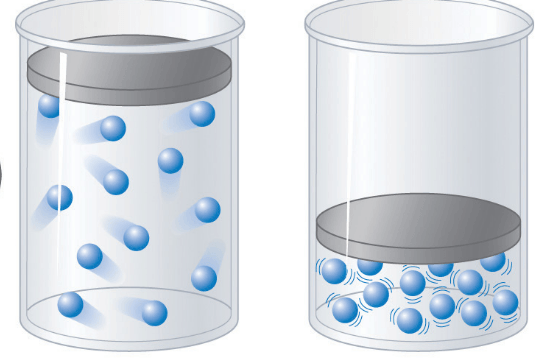
Which container will have a lower pressure?
a)
left
b)
right
c)
they both have the same pressure
d)
I don't know
12.
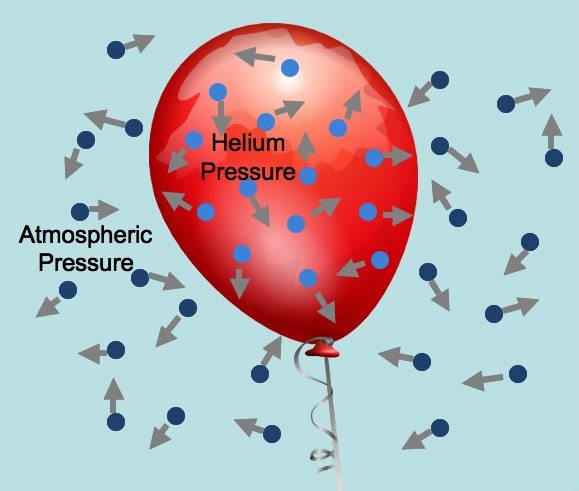
What causes pressure?
a)
The walls of the container
b)
The vacuum in the container
c)
The collisions of the particles
d)
Atmospheric pressure acting on the outside walls
13.
The relationship of which two variables are compared in Boyle's Law?
a)
pressure & volume
b)
volume & temperature
c)
temperature & pressure
d)
volume & moles (amount of gas)
14.
Boyle's law : When _______ is held constant, the pressure and volume of a gas are ________ proportional
a)
temperature, equally
b)
mass, inversely
c)
temperature, inversely
d)
mass, equally
15.
What type of relationship is Charles' Law?
a)
Inverse
b)
Direct
c)
Not enough information
d)
#goals
16.
What is the formula Charles' Law?
a)
V = T
b)
VT = VT
c)
T1 / V1 = T2 / V2
d)
V1 / T1 = V2 / T2
17.
This variable in an experiment is the one being deliberately changed by the scientist.
a)
dependent variable
b)
independent variable
c)
data
d)
control group
18.
Should experiments be repeated over and over to see if the results are the same each time?
a)
yes
b)
no
19.
A series of steps used by scientists to solve a problem or answer a question.
a)
scientific method
b)
recipe
c)
data collection
d)
metric system
20.
TRUE/ FALSE: Science is a continually ongoing process.
a)
True
b)
False
Reset

