
 Worksheets
Benchmark Review Science Grade 8
Total questions: 77
Worksheet time: 54mins
Name
Class
Date
1.

How many protons are in Beryllium?
a)
4
b)
9
c)
5
d)
2
2.

How many neutrons are in a Gold atom?
a)
79
b)
196
c)
118
d)
275
3.

What is the atomic mass of Gold?
a)
79
b)
196.9665
c)
117
d)
275
4.

How many neutrons does an Oxygen atom have?
a)
8
b)
16
c)
24
d)
7.999
5.
How REACTIVE an element is is based on
a)
protons
b)
atomic number
c)
electrons
d)
valence electrons
6.
Which type of subatomic particles have the LEAST amount of mass?
a)
protons
b)
electrons
c)
neutrons
d)
nucleus
7.
What gives an atom mass?
a)
Protons & electrons in the nucleus
b)
electrons in the cloud
c)
protons & neutrons in the nucleus
d)
Protons & electrons in the cloud
8.

How many neutrons does NA have?
a)
11
b)
23
c)
22
d)
12
9.

How many protons does this element have?
a)
40
b)
21
c)
20
d)
41
10.
What determines an elements identity?
a)
electrons
b)
periodic table
c)
protons
d)
mass
11.
the central region of an atom where its neutrons and protons are is its
a)
nucleus
b)
electron cloud
c)
core
d)
center
12.
The first energy level can hold up to how many electrons?
a)
8
b)
4
c)
2
d)
5
13.
What is the atomic number?
a)
the number of protons
b)
the number of protons and neutrons
c)
the number of neutrons
d)
the number of protons and electrons
14.
What is the mass number?
a)
the number of protons
b)
the number of protons and neutrons
c)
the number of neutrons
d)
the number of protons and electrons
15.
What element contains 26 protons?
a)
Iron
b)
Sodium
c)
Aluminum
d)
Helium
16.

a)
Nucleus, positive
b)
Nucleus, negative
c)
Nucleus, neutral
d)
Electron Cloud, positive
17.

a)
Nucleus, positive
b)
Nucleus, negative
c)
Nucleus, neutral
d)
Electron Cloud, positive
18.

a)
Electron Cloud, positive
b)
Nucleus, negative
c)
Electron Cloud, negative
d)
Electron Cloud, neutral
19.

a)
number of valence electrons
b)
number of protons
c)
number of electrons
d)
number of neutrons
20.

a)
Group Number
b)
Period Number
c)
Atomic Number
d)
Atomic Mass
21.
What is velocity?
a)
the quickness of an object
b)
the location of an object
c)
acceleration
d)
speed in a specific direction
22.
If a cheetah runs 180 miles in 3 hours, what is its average speed? S= D/T
a)
60 hours
b)
60 miles
c)
60 miles/hour
d)
60 miles/second/second
23.
How far will a person go if they jog for 2 hours at a speed of 12 km/hr?
a)
6 km
b)
0.5 km
c)
10 km
d)
24 km
24.
F=MA
An object of mass 10 kg is accelerated upward at 2 m/s2. What force is required?
An object of mass 10 kg is accelerated upward at 2 m/s2. What force is required?
a)
20 N
b)
2 N
c)
5 N
d)
0 N
25.
A 20 kg bike accelerates at 10 m/s2. what was the force? F=M*A
a)
2 Newtons
b)
20 Newtons
c)
200 Newtons
d)
30 Newtons
26.
If a force of 26 N is exerted on two balls, one with a mass of 0.52 kg and the other with a mass of 0.78 kg, which ball will have the greater acceleration? (F=ma)
a)
The one with a mass of .78 kg will have the greatest acceleration.
b)
The one with a mass of .52 kg will have the greatest acceleration.
c)
They will both accelerate at the same rate.
27.

In a tug of war, when one team is pulling with a force of 100 N and the other at 80 N. What is the net force?
a)
20 N
b)
80 N
c)
100 N
d)
180 N
28.
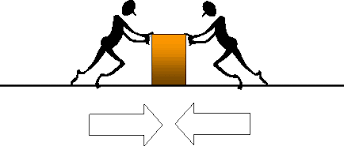
If an object is stationary (not moving) the forces acting upon it are _____________
a)
unbalanced
b)
weak
c)
balanced
d)
Hulk Smash!
29.
You and your dad are moving the couch from one side to another. Your dad pushes with a force of 35 N to the right and you push with a force of 25 N right. What is the net force on the couch?
a)
60 N right
b)
10 N left
c)
10 N right
d)
50 N left
30.
You and your friend, are playing tug of war. Your friend pulls with a force of 55 N, to the rights. You pull with a force of 65 N, to the left. What is the net force on the rope?
a)
10 n, to the left
b)
20 N
c)
10 N, to the left
d)
10 N, to the right
31.

What moon phase comes before a Full Moon?
a)
Waxing Crescent
b)
Waning Crescent
c)
Waxing Gibbous
d)
Waning Gibbous
32.

What causes Day and Night on Earth?
a)
The rotation of the Earth
b)
Earth moving farther from and closer to the Sun
c)
The Revolution of Earth
d)
The Sun moving around Earth
33.

If the Earth stopped rotating, What would happen?
a)
Nothing would really happen
b)
There would no longer be 24 hours of day/night
c)
Seasons would no longer happen
d)
The earth would fly off into space
34.
Which of the following statements is most accurate about the Movement of Earth and the Sun?
a)
The Sun revolves around the Earth
b)
The Earth rotates around the Sun
c)
The Earth revolves around the Sun
d)
The Earth rotates and revolves around the Sun
35.

Which moon phase is shown in the image?
a)
first quarter
b)
waning crescent
c)
waxing crescent
d)
waning gibbous
36.

Which moon phase is shown in the image?
a)
first quarter
b)
third quarter
c)
full moon
d)
waning crescent
37.
_______ means to spin on its axis.
a)
Revolve
b)
Rotate
c)
Orbit
38.
_______ is the movement of an object around another object.
a)
Revolve
b)
Rotate
c)
Orbit
39.

Which season is the northern hemisphere experiencing?
a)
Spring
b)
Summer
c)
Fall
d)
Winter
40.

Which season is the northern hemisphere experiencing?
a)
Spring
b)
Summer
c)
Fall
d)
Winter
41.
How many degrees is the Earth's axis tilted?
a)
0
b)
23.5
c)
50
d)
90
42.
What is the name of a day in which day and night are of equal duration?
a)
solstice
b)
equinox
c)
axis
d)
hemisphere
43.
What is the name of the longest day of the year?
a)
vernal equinox
b)
autumnal equinox
c)
summer solstice
d)
winter solstice
44.
What is the name of the shortest day of the year?
a)
vernal equinox
b)
autumnal equinox
c)
summer solstice
d)
winter solstice
45.
As the moon's shape appears to get smaller, we say that the moon is _.
a)
swelling
b)
waxing
c)
waning
d)
disappearing
46.
About how long does it take the moon to make one complete cycle around the earth?
a)
65 days
b)
8 days
c)
365 days
d)
28 days
47.
During the phases of the Moon, the Moon appears to change shape. This change in appearance is due to the Moon...
a)
physically changing size and shape.
b)
moving closer and then farther away from Earth.
c)
reflecting a different amount of light due to alignment with Earth and the Sun.
d)
having craters on its surface.
48.
What are the reasons for the seasons?
a)
Earth's tilt and rotation.
b)
Earth's rotation and revolution.
c)
Earth's tilt and revolution.
d)
Earth's tilt and resolution
49.
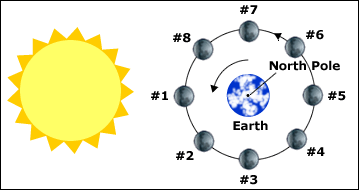
What phase is the moon when in position #6?
a)
Waning Gibbous
b)
Waxing Gibbous
c)
Waning Crescent
d)
Waxing Crescent
50.
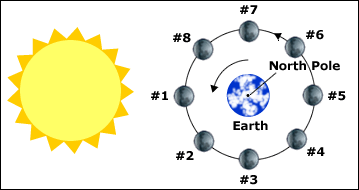
What phase is the moon when in position #5?
a)
New Moon
b)
First Quarter
c)
Full Moon
d)
Third Quarter
51.
Why does none of the moon appear lit during a new moon?
a)
The sun's light is blocked by Earth's shadow
b)
Because the moon is between the Earth and the Sun
c)
Because the moon is located at a right angle to Earth, relative to the sun
d)
Part of the moon that is lit faces away from the sun and Earth
52.
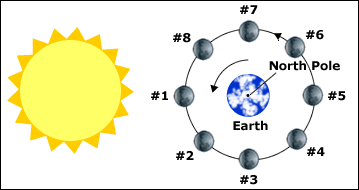
In what phase is the moon when in position #8?
a)
Waning crescent
b)
First Quarter
c)
Waxing crescent
d)
Third Quarter
53.
Hotter stars appear to be what color?
a)
Red
b)
Blue
c)
Yellow
d)
Green
54.
Cooler stars appear to be what color?
a)
Red
b)
Blue
c)
Yellow
d)
Green
55.
What determines the color of a star?
a)
It's size
b)
It's temperature
c)
It's composition
d)
They are all the same color
56.
What fuel do stars use?
a)
Oxygen
b)
Hydrogen
c)
Carbon
d)
Iron
57.
Larger stars (stars with more mass) have a longer life cycle.
a)
True
b)
False
58.

This is an image of the formation of a star, also known as a ....
a)
Main Sequence
b)
Planetary Nebula
c)
Supernova
d)
Stellar Nebula
59.
In this stage, a star spends most of its life. Hydrogen is fused into helium at a temperature of millions of degrees.
a)
nebula
b)
protostar
c)
main-sequence
d)
supergiant
60.
In this stage, a star spends most of its life. Hydrogen is fused into helium at a temperature of millions of degrees.
a)
nebula
b)
protostar
c)
main-sequence
d)
supergiant
61.
Low mass stars expand into what after using up the hydrogen in their core
a)
red giants
b)
supergiants
c)
white dwarfs
d)
protostars
62.
A low mass star ends its life as a
a)
Supernova
b)
Black hole
c)
White dwarf
d)
Nebula
63.
This stage is when a high mass star explodes
a)
Supergiant
b)
Red giant
c)
Supernova
d)
Black hole
64.

In the diagram given, what happens as we move to the left?
a)
Stars Get Larger
b)
Stars get Colder
c)
Stars get hotter
65.

Which star has the lowest temperature?
a)
A
b)
B
c)
C
d)
D
66.
The category that contains the most stars is...
a)
Main Sequence
b)
Supergiants
c)
Giants
67.

As you move from the bottom to the top of the H R diagram the __________ changes.
a)
Temperature
b)
Luminosity or Brightness
68.
How many Hydrogen are in 4H2O?
a)
6
b)
8
c)
2
d)
4
69.
2H2 + O2 ----> 2H2O What is the product?
a)
------>
b)
2H2O
c)
2H2+ O2
70.
2H2 + O2 --------> 2H2O What are the reactants?
a)
----->
b)
2H2O
c)
2H2 +O2
71.
How many Magnesium are in 10MgCl2?
a)
10
b)
5
c)
20
72.
How many elements are in C6H12O6?
a)
1
b)
2
c)
3
d)
4
73.
How many atoms are there TOTAL in:
H2SO4
H2SO4
a)
6
b)
5
c)
7
d)
3
74.
Number of N in (NH₄)₂CrO₄
a)
1
b)
2
c)
8
d)
16
75.
(Element or Compound)
C2H8O
C2H8O
a)
Element
b)
Letters
c)
Numbers
d)
Compound
76.
How many O's are in Al₂(SO₄)₃
a)
4
b)
12
c)
7
d)
24
77.
Number of H in 3(NH₄)₂CrO₄
a)
4
b)
2
c)
8
d)
24
100 %

