wayground logo

Free Printable Worksheets

Font size

S
M
L
XL
Worksheets

Applying Newton's 3 Laws of Motion

Total questions: 35

Worksheet time: 2hrs 59mins

Name
Class
Date
1.
 Newton’s third law of motion involves the interactions of 
a)
one object and one force
b)
 one object and two forces
c)
two objects and one force. 
d)
two objects and two forces. 
2.
A hammer drives a nail into a piece of wood. Identify an action-reaction pair in this situation. 
a)
The nail exerts a force on the hammer; the hammer exerts a force on the wood.
b)
The hammer exerts a force on the nail; the wood exerts a force on the nail.
c)
The hammer exerts a force on the nail; the nail exerts a force on the hammer. 
d)
The hammer exerts a force on the nail; the hammer exerts a force on the wood. 
3.
Newton's second law of motion states that an unbalanced force that acts upon an object causes it to:
a)
accelerate
b)
not accelerate (keep the same velocity
c)
have a velocity
4.
The scientist who is most famous for developing the Laws of Motion is _____.
a)
Albert Einstein
b)
Stephen Hawking
c)
Sir Isaac Newton
d)
Galileo Galilei
5.

When an object resists change, like a body in a turning car, it is called ________________.

a)

inertia

b)

force

c)

friction

d)

drag force

6.
A sled sliding on a flat, icy surface with a constant velocity is best described by
a)
Newton’s first law of motion for objects at rest.
b)
Newton’s first law of motion for objects in motion.
c)
Newton’s second law of motion.
d)
Newton’s third law of motion.
7.
A person steps out of the boat and onto the dock.  As the person moves forward onto the dock, the boat moves backward.  Which statement best describes the backward motion of the boat as the person steps forward?
a)
For every action there is an equal and opposite reaction.
b)
Every mass exerts a force on every other mass.
c)
An object at rest tends to stay at rest.
d)
Friction opposes the motion of an object.
8.
What is Force?
a)
A Push
b)
A Pull
c)
Jumping
d)
Either a push or pull
9.
If a 10 kilogram object accelerates suddenly at 15 m/s2, how much force was applied to the object?
a)
150 Newtons
b)
15 Newtons
c)
150 kilograms
d)
100 kilograms
10.
An object will not have any inertia if it is _______________
a)
Accelerating
b)
Moving in a circle
c)
In space
d)
All objects have inertia
11.

The Law of Inertia

a)

Newton's

1st

Law of Motion

b)

Newton's

2nd

Law of Motion

c)

Newton's

3rd

Law of Motion

12.

For every action, there is an equal and opposite reaction.

a)

Newton's

1st

Law of Motion

b)

Newton's

2nd

Law of Motion

c)

Newton's

3rd

Law of Motion

13.

F=ma

a)

Newton's

1st

Law of Motion

b)

Newton's

2nd

Law of Motion

c)

Newton's

3rd

Law of Motion

14.

A swimmer pushes water back with her arms but her body moves forward.

a)

Newton's

1st

Law of Motion

b)

Newton's

2nd

Law of Motion

c)

Newton's

3rd

Law of Motion

15.

What law describes the importance of mass on a moving object?

a)

1st

b)

2nd

c)

3rd

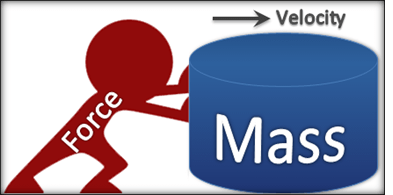
16.

What law best describes this image?

a)

The Law of Inertia

b)

The Law of Acceleration

c)

The Law of Action and Chain Reaction

17.
What does the term inertia mean?
"Newton's first law focuses on the law of inertia."
a)
The tendency of an object to resist a CHANGE in its state of motion.
b)
Opposes the motion of one object moving past another.
c)
The speed and direction of a moving object.  
d)
Forces that do not cancel each other out when acting together on a single object. 
18.
What does the term friction mean?
" The oil in my car reduces the friction on my engine."
a)
Using force to move an object. 
b)
How fast an object's position is changing with time at any moment. 
c)
Opposes the motion of one object moving past another. 
d)
A wheel with a groove in the rim. 
19.
What does the term acceleration mean?
"The car showed acceleration by going faster and faster."
a)
A change in velocity. 
b)
When my car goes faster. 
c)
A push or pull on an object. 
20.
An ice skater at rest pushes against a sled at rest, causing both the skater and sled to move away from each other with different accelerations. This is an example best described by
a)
Newton’s first law of motion for objects at rest.
b)
Newton’s first law of motion for objects in motion.
c)
Newton’s second law of motion.
d)
Newton’s third law of motion.
21.
How does Newton’s third law explain how a rocket takes off?
a)
The rocket’s acceleration is positive, while the gasses acceleration is negative but the direction is the same. 
b)
The rocket is at rest until ignition.
c)
The hot gasses move in one direction, while the rocket moves in the opposite direction but with equal force.
22.
Which of the following explains the difference between speed and velocity?
a)
One has motion, and the other does not.
b)
One has direction, and the other does not.
c)
One involves time, and the other does not.
d)
One involves acceleration, and the other does not.
23.
If an action force is a cue ball (white) hitting a billiard ball (various colors) when playing pool, then the reaction force is
a)
exerted on the table
b)
exerted on all the other billiard balls.
c)
not present
d)
exerted by the billiard ball on the cue ball.
24.
If a baseball and a cannonball are dropped from the same height at the same time, which ball will hit the ground first?
a)
the cannonball
b)
the baseball
c)
The balls land at the same time.
d)
the ball with the larger volume
25.

If a force of 26 N is exerted on two balls, one with a mass of 0.52 kg and the other with a mass of 0.78 kg, which ball will have the greater acceleration?

a)

The one with a mass of .78 kg will have the greatest acceleration.

b)

The one with a mass of .52 kg will have the greatest acceleration.

c)

They will both accelerate at the same rate.

26.
If there is a big mass, it would need a stronger force to accelerate it.  Which law does this describe?
a)
Newton's 1st Law
b)
Newton's 2nd Law
c)
Newton's 3rd Law
27.
In a football game, two players tackle each other so hard that they both fly in opposite directions after they hit each other.  What law of motion is this an example of?
a)
Newton's 2nd Law
b)
Newton's 3rd Law
28.
A student leaves a pencil on a desk and it stays there until I pick it up. 
a)
1st Law
b)
2nd Law
29.
A soccer player kicks a ball with their foot and their toes are left stinging. 
a)
2nd Law 
b)
3rd Law 
30.
Two students are in a baseball game. First student hits a ball hard and it has a greater acceleration than the 2nd student who bunts the ball lightly. 
a)
1st Law
b)
2nd Law
31.
Which law explains when a magician pulls a tablecloth out from under dishes and glasses on a table without disturbing them.
a)
Law 1
b)
Law 3
32.
Pushing  a child on a swing is easier than pushing an adult on the same swing. 
a)
1st Law 
b)
2nd Law
33.
Which has more Inertia? (and more force to move) 
a)
Truck
b)
Ant
34.

A 9 kg block is pulled along the floor with a force of 120 N, with a frictional force of 30 N opposing the motion. What is the acceleration of the block?

a)

40 m/s2

b)

1.3 m/s2

c)

13 m/s2

d)

10 m/s2

35.

What is the mass of a soccer ball traveling 6 m/s2 with a force of 30 N for a penalty kick?

a)

3 kg

b)

5 kg

c)

12 kg

d)

8 kg