wayground logo

Free Printable Worksheets

Font size

S
M
L
XL
Worksheets

Chapter 5 Evolution

Total questions: 21

Worksheet time: 21mins

Name
Class
Date
1.

Over time, animals may change behavior or physical appearance in response to changes in the environment. What is this called?

a)

resistance

b)

genetic change

c)

adaptation

d)

genetic variation

2.

Many insects can adapt very quickly to insecticides because :

a)

the insects' genetic structure is stable

b)

the insects' generation time is short

c)

the insects' form separate species

d)

they form a hard skeleton

3.

What do we call the process by which populations change over time?

a)

evolution

b)

speciation

c)

selective breeding

d)

adaptation

4.

Scientists compare organisms' DNA to support the theory that all species share a common:

a)

environment

b)

separation

c)

population

d)

ancestor

5.
Who was the naturalist that traveled the world to study plants and animals?
a)
Albert Einstein
b)
Charles Darwin
c)
Charles Barkley
d)
Isaac Newton
6.
To adjust to a changing environment
a)
Mutation
b)
Adapt
7.
Darwin wrote that organisms with traits that are best suited to the environment will ________________
a)
increase in number
b)
become extinct
8.
What characteristic did Darwin observe about the finches on the Galapagos Islands?
a)
Their feathers 
b)
Genotypes 
c)
Their beaks
d)
Their body sizes
9.
When an organism completely dies out, it is called.....
a)
Adaption
b)
Extinction
c)
Fossilization
d)
Mutation
10.
The white feathers of a snowy owl allow it to blend in with its environment during the winter months (snow). This is an example of ________________
a)
Species
b)
Environmental Change
c)
Adaptation
d)
Variation
11.
Darwin referred to this as survival of the fittest. Over time, it results in changes in the inherited characteristics of a population because organisms with adaptations that make them fit for their environment will survive and reproduce better than those without favorable traits.
a)
Natural Selection
b)
Genetic Variation
c)
Survival of the Fittest
12.
What is the advantage of having different shaped beaks?
a)
To look different from other species.
b)
To be able to eat the food readily available in the environment.
c)
To protect itself against predators.
d)
To protect itself against prey.
13.
Darwin's expedition was called the Voyage of the _________.
a)
Titanic
b)
Beagle
14.
Remains of ancient organisms are called
a)
Extinctions
b)
Fossils
c)
Mutations
d)
Variations
15.

A characterstic that can be passed from parent to offspring through genes is called:

a)

resistance

b)

sediment

c)

trait

d)

genetic change

16.

What process often begins by a portion of a population becoming physically or geographically separated?

a)

speciation

b)

selective breeding

c)

genetic change

d)

resistance

17.

What evidence of natural selection is available today that was not available to Darwin?

a)

There is great variation among organisms

b)

organisms inherit traits

c)

differences in genes create variation

d)

humans can breed organisms for specific traits

18.

A turtle will lay 100 eggs, knowing only a few will survive. This is called:

a)

division

b)

genetic change

c)

speciation

d)

overproduction

19.
Why are advantageous traits more likely to be passed onto offspring?
a)
Because they are more likely to survive and reproduce.
b)
Because they come from dominant alleles.
c)
Because they come from recessive alleles.
d)
Because the trait is an acquired phenotype.
20.
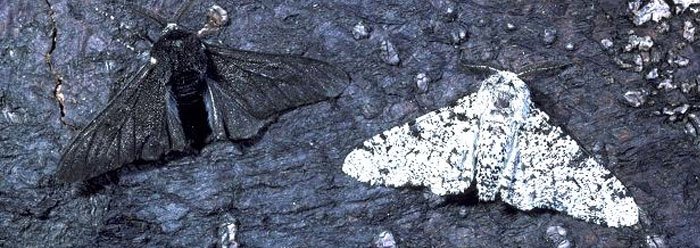
The trees these moths used to live on were white, but have been covered in soot from coal factories. Which moth will be more successful in this environment?
a)
Dark moth
b)
Light moth
c)
Both will be equally successful
d)
Neither will be successful
21.
The diagram shows fossils in different rock layers. Which of these statements about the age of these fossils is most likely correct?
a)
Fossil A and C are the same age
b)
Fossil B is older than fossil C
c)
Fossils A is older than fossil B
d)
Fossil D is older than fossil C