
 Worksheets
Earth and Weather Test
Total questions: 20
Worksheet time: 20mins
Name
Class
Date
1.
The outermost solid layer of the Earth is called the
a)
mantle
b)
outer core
c)
inner core
d)
crust
2.
This is the outermost, rigid layer of the Earth, made up of two parts, is divided into pieces call tectonic plates.
a)
Inner Core
b)
Asthensophere
c)
Lithosphere
d)
Outer Core
3.

Identify the letter in the diagram. Identify letter A
a)
Lithosphere
b)
Asthenosphere
c)
Mantle
d)
Outer Core
4.
What are the 3 major types of rocks?
a)
Igneous, Metamorphic, Sedimentary
b)
Metamorphic, Igneous, Cementation
c)
Brown, Red, Gray
d)
Streak, Hardness, Breakage
5.
What process is used to form sedimentary rocks?
a)
Lava cools and hardens to form a rock.
b)
Weathering, Erosion, Deposition, Compaction, Cementation
c)
Extreme heat and pressure from inside the Earth turn rocks into new rocks.
d)
Magma trapped under the Earth's surface cools and solidifies.
6.
This rock was formed when molten rock cooled into a solid. What type of rock is it?
a)
Igneous Rock
b)
Metamorphic Rock
c)
Sedimentary Rock
7.

What is the theory that states that parts of the Earth's crust slowly drift atop a liquid core.
a)
Theory of Evolution
b)
Heliocentric Theory
c)
Geocentric Theory
d)
Continental Drift Theory
8.
What do you call the evidence of Wegener's Theory that tells about the remains of an organism that lived long time ago?
a)
Ashes
b)
Bones
c)
Follicles
d)
Fossils
9.

What do you call the supercontinent landmass formed million years ago?
a)
Pangea
b)
Asia
c)
Pantallasa
d)
Eurasi
10.
What types of air masses form over oceans?
a)
Maritime
b)
Continental
c)
Polar
d)
Tropical
11.
What's the humidity and temperature of a continental tropical air mass?
a)
Wet and cold
b)
Dry and warm
c)
Wet and warm
d)
Dry and cold
12.
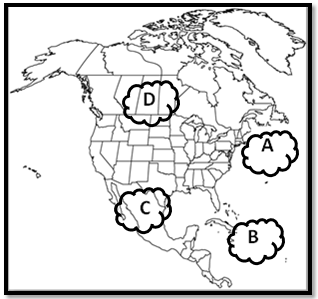
Which type of air would you find at air mass C?
a)
cold, dry
b)
warm, humid
c)
warm, dry
d)
cold, humid
13.
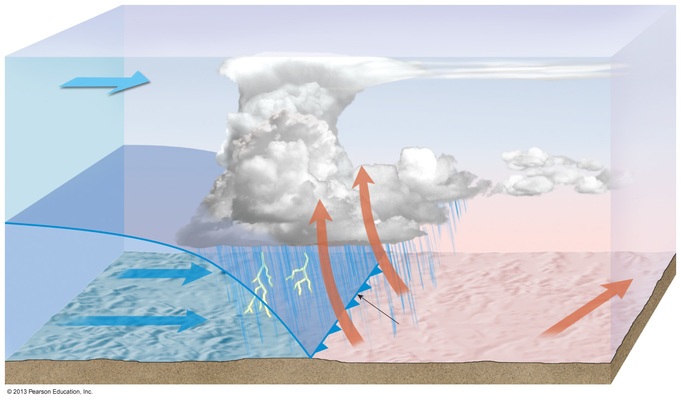
What type of storm front is this?
a)
warm front
b)
cold front
c)
stationary front
d)
occluded front
14.
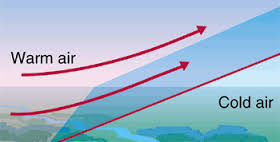
Which type of front is pictured?
a)
Cold front
b)
Warm front
c)
Occluded front
d)
Stationary front
15.
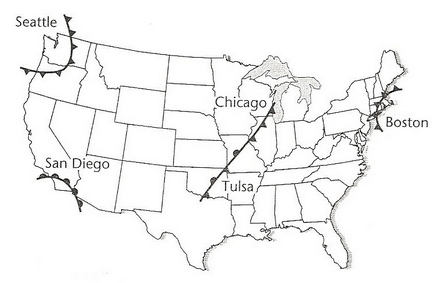
Which type of front is located near Chicago?
a)
warm front
b)
cold front
c)
occluded front
d)
stationary front
16.

What information is NOT given on the map?
a)
The location of isobars
b)
Direction and location of fronts
c)
Weather conditions
d)
The weekly weather forecast
17.

Which mineral property is being shown here?
a)
luster
b)
hardness
c)
cleavage
d)
streak
18.
____________ is determined by scratching a mineral with other minerals.
a)
fracture
b)
hardness
c)
streak
d)
color
19.
The process by which water, ice, wind or gravity moves weathered rock and soil from one place to another.
a)
weathering
b)
erosion
c)
deposition
d)
dumptruck
20.
The natural chemical or physical processes that breaks down rock on Earth's surface.
a)
weathering
b)
erosion
c)
deposition
d)
jackhammering
100 %

