
 Worksheets
The Water Cycle, Water Distribution, and Properties of Water
Total questions: 20
Worksheet time: 21mins
Name
Class
Date
1.

What is the water cycle?
a)
the 3 forms of water
b)
the movement of water on, above, or below the surface of the Earth
c)
when water melts
d)
when clouds form
2.
What is the energy source for the water cycle?
a)
the sun
b)
the earth
c)
water
d)
the moon
3.

What part of the water cycle does this picture show?
a)
condensation
b)
precipitation
c)
evaporation
4.
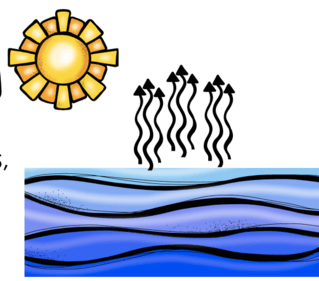
What part of the water cycle does this picture show?
a)
condensation
b)
precipitation
c)
evaporation
5.
What is precipitation?
a)
The part of the water cycle when the sun heats up water, turning it from a liquid into water vapor or steam. It rises from the ground into the air.
b)
The part of the water cycle when the water vapor in the air gets cold. The water turns back into a liquid and forms clouds.
c)
The part of the water cycle when clouds get heavy and can no longer hold the liquid water. This causes the water to fall from the sky to the earth as rain, snow, sleet, or hail.
6.

Does evaporation happen before or after condensation?
a)
before
b)
after
c)
during
7.

Does precipitation happen before or after condensation?
a)
before
b)
after
c)
during
8.
Which represents the distribution of water on Earth?
a)
3% freshwater, 97% salt water
b)
97% freshwater, 3% salt water
c)
71% freshwater, 29% salt water
d)
29% freshwater, 71% salt water
9.
Which source of freshwater is not easily available for human use?
a)
oceans
b)
freshwater lakes
c)
rivers
d)
icecaps/glaciers
10.

Which BEST describes how the total amount of water present in the hydrosphere varies over time?
a)
The total amount of water in the hydrosphere decreases over time due to the process of evaporation.
b)
The total amount of water in the hydrosphere remains the same over time, but changes form due to the water cycle.
c)
The total amount of water in the hydrosphere increases over time due to the process of precipitation.
d)
The total amount of water in the hydrosphere both decreases and increases over time due to competing processes such as evaporation and precipitation.
11.
What two elements make up water?
a)
Helium and oxygen
b)
Hydrogen and oxygen
c)
helium and carbon
d)
oxygen and carbon
12.

What word describes when water is attracted to other substances?
a)
cohesion
b)
adhesion
c)
capillary action
d)
surface tension
13.

Why does water move from the roots to the leaves of plants?
a)
Water is pushed by solutes
b)
Capillary action pulls the water molecules like a chain
c)
Water is pulled by gravity
d)
Water’s cohesion causes it to “pull” towards the leaves
14.

tendency of molecules of the same kind to stick to one another
a)
cohesion
b)
adhesion
c)
solution
d)
polar molecule
15.
Why does ice float?
a)
As water freezes, it expands and its density decreases.
b)
As water freezes, it takes up more hydrogen from the atmosphere, causing it to have a greater buoyancy.
c)
As water freezes, air becomes trapped between the hydrogen bonds of water molecules.
d)
As water freezes, it takes up more oxygen from the atmosphere, causing it to have a greater buoyancy.
16.
Which end of the water molecule has a slightly positive charge?
a)
the oxygen end
b)
the hydrogen end
c)
both ends are slightly positive
d)
neither end is positive
17.

The reason the water balloon did NOT pop while held over a flame is water's _________.
a)
Less dense than air.
b)
Hydrogen bonds between water molecules.
c)
polarity.
d)
high specific heat capacity.
18.
Water is a universal solvent because it...
a)
It can be found anywhere
b)
It freezes when it gets cold
c)
floats when frozen
d)
Dissolves most substances
19.
Water beads up on the surface of a penny because of this property.
a)
Adhesion
b)
High Surface Tension
c)
Universal Solvent
d)
Changes in Density
20.

Attractions between water molecules are called
a)
Covalent bonds
b)
Ionic bonds
c)
Polar bonds
d)
Hydrogen bonds
100 %

