
 Worksheets
Topic 4 Waves - Vocab Practice
Total questions: 34
Worksheet time: 22mins
Name
Class
Date
1.
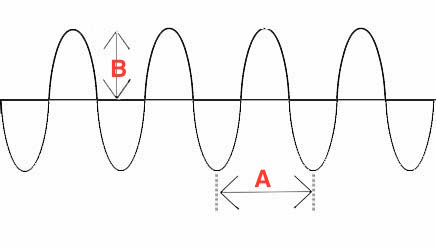
What property of this wave is represented by the letter "A"
a)
amplitude
b)
crest
c)
trough
d)
wavelength
2.
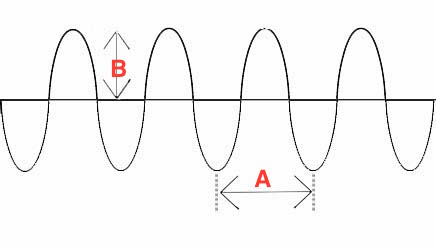
What property of the wave is represented by the letter "B"?
a)
amplitude
b)
crest
c)
trough
d)
wavelength
3.
The highest point on a wave is:
a)
the crest
b)
the trough
c)
the top
d)
the coast
4.
The lowest point on a wave is the:
a)
Amplitude
b)
Crest
c)
Trough
d)
Wavelength
5.
The number of wavelengths that pass a point each per second is:
a)
frequency
b)
period
c)
longitudinal
d)
transverse wave
6.
The type of waves that require medium to pass:
a)
Mechanical Waves
b)
Electromagnetic Waves
7.

Which vocabulary term is used to identify the distance between points C & G?
a)
Amplitude
b)
Crest
c)
Frequency
d)
Wavelength
8.
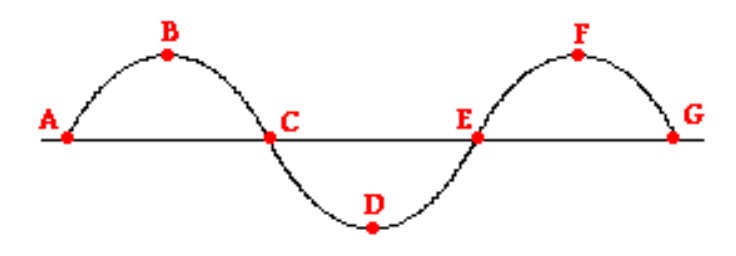
Which letter(s) represent the trough of the wave?
a)
A
b)
B & D
c)
D
d)
C & G
9.
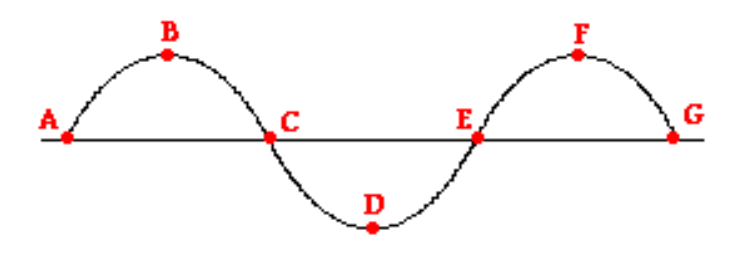
Which letter(s) represent the crest of the wave?
a)
A
b)
B & D
c)
B & F
d)
F
10.

Which wave in the diagram has the greatest frequency?
a)
1
b)
2
c)
3
d)
4
11.
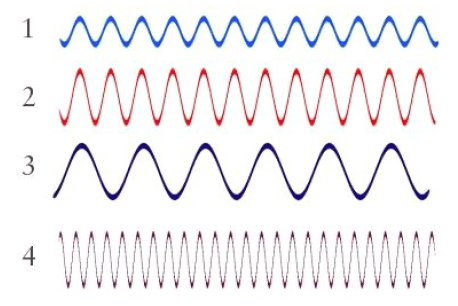
Which wave in the diagram has the greatest wavelength?
a)
1
b)
2
c)
3
d)
4
12.
Which of the following can sound travel through?
a)
solid
b)
liquid
c)
gas
d)
all of the above
13.
crest to crest or trough to trough
a)
crest
b)
trough
c)
amplitude
d)
wavelength
14.
which material does sound travel the fastest?
a)
solid
b)
liquid
c)
gases
15.
________ is the midpoint in a wave where amplitude begins.
a)
point of origin
b)
amplitude
c)
crest
d)
wavelength
16.
What kind of wave can travel through space?
a)
electromagnetic waves
b)
compressional waves
c)
transverse waves
d)
longitudinal waves
17.
A wave carries...?
a)
energy only
b)
matter only
c)
the matter carries the energy
d)
neither
18.

This type of Electromagnetic wave shows a break in bones.
a)
gamma ray
b)
x-ray
c)
brokenometer
d)
radio wave
19.
Sound will travel slowest through which of the following forms of matter?
a)
milk
b)
desk
c)
air
d)
door
20.
What kind of wave can travel through space?
a)
electromagnetic waves
b)
compressional waves
c)
transverse waves
d)
longitudinal waves
21.
Sound travels FASTEST through which of these materials?
a)
Air
b)
Empty space
c)
Metal
d)
Water
22.
Sound is caused by?
a)
force
b)
vibrations
c)
instruments
d)
medium
23.
What is vibration?
a)
how loud a sound is
b)
the back and forth movement of matter
c)
how high or low a sound is
d)
the loudness or softness of a sound
24.

Sound is a form of?
a)
energy
b)
pitch
c)
volume
d)
matter
25.
This is what you get when sound waves are reflected, or bounce back, off of a hard surface.
a)
Amplitude
b)
Pitch
c)
Volume
d)
Echo
26.
Why is sound able to travel faster through a solid than a gas?
a)
Gas molecules are packed tightly.
b)
Sound does not travel faster through a solid than a gas.
c)
Solid molecules are packed tightly.
d)
Gas molecules move slowly.
27.
The units for frequency are measured in _____________.
a)
hertz
b)
seconds
c)
m/s
d)
m
28.
How does a sound wave interact with a human ear?
a)
vibrates the ear drum
b)
bounces off the ear canal
c)
rotates the ear drum
d)
vibrates the ear canal
29.

Which wave has a greater frequency?
a)
A
b)
B
30.

How would a person measure the wavelength on this sound wave?
a)
dense to less dense
b)
trough to crest
c)
compression to compression
d)
beginning of illustration to the end
31.
Waves can travel through empty space or they can travel through a medium. Which statement best describes a medium?
a)
The solid matter that waves travel through
b)
The gas matter that waves travel through
c)
The liquid matter that waves travel through
d)
The solid, liquid, or gas matter that waves travel through
32.
What do mechanical waves travel through?
a)
Medium
b)
empty space
c)
vacuum
d)
the boo
33.
The most dense part of a longitudinal wave.
a)
Density
b)
Compression
c)
Rarefaction
d)
Amplitude
34.
Seismic waves contain which type of waves?
a)
transverse
b)
longitudinal
c)
both transverse and longitudinal
d)
neither transverse or longitudinal
100 %

