
NEW
Font size
S
M
L
XL
 Worksheets
Lenses and Mirrors
Total questions: 44
Worksheet time: 33mins
Name
Class
Date
1.

The following is a picture of what type of mirror?
a)
Convex Mirror
b)
Concave Mirror
c)
Plane Mirror
d)
Flat Mirror
2.

The following is a picture of what type of mirror?
a)
Convex Mirror
b)
Concave Mirror
c)
Plane Mirror
d)
Flat Mirror
3.
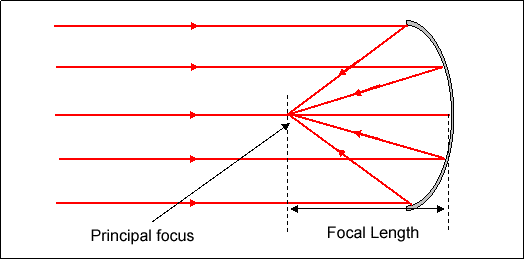
This is an example of a __________ mirror.
a)
Concave
b)
Convex
c)
Plane
d)
Magnifying
4.

This is an example of a _____________ mirror
a)
Concave
b)
Convex
c)
Plane
d)
Magnifying
5.
Convex Mirrors produce...
a)
only virtual images
b)
virtual or real images
c)
only real images
d)
inverted images
6.
An image that you can see , but does not really exist is called which of the following?
a)
Real Image
b)
Fake Image
c)
Virtual Image
d)
Digital Image
7.
An incident ray that is parallel to the principal axis...
a)
will reflect parallel to the principal axis
b)
will refract through the focal point
c)
will reflect through the center of curvature
d)
will continue along the same path through the lens
8.
a real image...
a)
is produced by virtual rays and can be projected on a screen
b)
is produced by real rays and cannot be projected on a screen
c)
is produced by virtual images and cannot be projected on a screen
d)
is produced by real rays and can be projected on a screen
9.
Concave mirrors can create virtual and real images.
a)
True
b)
False
10.
Convex mirrors can create real images.
a)
True
b)
False
11.
Plane mirrors create real images.
a)
True
b)
False
12.
A virtual image is a copy of an object formed at the location from which the light rays appear to come.
a)
True
b)
false
13.
Plane mirrors always produce ______
a)
Real images
b)
Virtual Images
14.
The law of reflection states that the angle of reflection is equal to the angle of incidence.
a)
True
b)
False
15.
Concave mirrors can form real images
a)
yes
b)
no
16.
Concave mirrors can form virtual images
a)
yes
b)
no
17.
The point at which the light rays meet is called the focal point.
a)
true
b)
False
18.
A real image is a copy of an object formed at the point where light rays actually meet.
a)
true
b)
false
19.
Convex mirrors cause light to spread out.
a)
True
b)
False
20.
A virtual image is a copy of an object formed at the location from which the light rays appear to come.
a)
True
b)
False
21.
Concave mirrors will produce...
a)
Real, erect images
b)
Virtual, inverted images
c)
Real, inverted images
d)
no images form
22.
If an object is placed at f in front of a concave mirror...
a)
the image forms at f
b)
the image forms at 2f
c)
the image forms at 3f
d)
no image forms
23.

Which type of mirror magnifies a close up image, like a make-up mirror.
a)
Concave
b)
Convex
c)
Specular
d)
Plane
24.

Which type of mirror is shown.
a)
Concave
b)
Convex
c)
Specular
d)
Plane
25.
Convex mirrors, like those found on the side of a car, produce images that are always _________________.
a)
Real, larger and inverted
b)
Virtual, larger, and inverted
c)
Virtual, smaller and upright
d)
Of equal size and position as the original object
26.

The point where the rays meet is known as....
a)
Fire
b)
the focal point
c)
refraction
d)
Plane of the lens
27.
How far is an object from a concave mirror if the image formed is upright?
a)
one focal length
b)
less than one focal length
c)
more than two focal length
d)
two focal lengths
28.
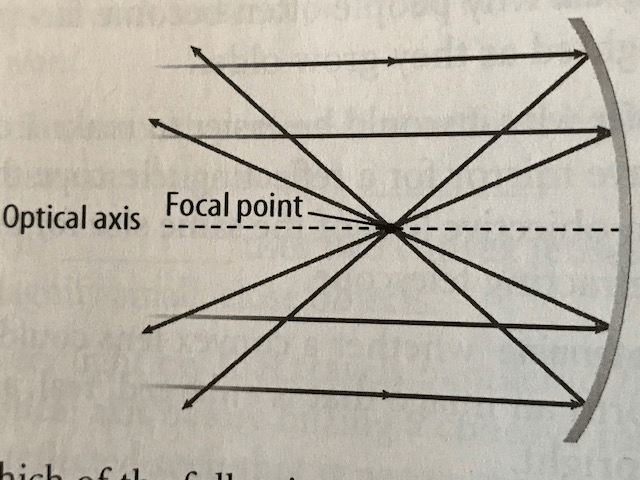
Which of the following describes a light ray that passes through the focal point and then is reflected by the mirror?
a)
It travels parallel to the optical axis
b)
It forms a real image
c)
It is reflected back through the focal point
d)
It forms a virtual image
29.
When an object is placed on the focal point in front of a convex lens, the image produced is ___.
a)
real, reduced, and inverted
b)
real, enlarged, and inverted
c)
real, true, and inverted
d)
There is no image
30.
When an object is placed between the focal point and the convex lens, the image produced is ___.
a)
real, reduced, and inverted
b)
real, enlarged, and inverted
c)
virtual, enlarged, and upright
d)
virtual, reduced, and upright
31.
Where can an object be placed in front of a concave lens in order to produce a "no image"?
a)
On the focal point.
b)
This is not possible for a concave lens.
c)
Between the lens and the focal point.
d)
Beyond the focal point.
32.
In the formulat 1/f= 1/do + 1/di, the variable "f" refers to the _____.
a)
object distance from the lens
b)
image distance from the lens
c)
magnification
d)
focal point
33.
In the formula 1/f=1/do +1/di, the variable "do" refers to _____.
a)
the object distance from the lens
b)
the image distance from the lens
c)
the object height
d)
the image height
34.
In the formula 1/f = 1/do + 1/di, the variable "di" refers to _____.
a)
the object distance from the lens
b)
the image distance from the lens
c)
the object height
d)
the image height
35.
In the formula m = hi/ho, the variable "m" refers to ___.
a)
the height of the image
b)
the height of the object
c)
the focal point
d)
how reduced or enlarged the image is compared to the object
36.
In the formula m = hi/ho, if the variable "hi" is negative, that implies that the image is ___.
a)
true
b)
upright
c)
inverted
d)
reduced
37.
If the focal point is a negative number, the lens is _____.
a)
convex
b)
concave
c)
virtual
d)
real
38.
When the variable "di" is a negative number, the image is ____.
a)
upright
b)
inverted
c)
virtual
d)
real
39.
When an object is placed at 2f in front of a convex lens, the image will be ___.
a)
real, reduced, and inverted
b)
real, same size, and inverted
c)
real, enlarged, and inverted
d)
virtual, enlarged, and upright
40.
A converging lens has a focal length of 30 cm. A 5 cm tall candle is placed at a distance of 10 cm in front of the lens. Determine the image distance.
a)
- 45 cm
b)
-30 cm
c)
-15 cm
d)
6 cm
41.

An object of height 4 cm is placed 10 cm away from a concave lens of focal length 6 cm as shown below.Image is
a)
virtual.inverted
b)
virtual,upright
c)
real,inverted
d)
real,upright
42.

What type of lens do humans have in their eyes?
a)
Concave Lens
b)
Convex Lens
43.
An object is located 0.15 m from a converging lens with focal length 0.10 m.
How far from the lens is the image formed?
How far from the lens is the image formed?
a)
100/3 m
b)
3/10 m
c)
10/3
d)
3/100 m
44.
An object is located 15 m from a converging lens with focal length 10 m.If the object is 2 cm tall, find the image height if the image is located at 30 m.
a)
4 m
b)
-4m
c)
1m
d)
-1m
Reset

