Wayground logo

Free Printable Worksheets

Font size

S
M
L
XL
Worksheets

Earth

Total questions: 62

Worksheet time: 50mins

Name
Class
Date
1.
What causes the seasons to change?
a)
rotation
b)
revolution
2.
Which one takes one year?
a)
rotation
b)
revolution
3.
What is energy created by the sun called?
a)
sun energy
b)
hot energy
c)
solar energy
d)
solar heat
4.
What causes day and night?
a)
rotation
b)
revolution
5.
What describes the earth going around the sun?
a)
rotation
b)
revolution
6.
Which one takes 24 hours?
a)
rotation
b)
revolution
7.
Why does Earth have different seasons? 
a)
because of the distance between Earth and the sun 
b)
because of the speed of Earth as it rotates on its axis 
c)
because of the amount of light blocked by the moon on its axis 
d)
because of the tilt of Earth on its axis as it moves around the sun 
8.
Without _____ from the Sun we could not be able to see.
a)
Sun
b)
Star
c)
Temperature
d)
light
9.
Which season is taking place in the Northern Hemisphere in Position 4?
a)
Winter
b)
Spring
c)
Summer
d)
Fall
10.
At position A, which hemisphere would have summer?
a)
Northern hemisphere
b)
Southern hemisphere
11.
Why is the Equator warmest?
a)
Because it is closest to the sun.
b)
Because it receives the most direct sunlight
c)
Because no clouds form here.
d)
Because it is far from the sun
12.

Why do we experience the changing of the season on the earth?

a)

distance from the sun

b)

rotation of the earth

c)

change in solar output

d)

tilt of the earth's axis

13.
Which season is taking place in the Northern Hemisphere in Position 1?
a)
Winter
b)
Spring
c)
Summer
d)
Fall
14.
Why do globes lean sideways?
a)
To allow them to spin easier.
b)
To demonstrate the tilt of Earth's axis.
c)
To demonstrate the effects of gravity.
d)
To demonstrate day and night.
15.
Which of these is a sign of spring?
a)
snow
b)
leaves falling
c)
flowers blooming
d)
cold weather
16.
How long does it take the earth to revolve once around the sun?
a)
12 hours
b)
24 hours
c)
30 days
d)
365.25 days
17.

Why is the sun important? (select all that apply)

a)

Plants need it to grow

b)

We need it to stay happy! (Vitamin D)

18.
What is the water cycle?
a)
the 3 forms of water
b)
the movement of water on, above, or below the surface of the Earth
c)
when water melts
d)
when clouds form
19.
What part of the water cycle does this picture show?
a)
condensation
b)
precipitation
c)
evaporation
20.
What is it called when WATER is FORMED from an LIQUID to a WATER VAPOR Oor an [GAS]?
a)
EVAPORATION
b)
PRECIPITATION
c)
TRANSPIRATION
21.
What is the next stage after EVAPORATION in the water cycle?
a)
CONDENSTATION
b)
GROUNDWATER
22.
Which best explains why runoff is important?
a)
It returns water to other locations on Earth
b)
It increases the chance of flooding
c)
It makes evaporation occur faster
d)
It increases condensation
23.
What is it called when plants give off water vapor as a waste product?
a)
condensation
b)
evaporation
c)
sublimation
d)
transpiration
24.
97% of Earth's water is __________ water.
a)
Fresh
b)
Salt
25.
3% of Earth's surface water is _________ water.
a)
Fresh
b)
Salt
26.
What percent of water on Earth is freshwater?
a)
12%
b)
20%
c)
14%
d)
3%
27.
Rivers and lakes are ?
a)
Saltwater 
b)
Freshwater
c)
Bottled Water
d)
Tap Water
28.
Our largest supply of fresh water can be found in the
a)
Atmosphere
b)
Ocean
c)
Ice
d)
Land
29.
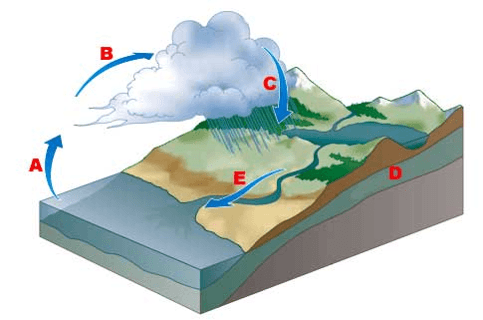
What is occurring at A in the diagram?
a)
runoff
b)
precipitation
c)
evaporation
d)
condensation
30.
About ___ percent of Earth's surface is covered byoceans and seas.
a)
67
b)
70
c)
55
d)
78
31.
What process is happening at C in the diagram?
a)
runoff
b)
precipitation
c)
condensation
d)
transpiration
32.
An opening in earth's crust from which lava flows.
a)
volcano
b)
trench
c)
mountain
33.
A thin natural waterway that allows water to flow into a lake or ocean.
a)
river
b)
island
c)
lake
34.
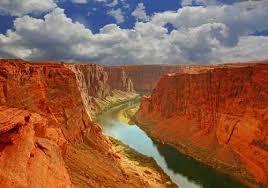
What process created this V-shaped valley?
a)
Erosion due to a river
b)
Erosion due to a glacier
c)
Weathering due to a river
d)
Weathering due to wind
35.
The process of breaking up rocks on Earth's surface is called...
a)
sediment
b)
erosion
c)
weathering
d)
deposition 
36.
wind erosion forms what type of landform?
a)
meander
b)
drumlin
c)
sand dune
d)
sand bar
37.
What is sediment?
a)
the process of rocks being broken down and carried away
b)
bits of rock, sand, and silt caused by the weathering of rocks
c)
the top layer of the soil
d)
decaying plant or animal material 
38.
Rain washing away soil from a hillside
a)
Weathering
b)
Erosion
c)
Deposition
39.

Which features are lowland areas between higher areas such as mountains?

a)

Plateaus

b)

Canyons

c)

Valleys

d)

Caverns

40.

What are openings in the Earth's surface from which lava flows?

a)

Glaciers

b)

Volcanoes

c)

Mountains

d)

Gaps

41.

Which changes are rapid process changes?

a)

Landslides, floods, earthquakes

b)

Landslides, erosion, weathering

c)

Weathering, erosion, depostion

d)

Eruptions, earthquakes, deposition
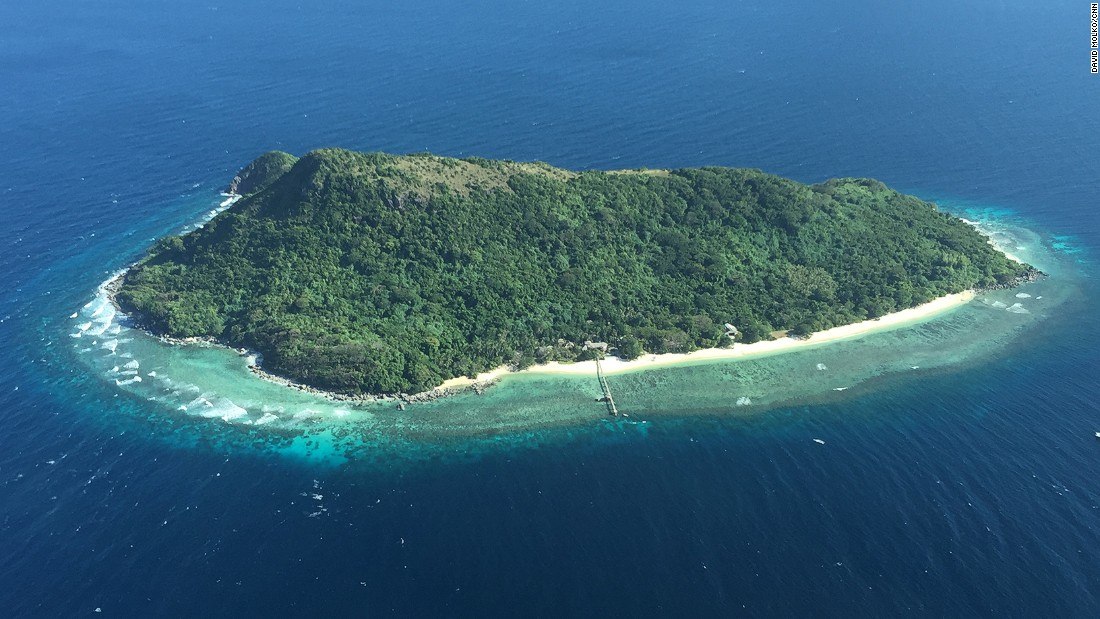
42.
What land form is this?
a)
valley
b)
canyon
c)
mountain
d)
plain
43.
What land form is this?
a)
valley
b)
plain
c)
volcano
d)
canyon
44.
What land form is this?
a)
plain
b)
valley
c)
mountain
d)
canyon
45.
What land form is this?
a)
valley
b)
canyon
c)
plain
d)
mountain
46.
What land form is this?
a)
island
b)
valley
c)
plain
d)
mountain
47.
What land form is this?
a)
valley
b)
plain
c)
volcano
d)
mountain
48.
Which of the following is a nonrenewable resource?
a)
water
b)
wind
c)
sunlight
d)
oil 
49.
Which of the following is a renewable resource?
a)
oil
b)
coal
c)
sunlight
d)
natural gas
50.

what is the minimum height of a mountain?

a)

2000 ft

b)

1023.5 ft

c)

5000 ft

d)

2500 ft

51.

Which of the following are land forms?

a)

lava

b)

valleys

c)

islands

d)

plains

e)

peninsulas

52.
What is magma called when it is above ground? 
a)
Lava
b)
Metamorphic Rock
c)
Convection Current
d)
Mountain
53.
The theory that the plates are moving is called the Theory of ......
a)
Pangea
b)
Plate Tectonics
c)
The Rock Cycle
d)
Fossils
54.
The continents were all part of one super continent called
a)
Europe 
b)
Asia 
c)
Africa
d)
Pangea
55.
The movement of the plates away from Pangea to where they are today is called 
a)
Convection 
b)
Continental Drift
c)
Subduction
d)
Earthquakes
56.
Movement of the Earth's crust can result in 
a)
Earthquakes
b)
Volcanoes
c)
Mountains
d)
All of the above
57.

The theory of continental drift was developed by ...

a)

Alfred Wegener

b)

Albert West

c)

Alfred Eisenhower

d)

Albert Wegener

58.

The collision of two continental plates results in

a)

ocean trenches

b)

mountain-building

c)

plate tectonics

d)

lava

59.

Earthquakes often occur when two ___________________ slide past eachother

a)

plates

b)

landforms

60.

Are the continents still moving?

a)

yes

b)

no

61.
Area of land completely surrounded by water.
a)
island
b)
peninsula
c)
volcano
62.
What forces change the earth's surface?
a)
Rain, ice, wind
b)
lightening, thunder, wind
c)
Ice, water, wind
d)
thunder, glaciers, water