
 Worksheets
LMS Science Homework #14
Total questions: 25
Worksheet time: 21mins
Name
Class
Date
1.
Which of the following properties uniquely identifies every element?
a)
Number of valence electrons
b)
Phase at room temperature
c)
Number of protons
d)
Charge of the atom
2.
An elements reactivity and other chemical properties are determined by the number of….
a)
isotopes it has.
b)
oxidation states
c)
orbitals in an atom.
d)
valence electrons
3.
Molybdenum has an atomic number of 42. This means that molybdenum...
a)
has a freezing point of 42 degrees Fahrenheit.
b)
belongs to Group 42 on the Periodic Table.
c)
Can form 42 bonds with other atoms.
d)
contains 42 protons in its nucleus.
4.
Which is the smallest subatomic particle with the least amount of mass?
a)
Proton
b)
Electron
c)
Neutron
5.
What group of elements are on the "staircase" of the periodic table of elements?
a)
Metals
b)
Nonmetals
c)
Metalloids
d)
Halogens
6.
Mass number =
a)
electrons + protons
b)
electrons + neutrons
c)
protons + neutrons
d)
protons + neutrons + electrons
7.
If an element has two energy levels (orbitals), what period is it in?
a)
1
b)
2
c)
3
d)
4
8.
Which subatomic particle(s) is/are found outside the nucleus?
a)
Protons only
b)
Electrons only
c)
Neutrons only
d)
Protons and Neutrons
9.
An atom of a certain element has 36 protons, 36 electrons, and a mass number of 84. At room temperature this element is a very stable gas. How many neutrons are in the atom?
a)
48
b)
36
c)
84
d)
-36
10.

a)
A
b)
B
c)
C
d)
D
11.
Which information could a student determine from only the chemical formula of a protein?
a)
The color of the protein
b)
The number of molecules in each sequence that makes up a protein
c)
The physical arrangement of atoms in the structure of the protein
d)
The number of atoms of each element in the protein
12.
When trying to identify an unknown element, a scientist determines what other elements the unknown element reacts with chemically. Which property of the unknown element determines the other elements it reacts with?
a)
The total number of neutrons in the unknown element
b)
The total number of particles in the nucleus of the unknown element
c)
The number of protons in the nucleus of the unknown element
d)
The number of valence electrons in the unknown element
13.
A scientist spilled a few drops of dilute hydrochloric acid (HCl) on a lab table. For safety purposes, the scientist sprinkled some baking soda (NaHCO3) onto the spill. Which observation would provide the best evidence that a chemical reaction occurred?
a)
The baking soda and hydrochloric acid combined, and bubbles formed
b)
The baking soda absorbed the hydrochloric acid.
c)
Some of the baking soda dissolved in the hydrochloric acid
d)
The hydrochloric acid evaporated, leaving only the baking soda.
14.

Which of these formulas contain equal numbers of nitrogen atoms?
a)
Formulas I and III
b)
Formulas I and IV
c)
Formulas II and III
d)
Formulas I, II, and V
15.

Aluminum, sulfur, and chlorine are elements found on the periodic table. Tests involving these three elements would show that at normal room temperature —
a)
sulfur is malleable and aluminum conducts electricity
b)
chlorine is malleable and conducts electricity
c)
aluminum is malleable and conducts electricity
d)
all three elements are malleable and conduct electricity
16.

Which of the fallowing is the correct energy transfer of a toaster?
a)
Radiation-thermal-electrical.
b)
Electrical-thermal-radiation.
c)
Thermal-electrical-radiation.
d)
Electrical-radiation-thermal.
17.

a)
A
b)
B
c)
C
d)
D
18.

Name the boundary
a)
convergent boundary
b)
divergent boundary
c)
transform boundary
d)
sergent boundary
19.
A subduction zone is
a)
a denser tectonic plate sinks below another
b)
at every type of convergent plate boundary
c)
at every type of divergent plate boundary
d)
at transform boundaries
20.

Which of Earth's layers is broken into several large tectonic plates?
a)
Asthenosphere
b)
Lithosphere
c)
Inner core
d)
Outer core
21.
Which of these statements is correct?
a)
Continental crust is thicker than oceanic crust
b)
Continental crust is thinner than oceanic crust
c)
Continental crust is smaller than oceanic crust
d)
Continental crust is more dense than oceanic crust
22.

What is represented by the picture?
a)
Sea-floor spreading
b)
Pangea
c)
How the continents are arranged today
d)
Volcanoes
23.
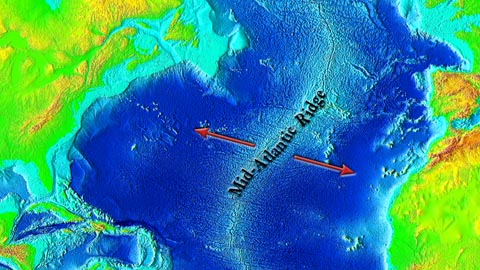
The image shows the Mid Atlantic Ridge. Which type of boundary occurs at this ridge where the ocean floor is spreading apart?
a)
convergent
b)
divergent
c)
transform fault
d)
compression
24.

What is the contour interval?
a)
500 ft
b)
100 ft
c)
50 ft
d)
20 ft
25.
What is the elevation gain from point A to point X?
a)
500 ft
b)
100 ft
c)
50 ft
d)
700 ft
100 %

