

Wayground logo

Free Printable Worksheets

Font size

S
M
L
XL
Worksheets

Chemical reactions

Total questions: 20

Worksheet time: 15mins
Name
Class
Date
1.
In a chemical equation, is it true that -
a)
the reactant side and product side can have different numbers of atoms for each element
b)
there can be different elements on the reactant side and the product side
c)
an element or compound must be accompanied by a phase change
d)
the coefficients indicate the number of molecules of each reactant used and the number of molecules of each product made
2.
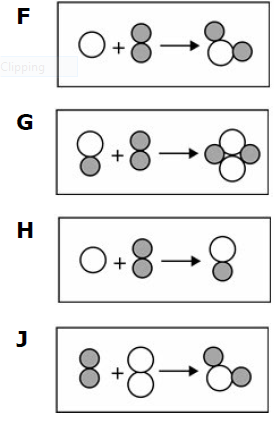
Which of the following models best demonstrates a balanced chemical equation?
a)
F
b)
G
c)
H
d)
J
3.
Which of the following equations demonstrates an actual chemical reaction that forms a new substance?
a)
A
b)
B
c)
C
d)
D
4.
Which of these formulas contain equal numbers of nitrogen atoms?
a)
Formulas I and III
b)
Formulas I and IV
c)
Formulas II and III
d)
Formulas I, II, and V
5.
The reactants are on the left side of the chemical equation.
a)
True
b)
False
6.
In which of these compounds are there twice as many oxygen atoms as hydrogen atoms?
a)
H3PO4
b)
H2SO4
c)
HCIO3
d)
H20
7.
When a scientist mixed two chemicals, an exothermic reaction takes place. Which of the following would be proof that the reaction was exothermic?
a)
a change of color
b)
a change of state
c)
a temperature decrease
d)
a temperature increase
8.
What types of reactions absorb and release heat?
a)
acidic and basic
b)
endothermic and exothermic
c)
endothermic and heat transfusion
d)
covalent and ionic
9.
In the reaction methane + oxygen turns into carbon dioxide + water, the methane and oxygen are called _______________.
a)
reactants
b)
products
c)
neutrals
d)
energizers
10.
If you combine two substances in a beaker at room temperature and the beaker feels cold to the touch, it means that the substances:
a)
have not reacted with each other
b)
have undergone an endothermic reaction
c)
have undergone a physical change
d)
have undergone an exothermic reaction
11.
In any chemical reaction, the mass of the products is always:
a)
slightly less than the mass of the reactants
b)
much less than the mass of the reactants
c)
the same as the mass of the reactants
d)
greater than the mass of the reactants
12.

Another word for a combustion reaction is....

a)

a combination reaction

b)

burning

c)

freezing

d)

decomposition

13.

In a precipitation reaction, 2 liquids are mixed together to form a ___________

a)

solution

b)

mixture

c)

solid

d)

gas

14.

Which of the following reactions best describes the general form of a decomposition reaction?

a)

A + B --> C + D

b)

A + B --> C

c)

A --> C + D

15.

In a combination reaction

a)

lots of reactions happen at once

b)

one substance breaks down to make 2 new substances

c)

2 substances combine to make one

d)

a gas is always made

16.

A precipitate is...

a)

a gas

b)

a liquid

c)

a solid

d)

a solution

17.

Rusting is an example of

a)

corrosion

b)

neutralisation

18.

Select the reactions which represent decomposition reactions:

a)

2KClO3 --> 2KCl + 3O2

b)

Fe + S --> FeS

c)

2H2 + O2 --> 2H2O2

d)

2H2O2 --> 2H2 + O2

19.

Select the reactions which represent combination reactions:

a)

2KClO3 --> 2KCl + 3O2

b)

Fe + S --> FeS

c)

2H2 + O2 --> 2H2O2

d)

2H2O2 --> 2H2 + O2

20.

What coefficients (big numbers in front!) need to be added into this combustion equation to balance it:


C3H8 + _____O2 -->_____ CO2 + _____H2O


The numbers in the answer are in the order they would be put into the equation.

a)

5, 4, 3

b)

5, 3, 4

c)

4, 3, 5

d)

5, 5, 5
