wayground logo

Free Printable Worksheets

Font size

S
M
L
XL
Worksheets

Social Studies Review

Total questions: 108

Worksheet time: 2hrs 46mins

Name
Class
Date
1.
The main reason for the Spanish - American War was control over the country of _______.
a)
Cuba
b)
Puerto Rico
c)
Haiti
d)
Jamaica
2.

Spain ended up sinking which US boat leading to the Spanish-American War?

a)

USS Maine

b)

USS Delaware

c)

Lusitania

d)

Titanic

3.
The reason for high cattle prices in the East was___________.
a)
low demand
b)
high supply
c)
high demand
4.
The reason cattle were cheap in Texas was because of ______________.
a)
high supply
b)
low supply
c)
high demand
5.
The first cattle trail was_____________.
a)
The Chisholm Trail
b)
The Great Western Trail
c)
The Texan Trail
6.
The Panama Canal connects which two bodies of water?
a)
Atlantic/Indian
b)
Pacific/Atlantic
c)
Pacific/Indian
d)
Atlantic/Artic
7.

The United States built the Panama Canal to get a quick ocean route from

a)

the east to the west

b)

the north to the south

c)

North America to South America

d)

the east to the south

8.
Which is a reason people came to America?
a)
Baseball
b)
Colleges
c)
Job opportunities
d)
Vacation
9.
He invented the telephone in 1876 in Boston, Massachusetts
a)
Thomas Edison
b)
Alexander Graham Bell
c)
George Washington Carver
d)
The Wright Brothers
10.
He invented the electric light bulb in 1879 at his laboratory in New Jersey called Menlo Park.
a)
Thomas Edison
b)
Alexander Graham Bell
c)
George Washington Carver
d)
The Wright Brothers
11.
Who invented the first airplane that could successfully hold a human and an engine in 1903.
a)
Alexander Graham Bell
b)
Thomas Edison
c)
George Washington Carver
d)
The Wright Brothers
12.
How did Alexander Graham Bell change the world?
a)
He helped Southern Farmers live a better life
b)
He made it a lot easier for people to travel
c)
He made it  easier for people to communicate
d)
He made it easier to work at night and increased the amount of work that a person could do in a day.
13.
How did Thomas Edison change the world?
a)
He made it easier to work at night and increased the amount of work that a person could do in a day
b)
He made it a lot easier for people to communicate
c)
He made it a lot easier for people to travel.
d)
He helped southern farmers live a better life
14.
Where was the first flight
a)
Kitty Hawk, North Carolina
b)
Fort Sumter, South Carolina
c)
Charlotte, North Carolina
d)
Charleston, South Carolina
15.
Who was the African American scientist who created more than 300 products from peanuts and sweet potatoes?
a)
The Wright Brothers
b)
Alexander Graham Bell
c)
George Washington Carver
d)
Thomas Edison
16.

Which of the following countries was NOT an Allied Power in World War 1?

a)

Germany and Italy

b)

the United States and France

c)

Britain and France

d)

Germany and Austria-Hungary

17.
9)  WWI began when Austria-Hungary declared war on Serbia one month after:
a)
Serbia tried to take more of Austria-Hungary's land.
b)
Serbia burned their flag.
c)
Archduke Ferdinand and his wife were killed.
d)
Serbia won more Olympic medals.
18.
Which of Woodrow Wilson's proposals was included in the Treaty of Versailles?
a)
the League of Nations
b)
reparations from Germany
c)
removal of all trade barriers
d)
restoration of the Russian monarchy
19.
According to Woodrow Wilson, the purpose of the League of Nations was
a)
to remove threat of future wars.
b)
to prevent nuclear proliferation.
c)
to help the US gain more territories.
d)
to help promote prohibition in other countries.
20.
On May 7, 1915, a German submarine torpedoed and sank
a)
the Maine
b)
The Titanic
c)
The Lusitania
d)
The Queen Mary
21.

What action on November 11, 1918, brought World War I to an end?

a)

An armistice was signed

b)

A surrender was given

c)

A propaganda campaign was waged.

d)

The allies won a major battle.

22.
Which of these is a type of fighting used in World War One?
a)
Trench Warfare
b)
Atomic Bomb
c)
Guerilla Warfare
d)
No-Man's Land
23.
What was the Zimmerman Note?
a)
The German policy of attacking all ships entering or leaving Britain
b)
Wilson's speech concerning why the U.S  should enter WWI
c)
A proposal by Germany that Mexico attack the US in return for territory
d)
a note left behind by a Serbian Nationalist in Austria-Hungary
24.
What is the nickname for the decade where the U.S. economy thrived before the Great Depression? 
a)
Dirty 30s
b)
Boring 40s
c)
Roaring 20s
d)
Fantastic 50s 
25.
Which area in the United States was known as the "Dust Bowl"
a)
southeast
b)
midwest
c)
northwest
d)
northeast
26.
What was the date of the stock market crash?
a)
10/29/1929
b)
2/17/1919
c)
10/10/1910
d)
10/19/1929
27.
What is the nickname given to the stock market crash?
a)
black friday
b)
red tuesday
c)
black tuesday
d)
red friday  
28.
Who was the President of the United States when the Great Depression started? 
a)
Franklin D. Roosevelt
b)
Harry S. Truman
c)
Dwight D. Eisenhower
d)
Herbert Hoover 
29.
Which New Deal program employed young men to work on various projects to improve the country?
a)
Social Security Act
b)
Fair labor Standards Act
c)
Rural Electrification Act
d)
Civilian Conservation Corps
30.
Who ruled as a dictator and leader of the Nazi party and wanted to build a powerful military and make his country a strong nation?
a)
Hitler
b)
Mussolini
c)
Stalin
31.
Who did Hitler blame for most of the Germany's problems?
a)
Americans
b)
Christians
c)
Muslims
d)
Jews
32.
Which 3 countries made up the Axis Powers?
a)
American, England, and Russia
b)
Sweden, Germany, and Denmark
c)
Italy, Russia, and Austria
d)
Italy, Germany, and Japan
33.
Who was the prime minister of England?
a)
Roosevelt
b)
Churchill
c)
Hitler
d)
Truman
34.
Why did Japan decide to attack the United States?
a)
They wanted to claim Hawaii.
b)
They didn't like FDR.
c)
The USA helped China defend itself.
d)
Japan knew only the US Navy was strong enough to stop them.
35.
When was Pearl Harbor attacked?
a)
December 7, 1941
b)
September 1, 1939
c)
October 31, 1941
d)
December 25, 1941
36.
Who ruled as a dictator in Italy?
a)
Hitler
b)
Stalin
c)
Mussolini
37.
World War 2 helped America come out of _________________ by providing jobs for people. 
a)
The Cold War
b)
The Dust Bowl
c)
The Great Depression
38.
What was the end date of the war in Europe?
a)
V-E Day
b)
V-J Day
c)
V-8 day 
d)
VH 1 day
39.
Victory in Europe (V-E Day) was a result of ________________.
a)
Japan surrendering
b)
The atomic bombings
c)
Germany surrendering
d)
the signing of the Treaty of Versailles
40.
What did allied forces do on D-Day, June 6, 1944?
a)
They sent thousands of troops to Berlin.
b)
They stormed the beaches of Normandy, France.
c)
The fought the Nazi troops in Russia.
d)
They took control of many Japanese islands.
41.
Which WWII leader declared war on Germany and Japan, and was loved by many Americans for the programs he developed ?
a)
Winston Churchill
b)
Franklin D. Roosevelt
c)
Harry S. Truman
d)
Adolf Hitler
42.
Which famous WWII leader was the dictator of the  Soviet Union that had an alliance with Germany at the beginning of the war but later joined forces with the allied powers.
a)
Benito Mussolini
b)
Adolf Hitler
c)
Winston Churchill
d)
Joseph Stalin
43.
Who was Rosie the  Riveter?
a)
The first woman to work in a factory during WWII
b)
a representation of American women that went to work during WWII
c)
A pretty girl used for make-up advertisements
d)
A famous pilot
44.
What two nations were in competition with each other during the Cold War?
a)
Spain and Portugal
b)
England and France
c)
Germany and Italy
d)
United States and Soviet Union
45.

What was the term 'iron curtain' used to describe the division of?

a)

North and South Vietnam

b)

East and West Asia

c)

North and South Korea

d)

East and West Europe

46.
Why was the United States involved in the Berlin Airlift?
a)
to airlift food to the people of West Berlin
b)
to bomb East Berlin
c)
to demolish the Berlin Wall
d)
to transport people out of East Berlin
47.
Why did the United States become involved in the Korean War?
a)
to contain communism
b)
to colonize Korea
c)
to spread communism
d)
to Christianize Koreans
48.
In 1950, Korea fought a civil war over the spread of communism.  Communists from the north tried to take over the south.  What role did he US play in this war?
a)
The US and its allies went to Vietnam to fight Korean Communists.
b)
The US and its allies join the fight to keep communism from spreading.
c)
The US and its allies did not join the Korean War.
d)
The US and its allies fought to defend the North.
49.
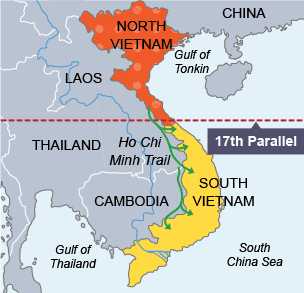
In the 1950s, the United States became involved in the Vietnam War. Why did the United States become involved in this war?
a)
to prevent the collapse of the government of North Vietnam
b)
to stop Vietnam from taking over Hong Kong
c)
to stop the spread of communism to South Vietnam
d)
to prevent attacks against United States shipping
50.
What was the name of the first satellite in space launched by the Soviet Union?
a)
Gagarin
b)
Apollo 11
c)
Sputnik
d)
Apollo 13
51.
What is the purpose of N.A.T.O?
a)
Countries joining together to end democracy
b)
Countries joining together to stop trade between the East and West
c)
Countries joining together to fend off attacks by other communist countries
d)
Countries joining together to create one kind of currency (S)
52.
Who was the Senator who started rumors of the Red Scare?
a)
John F. Kennedy
b)
Joseph Stalin
c)
Neil Armstrong
d)
Joseph McCarthy
53.
Why did the U.S. want the Soviet Union to remove its nuclear weapons from Cuba?
a)
It wanted to protect Cuba from communism
b)
Cuba is close to the U.S. border
c)
It was protecting nearby countries in Central America
d)
The U.S. did not have any missiles of its own
54.
Which U.S. President challenged America to be the first to put a man on the moon?
a)
Franklin D. Roosevelt
b)
Joseph Stalin
c)
John F. Kennedy
d)
Harry S. Truman
55.
What action caused the Cuban Missile Crisis?
a)
The Soviet Union placed missiles in Cuba that could be used against the U.S.
b)
The U.S. placed missiles in Cuba to be used again the Soviet Union
56.
What important entertainment industry influenced Americans the most in the 1950's and 1960's?
a)
Internet
b)
Newspapers
c)
Movies
d)
Television
57.

What did the Voting Rights Act of 1965 outlaw?

a)

allowing people under the age of 21 to vote

b)

denying the right to vote based on race or color

c)

allowing people to vote multiple times

d)

denying the right to vote based on gender

58.

Outlawed racial discrimination in employment

• Got rid of the "Jim Crow" laws in the South

• Racial segregation in schools and housing was made illegal


The list above best describes which of these laws

a)

the Civil Rights Act of 1964

b)

the Nineteenth Amendment

c)

Montgomery Bus Boycott

d)

the Fourteenth Amendment

59.

Brown v. Board of Education was a famous case heard by the United States Supreme Court in 1954. The court ruled that it is illegal to

a)

allow children to work long hours in factories.

b)

return an escaped slave to his or her master.

c)

have segregated schools based on people's skin color.

d)

pay black people less than white people for similar work.

60.

Rosa Parks was arrested in December of 1955 on a bus in Montgomery, Alabama. She would not give up her seat to a white passenger. Her action started a year-long civil rights protest in Alabama. That protest was called the

a)

Civil Rights Act of 1964

b)

March on Washington

c)

Brown v. Board of Education

d)

Montgomery Bus Boycott.

61.

Identify an event for which Martin Luther King, Jr. is most well-known.

a)

not giving up his seat on a bus to a white person

b)

leading a march on Washington D.C. for civil rights

c)

writing and reciting the Emancipation Proclamation

d)

creating Jim Crow laws that were used in the South

62.

Which important leader from the 1960s was assassinated in 1968 while running for president?

a)

Robert F. Kennedy

b)

Martin Luther King, Jr.

c)

Richard Nixon

d)

John F. Kennedy

63.

In 1954, the Supreme Court outlawed segregated schools at the state level. In this decision, which of these policies was illegal?

a)

preventing people from protesting against laws they feel are unjust

b)

having “separate but equal” schools for blacks and whites

c)

making people pay taxes if they were below the poverty level

d)

requiring that U.S. Presidents must have been born in the United States

64.

Which of the following is a fact that tells why Apple is important to the history of computers?

a)

It built the first computer to use MS-DOS.

b)

It invented the internet.

c)

It built the first digital computer.

d)

It invented the first personal computer.

65.

The use of terrorism has become more common around the world. What is the purpose of using terrorism?

a)

to control people with fear

b)

to work together toward peace

c)

to start wars

d)

to help people in poor countries.

66.

Which of the following events is an example of terrorism?

a)

the breakup of the Soviet Union

b)

the September 11 attacks

c)

the assassination of President Kennedy

d)

the Cuban Missile Crisis

67.
Who was the extremist responsible for 9/11?
a)
Kim Jong-il
b)
Saddam Hussein
c)
Adolf Hitler
d)
Osama bin Laden
68.
Who was president of the United States when the attacks occurred on September 11, 2001
a)
Barack Obama
b)
Jimmy Ford
c)
William Bill Clinton
d)
George W. Bush
69.
Who claimed responsibility for the attacks on September 11, 2001?
a)
Al-Qaeda
b)
Hamas
c)
Ku Klux Klan
d)
ISIS
70.
How many planes were hijacked on September 11, 2001?
a)
3
b)
4
c)
5
d)
6
71.

Why did the Cold War come to an end?

a)

The Soviet Union collapsed

b)

The United States collapsed

c)

Ronald Reagan was removed from office

d)

Mikhail Gorbachev was assassinated

72.

What was the most popular part of the Internet by 1995

a)

Micorsoft Windows

b)

AOL

c)

Google

d)

the World Wide Web

73.

Which two countries did the United States invade after the September 11th attacks

a)

Iraq & Afghanistan

b)

Afghanistan & Iran

c)

Iraq & Iran

d)

Iraq & Pakistan

74.
Texas cattle ranchers would move cattle along this route from Texas to Abilene, Kansas. 
a)
Kitty Hawk, NC
b)
Chisholm Trail
c)
Pearl Harbor, HI
d)
Chicago, IL
75.
The naval base where Japanese planes attacked in December 1941, bringing America into World War II.
a)
Pittsburgh, PA
b)
Montgomery, AL 
c)
Pearl Harbor, HI
d)
Chisholm Trali
76.
Where the Wright Brothers made the first airplane flight.
a)
Montgomery, AL
b)
Pittsburgh, PA
c)
Chicago, IL
d)
Kitty Hawk, NC
77.
This city was built where three major rivers(the Allegheny, Monongahela and Ohio) come together in a Y shape and became the center of steel production in the US.  
a)
Kitty Hawk, NC
b)
Pearl Harbor, HI
c)
Pittsburgh, PA
d)
Chicago, IL
78.
In 1960's, Rosa Parks was famous for being arrested here for not giving up her seat on a bus and later became the center for the Civil Rights Movement
a)
Montgomery, AL 
b)
Chicago, IL 
c)
Pearl Harbor, HI
d)
Kitty Hawk, NC
79.
This city has been the major city of the midwestern United States since the 1950's.
a)
Kitty Hawk, NC
b)
Pittsburgh, PA
c)
Montgomery, AL
d)
Chicago, IL
80.

The Harlem Renaissance can best be described as

a)

an organization created to help promote African-American businesses

b)

a period of great achievement by African American writers, artists, and performers

c)

a movement that sought to draw people back to the inner cities

d)

a relief program to provide jobs for minority workers

81.
A great jazz musician who helped the 1920s become known as the "Jazz Age"
a)
Henry Ford
b)
Babe Ruth
c)
Louis Armstrong
d)
Langston Hughes
82.
One of the greatest baseball players of all time, who helped professional sports become popular. 
a)
Babe Ruth
b)
Woodrow Wilson
c)
Charles Lindbergh
d)
Henry Ford
83.
A great aviator who became the first person to fly across the Atlantic Ocean by himself.
a)
Langston  Hughes
b)
Woodrow Wilson
c)
Henry Ford
d)
Charles Lindbergh
84.
Began mass production of his automobiles using the assembly line, making them affordable for average Americans.
a)
Charles Lindbergh
b)
Henry Ford
c)
Langston Hughes
d)
George Ford
85.
Famous African American poet who lived in Harlem and was a part of the Harlem Renaissance
a)
Louis Armstrong
b)
Langston Hughes
c)
Charles Lindbergh
d)
Woodrow Wilson
86.
What was the purpose of the 19th Amendment?
a)
End slavery
b)
Allowed women to have the right to vote
c)
Allowed former slaves to have the right to vote
d)
It changed the legal working age
87.
Which is an example of specialization during the 1920s?
a)
Henry Ford making the assembly line.
b)
Charles Lindbergh specialized in aviation and made the first solo flight across the Atlantic. 
c)
Langston Hughes specialized  in writing poetry. 
d)
Louis Armstrong  specialized in Jazz music.
88.
Many new businesses started during the 1920s and began selling new products.  How did this competition affect the economy?
a)
Businesses did not compete during  the 1920s.
b)
People became confused and stopped buying  things.
c)
Competing businesses found ways to lower their prices.
d)
Competing businesses had to raise their prices.
89.
What was an effect of the New Deal?
a)
International trade declined
b)
Government became responsible for the poor
c)
Women entered the workforce for the first time
d)
New monopolies formed
90.
Which of the following people were known for their musical talent? 
a)
John Steinbeck 
b)
Duke Ellington
91.
What were the 3 main programs President Roosevelt established to help reconstruct the U.S. economy?
a)
WPA, CCC, TAV
b)
CCC, TVA, WPA
c)
WAP, COP, WWW
d)
TVA, WPA, UGA
92.
Who was the African American athlete who won 4 gold medals at the 1936 Olympics?
a)
Barack Obama
b)
Duke Ellington
c)
Usain Bolt
d)
Jesse Owens
93.

This was a major reason for dropping the atomic bomb on Japan

a)

promote US Isolationism

b)

destroy Japan's industrial centers and save American lives

c)

Scare Hitler

94.

What was the purpose of rationing?

a)

increase supply of natural resources

b)

cause a shortage of crops

c)

provide supplies to the troops

95.
This amendment granted African American men the right to vote (1870) (USH.9A)
a)
13th
b)
14th
c)
15th
d)
5th
96.
Due Process is extended to every U.S. Citizen.
a)
True
b)
False
97.

The 24th Amendment...

a)

gave women the right to vote.

b)

eliminated the use of literacy tests.

c)

outlawed poll taxes.

d)

allowed for the popular election of US Senators.

98.
This act was passed to protect voting rights of African Americans; intended to prevent obstructions to voting for African American voters, such as paying a poll tax or taking a literacy test in order to be eligible to vote; ensured rights granted in the Fifteenth Amendment (USH. 9F)
a)
Civil Rights Act 1957
b)
Civil Rights Act 1964
c)
Executive Order 1948
d)
Voting Rights Act 1965
99.
Thurgood Marshall became _______.
a)
a president of the United States.
b)
a principal in a school who fought racism.
c)
the first African American on the Supreme Court.
d)
one of the authors of the constitution.
100.
 Martin Luther King Jr gave the famous “I Have A Dream” speech at what event?
a)
Freedom Rides
b)
Montgomery Bus Boycott
c)
March on Washington
d)
March from  Selma to Montgomery
101.
Martin Luther King, Jr., and Rosa Parks were part of what movement in the 1950s and 1960s?
a)
Anti-Immigration Movement
b)
Free Silver Movement
c)
Urban Renewal Movement
d)
Civil  Rights Movement
102.
This U.S. president was president during the Cuban Missile Crisis and supported the Civil Rights Movement. He was also assassinated for his support. 
a)
John F. Kennedy
b)
Robert F. Kennedy
c)
MLK
d)
FDR
103.
This law banned discrimination of any American because of race, gender,  or religion. 
a)
Voting Rights Act
b)
Civil Rights Act
c)
15th  Amendment
d)
Civil Rights Movement
104.
Who was responsible for the Cuban Missile Crisis?
a)
JFK
b)
FDR
c)
Nikita Khrushchev
d)
Joseph Stalin
105.

Farm worker, labor leader, and civil-rights activist who helped form the National Farm Workers Association, later the United Farm Workers.

a)

MLK

b)

Thurgood Marshall

c)

Cesar Chavez

d)

JFK

106.

26th Amendment

a)

Lowered the voting age from 21 to 17

b)

Lowered the voting age from 21 to 19

c)

Lowered the voting age from 21 to 20

d)

Lowered the voting age from 21 to 18

107.
An entrepreneur is someone 
a)
Someone who works for a new business
b)
Someone who starts a new business
c)
Someone who takes over an existing business
d)
Someone who does not want to work
108.
What is a good reason to save money?
a)
To have money to buy things
b)
To have money put aside for emergencies
c)
For a future purchase
d)
All choices