wayground logo

Free Printable Worksheets

NEW

Font size

S
M
L
XL
Worksheets

The Water Cycle

Total questions: 30

Worksheet time: 34mins

Name
Class
Date
1.
What is the water cycle?
a)
the 3 forms of water
b)
the movement of water on, above, or below the surface of the Earth
c)
when water melts
d)
when clouds form
2.
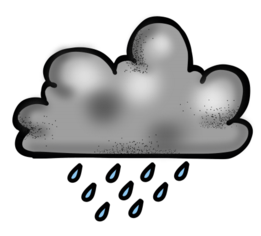
What part of the water cycle does this picture show?
a)
condensation
b)
precipitation
c)
evaporation
3.
Which is the opposite of condensation?
a)
runoff
b)
evaporation
c)
precipitation
d)
transpiration
4.
Which best explains why runoff is important?
a)
It returns water to other locations on Earth
b)
It increases the chance of flooding
c)
It makes evaporation occur faster
d)
It increases condensation
5.
What follows evaporation during the water cycle? How does this occur?
a)
Water evaporates into water vapor
b)
Water vapor condenses and forms a  cloud
c)
Water precipitates to the ground
d)
Water runs down into the hydrosphere
6.
What is it called when plants give off water vapor as a waste product?
a)
condensation
b)
evaporation
c)
sublimation
d)
transpiration
7.
When water _________, dew forms.
a)
Melts
b)
Evaporates
c)
Condenses
d)
Precipitates
8.
What is the energy source for the water cycle?
a)
the sun
b)
the earth
c)
water
d)
the moon
9.
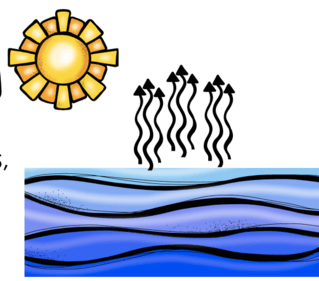
What part of the water cycle does this picture show?
a)
condensation
b)
precipitation
c)
evaporation
10.
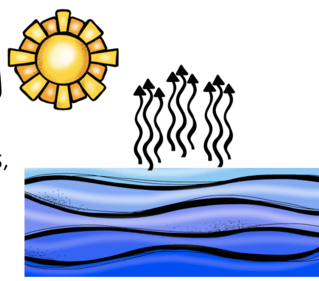
What part of the water cycle does this picture show?
a)
condensation
b)
precipitation
c)
evaporation
11.
What is evaporation?
a)

The part of the water cycle when the sun heats up water particles giving them enough energy to break the attraction and go into the air as water vapor.

b)

The part of the water cycle when the water vapor in the air gets cold. The water particles lose enough enough energy to gain attraction, stick together & become water droplets.

c)
The part of the water cycle when clouds get heavy and can no longer hold the liquid water. This causes the water to fall from the sky to the earth as rain, snow, sleet, or hail.
12.
What is condensation?
a)

The part of the water cycle when the water on the ground absorbs energy from the sun. The particles gain enough kinetic energy to break the attraction and go into the air as water vaport.

b)

The part of the water cycle when the water vapor in the air gets cold, loses enough kinetic energy to gain attraction & stick together forming water droplets.

c)
The part of the water cycle when clouds get heavy and can no longer hold the liquid water. This causes the water to fall from the sky to the earth as rain, snow, sleet, or hail.
13.
What is precipitation?
a)
The part of the water cycle when the sun heats up water, turning it from a liquid into water vapor or steam. It rises from the ground into the air.
b)
The part of the water cycle when the water vapor in the air gets cold. The water turns back into a liquid and forms clouds.
c)

The part of the water cycle when the force of gravity in the clouds is stronger than the force of updraft. This causes the water to fall from the sky to the earth as rain, snow, sleet, or hail.

14.

When water condenses, the water vapor in the air ________ energy, becomes ________ attracted and changes back into liquid.

a)

loses, less

b)

gains, less

c)

loses, more

d)

gains, more

15.
When water condenses, the liquid water forms ______________.
a)
water vapor
b)
steam
c)
air
d)
clouds
16.
Precipitation happens when clouds of water droplets are too ______________.
a)
cold
b)
light
c)
heavy
d)
hot
17.
Evaporation happens when the sun ___________ water and turns it into vapor.
a)
cools
b)
heats up
c)
freezes
d)
lights up
18.
Which stage does ground water try to return to the ocean or soak into the ground?
a)
condensation
b)
evaporation
c)
precipitation
d)
run off
19.
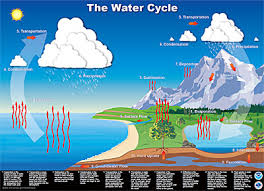
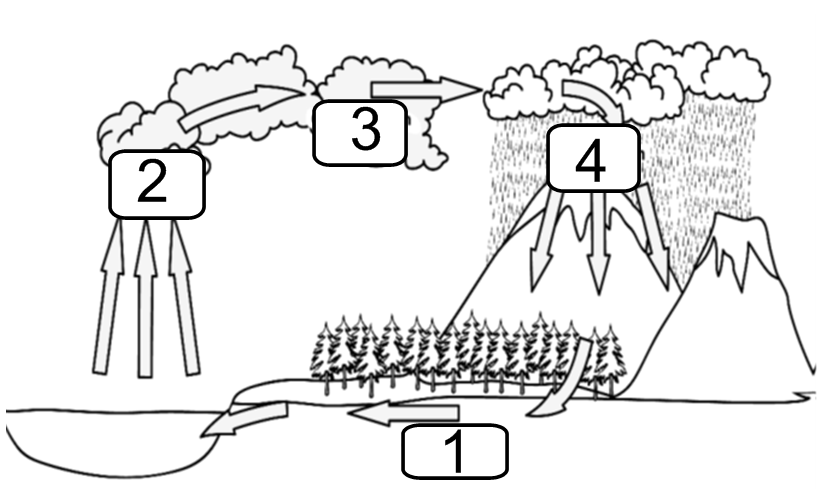
Which stage does the #2 show in the diagram?
a)
condensation
b)
evaporation
c)
precipitation
d)
run off
20.
Which stage does the #3 show in the diagram?
a)
condensation
b)
evaporation
c)
precipitation
d)
run off
21.
what does the #4 show in the diagram?
a)
condensation
b)
evaporation
c)
precipitation
d)
run off
22.
Rain soaks into the ground
a)
Infiltration
b)
Condensation
c)
Throughflow
d)
Surface runoff
23.
What is the definition of sublimation?
a)
a chemical process where a solid turns into a gas without going through a liquid stage
b)
the process of a liquid changing into a gas
24.
What is an example of sublimation?
a)
Ice cream melting
b)
Dry ice
25.

For condensation to occur, the warm water vapor must...

a)

melt

b)

cool

c)

get hotter

26.

What part of the water cycle takes place when water vapor sticks to particles in the air and forms clouds?

a)

Precipitation

b)

Evaporation

c)

Condensation

d)

Water accumulation

27.

T/F: The water cycle is driven by energy from the sun and the force of gravity.

a)

True

b)

False

28.

Evaporation is driven by which force?

a)

The sun

b)

Gravity

29.

Precipitation is driven by which force?

a)

The sun

b)

Gravity

30.
The process by which water on the ground surface enters the soil.
a)
Infiltration
b)
Groundwater
c)
Transpiration
d)
Evaporation