wayground logo

Free Printable Worksheets

Font size

S
M
L
XL
Worksheets

8th grade review

Total questions: 100

Worksheet time: 2hrs 31mins

Name
Class
Date
1.
What is a substance that is made of only one type of atom?
a)
proton
b)
compound
c)
water
d)
element
2.
How can you determine the identity of an atom?
a)
count the protons
b)
count the neutrons
c)
add the number of protons and neutrons together
d)
add the number of electrons and protons together
3.
What particle of an atom carries a positive electrical charge?
a)
neutron
b)
nucleus
c)
proton
d)
electron
4.
When two hydrogen atoms and one oxygen atom chemically combine, they produce water.  What is water?
a)
a compound
b)
an element
c)
a mixture
d)
a solution
5.
Which of the following is the best example of a physical change?
a)
closing a door
b)
breaking an egg
c)
tying your shoe
d)
putting coffee beans into a cupboard
6.
Jonathan cooked an egg for breakfast.  He cracked it and put it in a bowl and beat it with a fork.  Then he cooked it and put it on a plate.  Which of the following involves a chemical change to the egg?
a)
beating the egg
b)
cracking the egg
c)
cutting the egg
d)
cooking the egg
7.
Which of the following describes a chemical change?
a)
making ice cubes in a freezer
b)
cutting a carrot
c)
stirring salt into water
d)
combining baking soda with vinegar
8.
Why does a football expand when left in the hot sun?
a)
Heat energy is lost by the ball to its surroundings, causing it to take up a larger volume.
b)
The temperature decreases inside the ball, so it contracts.
c)
The temperature increases so the attraction between particles gets stronger.
d)
The particles of gas inside the ball heat up, bounce off each other and spread farther apart.
9.
Jack wants to investigate whether running 20 miles causes a physical change to his tennis shoes.  Which of the following could he do to find out?
a)
Measure the distance he traveled in the shoes.
b)
Use a ruler to measure tread wear on the bottom of his shoes before and after he runs.
c)
Measure the temperature of his shoes when he is done.
d)
Take pictures before and after to see if his shoes change color.
10.
Two chemicals are placed in a flask and the opening is covered with a balloon.  After five minutes the balloon has inflated.  Which of the following is true?
a)
The balloon inflates because of a chemical reaction between the two substances
b)
Somebody must have blown air into the balloon
c)
Balloons always inflate when placed on a flask
d)
Balloons never inflate when placed on a flask so this is not true
11.
At the Hall of Fame Hot Air Balloon Festival, propane is burned to heat the air inside the balloon.  As the air is heated, the balloon expands and rises.  Which is true?
a)
propane burning is a physical change and the balloon filling is a physical change
b)
propane burning is a physical change and the balloon filling is a chemical change
c)
propane burning is a chemical change and the balloon filling is a physical change
d)
propane burning is a chemical change and the balloon filling is a chemical change
12.
Which of the following is a chemical change?
a)
icicle melting
b)
sharpening a pencil
c)
burning a log
d)
dissolving Kool-Aid in water
13.
When a solid changes to a liquid, what is NOT true?
a)
The kinetic energy of the molecules increases
b)
The average motion of the molecules increases
c)
The molecules form new bonds
d)
The molecules become less closely packed
14.
Five ml of baking soda,10 ml of calcium chloride, and a cup of water are placed in a baggie and sealed tightly.  The water tips over and starts a chemical reaction.  The bag inflates due to carbon dioxide bubbles being formed.  Which of the following is true?
a)
The mass of the bag system before the reaction is greater than the mass after the chemical reaction
b)
The mass of the bag before the reaction is less than the mass after the chemical reaction
c)
The mass of the bag systsem before the reaction is the same as the mass after the chemical reaction
d)
The two masses are not related
15.
Physical and chemical changes make changes to matter.  What is true about what occurs during these changes?
a)
A small amount of matter is destroyed
b)
A small amount of matter is created
c)
Matter is never created or destroyed
d)
Energy flows form the original substance to the new substance
16.
Which of the following is a chemical reaction?
a)
A broken egg stinks after sitting out for a few days
b)
Perfume has an odor
c)
You can smell gasoline when you remove the gas cap on a gas tank
d)
An unripe orange doesn't smell
17.
Which of the following describes an atom?
a)
Protons and neutrons grouped together randomly
b)
A nucleus of electrons and neutrons surrounded by protons
c)
Protons and neutrons surrounded by electrons
d)
Protons and electrons grouped together randomly
18.
How are elements and atoms related to each other?
a)
Elements are made up of many different types of atoms
b)
A molecule is the same as an atom
c)
An element is smaller than an atom
d)
An element is made of all the same type of atom
19.
How are elements and atoms related to each other?
a)
Elements are made up of many different types of atoms
b)
A molecule is the same as an atom
c)
An element is smaller than an atom
d)
An element is made of all the same type of atom
20.
The difference between an element and compound is...
a)
Elements are made of one type of atom and compounds have more than one
b)
Elements are made of many types of atoms and compounds are not
c)
Elements are made of one type of atom and compounds have exactly two
d)
Elements are made of many types of atoms and compounds are not made of any
21.
The nucleus of an atom is made of...
a)
neurons and synapses
b)
gluons and neutrinos
c)
muons and leptons
d)
neutrons and protons
22.
Mass is the amount of matter in an object and the weight of an object...
a)
depends on what it eats
b)
depends on the amount of time
c)
depends on the pull of gravity
d)
depends on the distance in space
23.
What evidence indicates that a chemical change occurs when sugar is burned?
a)
Sugar smokes and leaves black residue and water
b)
Sugar is crystalline and white
c)
Sugar dissolves in water
d)
Sugar is edible
24.
A chemical change occurs...
a)
when a substance melts in the sun
b)
when a substance changes into something completely different
c)
when a substance changes its shape
d)
when a substance undergoes an expected color change
25.
A chemical reaction occurs when...
a)
a substance looks strange
b)
the substance changes color
c)
a substance smells funny
d)
new substances are formed
26.
When a chemical reaction occurs in a closed system, the mass of the substances in the reaction...
a)
is the same before and after the reaction
b)
is different before and after the reaction
c)
is only different if a gas is produced
d)
cannot be measured
27.
Sounds waves travel as what type of waves?
a)
Longitudinal Waves
b)
Transverse Waves
c)
Mechanical Waves
d)
Both longitudinal and mechanical waves
28.
Electromagnetic (EM) or light waves travel as what type of waves
a)
Longitudinal Waves
b)
Transverse Waves
29.
What is the force that creates sound? 
a)
amplitude
b)
pitch
c)
frequency 
d)
vibration
30.
The speed of sound is affected by?
a)
temperature
b)
amount of energy
c)
material or medium
d)
temperature and material of medium
31.
Light travels 
a)
around objects
b)
in a straight line
32.
What causes the straw to appear broken?
a)
reflection of the straw. 
b)
reflection of the light. 
c)
refraction of the straw.
d)
refraction of the light. 
33.
If a ball of cheese is fired into frictionless space, the amount of force needed to keep it going equals
a)
twice the force with which it was fired
b)
the same amount of force with which it was fired
c)
1/2 the force with which it was fired
d)
zero, since no force is requires to keep it moving. 
34.
One object has twice as much mass as another object. The first object also has also twice as much...
a)
velocity
b)
gravitational acceleration
c)
inertia
d)
all of these
35.
What is the speed of an object that travels 20 meters in 4 seconds?
a)
80 m/s
b)
0.2 m/s
c)
5 m/s
d)
24 m/s
36.
If a 10 kilogram object accelerates suddenly at 15 m/s2, how much force was applied to the object?
a)
150 Newtons
b)
15 Newtons
c)
150 kilograms
d)
100 kilograms
37.
Which best explains why we are able to accelerate forward when starting to run?
a)
As one leg moves backward, it provides an equal and opposite force for the other foot to move forward.
b)
No acceleration takes place. Runners are always at a fixed velocity.
c)
The striking foot pushes backward against the ground. The friction with the ground provides an equal and opposite force forward.
d)
The runner's upper body quickly leans forward, causing the entire body to begin accelerating forward
38.
What law of motion does this picture represent 
a)
Newtons law of gravity 
b)
Newtons 1st law 
c)
Newtons 4th law
d)
Newtons 3rd law 
39.
What Newtons law does this picture represent
a)
Newtons 2nd law 
b)
Law of gravity 
c)
Newtons 1st law
d)
Newtons 5th law
40.
What is speed?
a)
how far you go
b)
how much distance is covered over a period of time
c)
how fast you accelerate
d)
the change in the location of a object
41.
What is velocity?
a)
the quickness of an object
b)
the location of an object
c)
acceleration
d)
speed in a specific direction
42.
An object that changes speed or direction or both (velocity) is said to be -
a)
accelerating
b)
speeding
43.
What does this graph represent?
a)
Constant Speed
b)
Acceleration
c)
Deacceleration
d)
Not moving
44.
What is the average speed of this object's trip?
Think about: the distance the object traveled away from its point of origin.
a)
0.42 m/s
b)
60 m/s
c)
12 m/s
d)
5 m/s
45.
What is happening to line D?
a)
Stationary
b)
Accelerating
c)
Constant fast speed; moving away from the starting position
d)
Slower steady speed; moving away from the starting position
46.
What is happening at E?
a)
Stationary
b)
Accelerating
c)
Fast steady speed; moving away from the starting position
d)
Steady speed; returning to start position
47.
What is happening at A?
a)
Stopped
b)
Accelerating
c)
Slower steady speed; moving away from the starting position
d)
Steady speed; returning to start position
48.
How much time did it take for an animal to run 20 miles if it ran at 10 miles/hour?
a)
2 hours
b)
200 hours
c)
0.5 hours
d)
30 hours
49.
Shona cycles at an average speed of 8km/h. How far has she traveled if she cycles for 4 hours?
a)
55km
b)
32km
c)
43km
d)
32miles
50.
The graph represents
a)
no motion
b)
Constant velocity
c)
Acceleration
d)
negative acceleration
51.
Find the velocity of a plane that traveled 3000 miles west in 5 hours.
a)
65 mph west
b)
6 mph west
c)
600 mph west
d)
6000 mph west 
52.
It took 3.5 hours for a train to travel the distance between two cities at a velocity of 120 miles/hr.  How many miles lie between the two cities? 
a)
34 miles 
b)
420 miles
c)
120 miles 
d)
360 miles 
53.
The roller coaster has the most kinetic energy at position-
a)
W
b)
X
c)
Y
d)
Z
54.
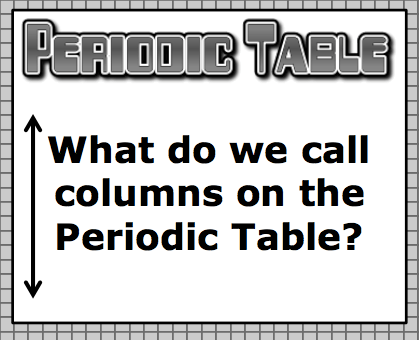
a)
Periods
b)
Groups
55.
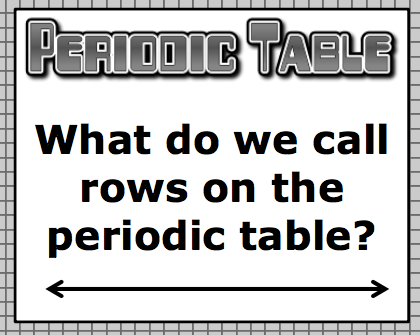
a)
Periods
b)
Groups
56.
The type of plate boundary where two plates come together is a .....
a)
Convergent Boundary
b)
Divergent Boundary
c)
Transform Boundary
d)
Plate Boundary
57.
Which of the following causes Earth's tectonic plates to move?
a)
Energy from the Sun
b)
Magnetic Pole Reversal
c)
Convection currents in the mantle
d)
Faults in Mountain Ranges
58.
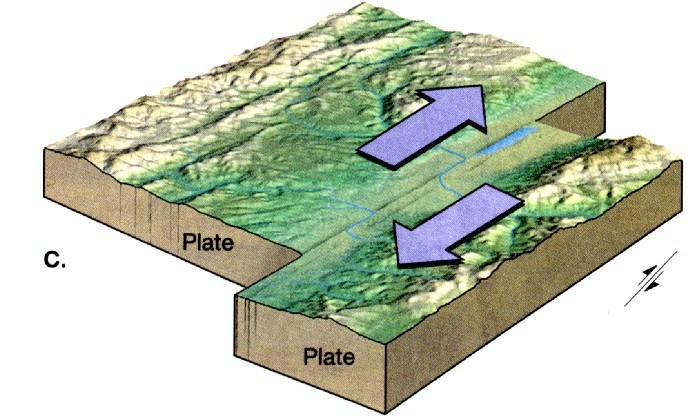
What type of plate boundary is this?
a)
Plate
b)
Divergent
c)
Convergent
d)
Transform
59.
What type of event will occur at this boundary?
a)
Earthquake
b)
Volcano Eruption
c)
Tornado
d)
Mountain Building
60.
A divergent boundary occurs when plates ....
a)
Pull apart
b)
Come together
c)
Slide past each other
d)
subducting
61.
Which of the following is the name of the ancient supercontinent formed 28 Million Years ago.
a)
Pangea
b)
Gondwanda
c)
Laurasia
d)
Neverland
62.
Which of the following is NOT evidence to support the theory of plate tectonics?
a)
Fossils
b)
Mountains
c)
Glaciers
d)
Sand Erosion
63.
What type of plate boundary is this?
a)
Transform
b)
Convergent
c)
Divergent
d)
Plate
64.
The theory that says Earth's continents once made up an ancient supercontinent, and have been drifting apart ever since, is called the theory of...
a)
Pangea
b)
Plate Tectonics
c)
Natural Selection
d)
Gravity
65.
Oceanic Trenches are formed by _______ plate boundaries
a)
Convergent
b)
Transform
c)
Plate
d)
Divergent
66.
A fault is formed by the movement of a __________ plate boundary
a)
Transform
b)
Convergent
c)
Divergent
67.
Islands can from from magma which is pushed up at a __________ plate boundary
a)
Divergent
b)
Convergent
c)
Transform
68.
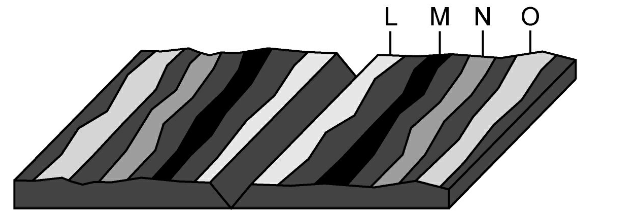
Where would the oldest rock be found?
a)
L
b)
M
c)
N
d)
O
69.
How is it possible for new crust to be formed without increasing the surface area of the Earth?
a)
Crust is destroyed at the same time it is created
b)
New crust is underwater where it sinks
c)
New crust breaks more easily than old crust
70.
Mountains are created when....
a)
Two continental plates collide
b)
Two oceanic plates pull apart
c)
An Oceanic plate subducts under a Continental Plate
d)
Two continental plates pull apart
71.
What is the outermost layer of earth?
a)
inner core
b)
outer core
c)
mantle
d)
crust
72.
Which layer is made of the most solid rock?
a)
inner core
b)
outer core
c)
mantle
d)
crust
73.
Which layer is made of solid iron & nickel?
a)
inner core
b)
outer core
c)
mantle
d)
crust
74.
What is the outer core made of?
a)
solid rock
b)
solid metal
c)
melted rock
d)
melted metal
75.
Which layer has the coolest temperatures?
a)
outer core
b)
inner core
c)
mantle
d)
crust
76.
Which layer has the hottest temperatures?
a)
inner core
b)
outer core
c)
mantle
d)
crust
77.
Which layer is the least dense?
a)
inner core
b)
outer core
c)
mantle
d)
crust
78.
Which statement is true about oceanic crust?
a)
It is made of melted rock.
b)
It is the thinner than continental crust.
c)
It is thicker than continental crust.
d)
It is made of liquid metal.
79.
Which layer causes the earth's magnetic field?
a)
inner core
b)
outer core
c)
mantle
d)
crust
80.
What is the lithosphere made of?
a)
the upper mantle
b)
the crust & part of upper mantle
c)
the crust and mantle
d)
the crust
81.
What kind of crust do we live on?
a)
oceanic crust
b)
continental crust
82.

Which layer is represented by the yellow layer?

a)

inner core

b)

outer core

c)

mantle

d)

crust

83.
Out of all the layers, which one would be the easiest for us to drill through?
a)
inner core
b)
outer core
c)
mantle
d)
crust
84.
Which statement is correct?
a)
As you move up through the layers, the pressure increases.
b)
As you move down through the layers pressure increases.
c)
As you move down through the layers, pressure decreases.
d)
As you move up down through the layers, pressure remains the same.
85.
What happens to temperature as you move down through the layers?
a)
it remains the same
b)
it increases then decreases
c)
it increases
d)
it decreases
86.

Low mass stars and high mass stars begin their life as...

a)

White dwarf

b)

Nebula

c)

Main sequence

d)

Red giant

87.

Low mass main sequence phase lasts how long?

a)

10 million years

b)

10 years

c)

10 billion years

d)

90 million years

88.

High mass stars have a long phase period.

a)

True

b)

False

89.

Low mass stars have a short main sequence phase.

a)

True

b)

False

90.

A high mass star has short main sequence that is (blank).

a)

90 billion years

b)

10 billion years

c)

100 million years

d)

90 million years

91.

What color is a high mass stars main sequence?

a)

Purple

b)

Yellow

c)

Orange

d)

Blue

92.

What color is a Low mass stars main sequence?

a)

orange

b)

yellow

c)

Blue

d)

Purple

93.

What are the 2 main gases that are found in the star phases?

a)

Hydrogen, Helium

b)

Hydrogen, Carbon

c)

Oxygen, Hydrogen

d)

Carbon, Oxygen

94.

What phase comes after a Red supergiant?

a)

Neutron Star

b)

Black hole

c)

Supernova

d)

Main sequence

95.

After the main sequence, the star has used up all of it's hydrogen and now fuses helium atoms. it gets bigger and becomes a.......

a)

Red supergiant

b)

high mass main sequence

c)

Red giant

d)

Nebula

96.

After all the helium is gone, a low mass star will collapse to become a.....

a)

New nebula

b)

Main Sequence

c)

White dwarf

d)

Red giant

97.

the star is fusing hydrogen atoms into helium, it takes about 10 billion years.

a)

High mass main sequence

b)

Low mass main sequence

c)

Neutron star

d)

White dwarf

98.

Clouds of gases in space

a)

Nebula

b)

White dwarf

c)

Low mass main sequence

d)

High mass main sequence

99.

Once the high mass star can no longer fuse atoms into new elements, it explodes in a ........

a)

Nebula

b)

supernova

c)

Black hole

d)

Neutron star

100.

After a supernova, high mass stars collapse into a.......

a)

black hole

b)

Neutron star

c)

Supernova

d)

Red supergiant