wayground logo

Free Printable Worksheets

NEW

Font size

S
M
L
XL
Worksheets

6th grade Review

Total questions: 65

Worksheet time: 48mins

Name
Class
Date
1.

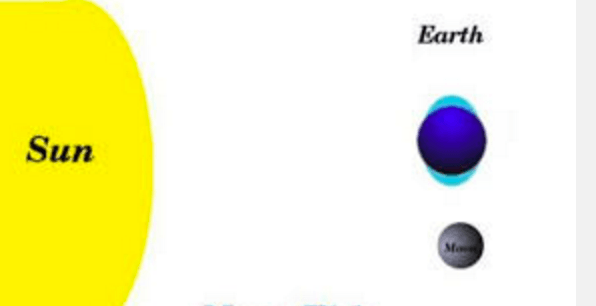
Wha type of tide would this arrangement of earth-moon-sun create?

a)

full moon tide

b)

new moon tide

c)

neap tide

d)

spring tide

2.
What type of tides would this arrangement of earth-moon-sun create?
a)
neap tide
b)
spring tide
c)
new moon tide
d)
full moon tide
3.
If tides alternate from high to low and there are two of each type of tide a day, about how many hours will generally be between each different tide?
a)
2 hours
b)
6 hours
c)
12 hours
d)
24 hours
4.
How many low tides and high tides happen in a day?
a)
1 low tide, 1 high tide
b)
4 low tides, 4 high tides
c)
3 low tides, 3 high tides
d)
2 low tides, 2 high tides
5.

What causes the moon's phases

a)

Where you are standing on Earth

b)

the amt of sunlight reflected onto the moon from the sun that we see

c)

The tilt of Earth

d)

how fast the moon is moving

6.
How long does it take the moon to complete an orbit around Earth?
a)
23 days
b)
29 days (1 month)
c)
2 weeks (half a month)
d)
365 days (a year)
7.
Why do we always see the same side of the moon from Earth?
a)
because the phases change
b)
because it rotates and revolves at the same rate
c)
because half of the moon always receives sunlight
d)
The moon changes positions
8.
Mrs. Smith says "the moon looks larger than the stars!" What explains this?
a)
The moons soaks up the star's light
b)
The moon is larger than Earth
c)
The moon is larger than stars
d)
the moon is closer to Earth than stars
9.
The 1st Quarter moon is lit on the:
a)
Left Side
b)
Right Side
10.
Identify the type of front that is shown in the image.
a)
Occluded Front
b)
Cold Front
c)
Stationary Front
d)
Warm Front
11.

What type of weather would you expect from this low pressure system pictured?

a)

clear

b)

cloudy

c)

severe storms

d)

hot

12.
In _________ pressure systems, air sinks:
a)
high
b)
low
c)
medium
d)
none
13.
This type of front results in the same weather for several days
a)
warm
b)
cold
c)
stationary
d)
occluded
14.
Which biome is characterized by low temperatures and low amounts of rainfall?
a)
tundra
b)
desert
c)
temperate deciduous forest
d)
tropical rain forest
15.
Which biome covers most of the land mass near the Earth's equator?
a)
tundra
b)
desert
c)
grassland
d)
tropical rainforest
16.
Which major biome is home to cacti, mesquite, white thorn, pack rats, small reptiles, and coyotes?
a)
desert
b)
taiga
c)
tundra
d)
grassland
17.
Which biome contains large populations of grazing herbivores, few species of birds, and deep, rich soil?
a)
taiga
b)
tundra
c)
deciduous forest
d)
grassland
18.
The most important abiotic factors when studying biomes are...
a)
Food and Water
b)
Water and Sunlight
c)
Temperature and Oxygen
d)
Water and Temperature 
19.

The spinning of the Earth on its axis that causes night and day is called.

a)

Rotation

b)

Revolution

c)

Evolution

d)

Isolation

20.
The sun and everything that revolves around it.
a)
solar system
b)
galaxy
c)
universe
d)
rotation
21.
A rocky body that orbits around a planet.
a)
moon
b)
star
c)
axis
d)
Sun
22.

What is a comet ?

a)

A satellite

b)

A celestial object such as a moon

c)

A celestial object consisting of ice and dust that has a tail

made up of gas and particles

d)

A celestial object consisting of ice and dust that does not have a tail
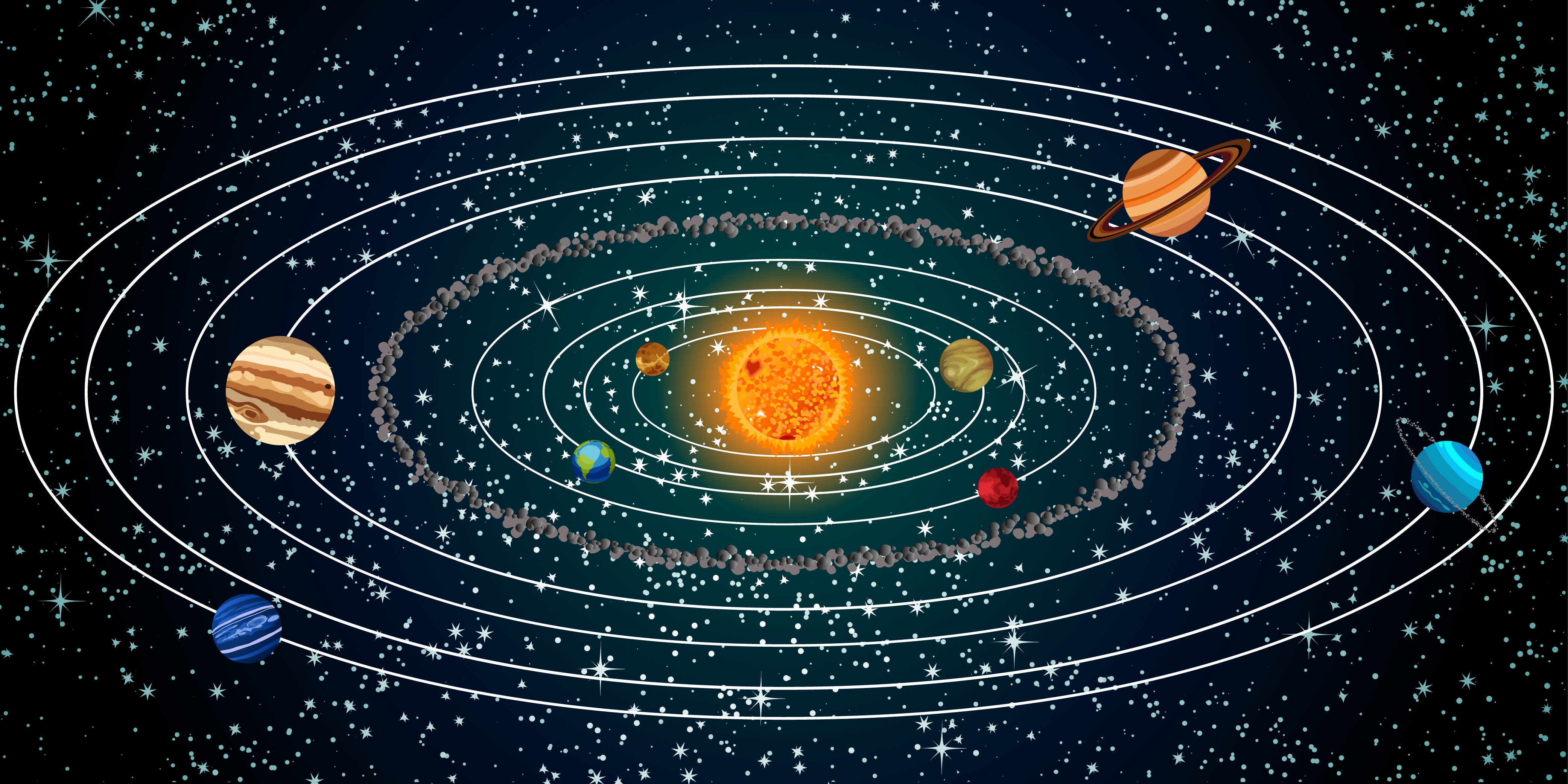
23.
Why do planets orbit the sun (and not float around in space)?
a)
the moons are keeping them in place
b)
They were hit by an asteroid
c)
they were hit by a comet
d)
the sun's gravity keeps them in place
24.
To "revolve" means to _________________
a)
rotate
b)
spin
c)
move
d)
orbit
25.
Name the moon phase
a)
waning crescent
b)
waxing crescent
c)
waning gibbous
d)
waxing gibbous
26.
Name the moon phase
a)
waning crescent
b)
waxing crescent
c)
waning gibbous
d)
waxing gibbous
27.

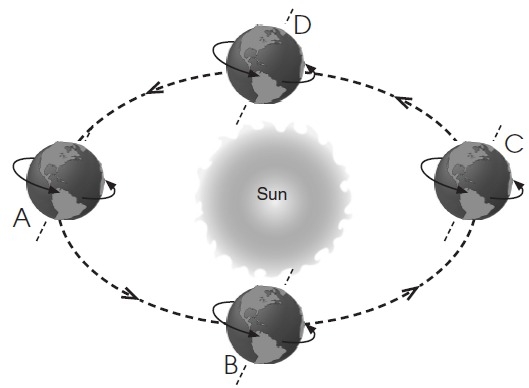
What season is letter A in the northern hemisphere?

a)

Winter

b)

Summer

c)

Spring

d)

Fall

28.
What are the reasons for the seasons?
a)
Earth's tilt and rotation.
b)
Earth's rotation and revolution.
c)
Earth's tilt and revolution.
d)
Earth's tilt and resolution
29.
Which moon phase is shown in this diagram?
a)
new moon
b)
1st quarter
c)
full moon
d)
last quarter/3rd quarter
30.
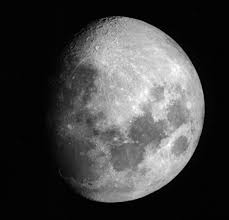
What phase is this?
a)
Waning Gibbous Moon
b)
Waxing Gibbous Moon
c)
Waning Crescent Moon
d)
Waxing Crescent Moon
31.
Name the phase of the moon for letter f
a)
Waning Gibbous
b)
Waxing Gibbous
c)
Waning Crescent
d)
Waxing Crescent
32.
All energy on Earth ultimately comes from what source?
a)
Water
b)
Sun
c)
Consumers
d)
Oxygen
33.
An organism that needs to eat other organisms to obtain energy is known as a:
a)
Autotroph
b)
Producer
c)
Consumer
d)
Mutualist
34.
The process by which energy is transferred from a warmer object to a cooler object by means of physical contact
a)
Thermal Energy
b)
Convection
c)
Radiation
d)
Conduction
35.
Energy that travels across distances in the form of electromagnetic waves. 
a)
Convection
b)
Radiation
c)
Conduction
d)
Induction
36.
Materials that transfer energy easily.
a)
Conductors
b)
Insulators
c)
Heat
d)
Energy
37.
Materials that do not transfer energy easily.
a)
Insulators
b)
Conductors
c)
Energy
d)
Heat
38.
The heat from a hot burner to a pot is transferred by ______.
a)
convection
b)
insulation
c)
radiation
d)
conduction
39.
The way the heat is moving from the hot coffee is called...
a)
convection
b)
radiation
c)
insulation
d)
conduction
40.
On a hot summer day, which shirt would you put on to make sure you stay cool while you are outside playing?
a)
A black shirt because it reflects the sun's energy.
b)
A white shirt because it reflects the sun's energy.
c)
A black shirt because it absorbs the sun's energy.
d)
A white shirt because it absorbs the sun's energy.
41.
Warm air rises and the cool air sinks demonstrates this type of heat transfer. 
a)
conduction
b)
convection
c)
radiation
d)
Insolation 
42.
The Gulf Stream is a current that brings warm ocean water from the south to the north. What type of heat transfer is this?
a)
conduction
b)
convection
c)
radiation
d)
Insolation 
43.
What happens to the movement of particles as they cool down?
a)
They slow down
b)
Nothing
c)
They don't move
d)
They speed up
44.
Energy due to motion is ____________ energy. 
a)
Potential 
b)
Energy
c)
Kinetic
d)
Friction
45.
__________ is stored energy. 
a)
Potential
b)
Kinetic
c)
None of the above 
d)
All of the above 
46.

When you are holding a book, energy is stored between the book and Earth; this type of energy is called ________ potential energy.

a)

Kinetic

b)

Chemical

c)

Gravitational

d)

Elastic

47.

When you stretch a rubber band, you are storing __________ energy.

a)

kinetic

b)

elastic potential

c)

gravitational potenial

d)

chemical potenial

48.
Energy can be _____________ or changed from one type to another.
a)
destroyed
b)
transferred
c)
created
d)
ignored
49.
The Coriolis Effect is caused by
a)
Earth rotating around the sun
b)
Earth rotating on its axis
c)
The tides
d)
Gravity
50.

Surface currents are a result of

a)

Global Wind Patterns

b)

Earth's Rotation

c)

Density

d)

The sun

51.

Deep Ocean currents are a result of

a)

Global Wind Patterns

b)

Earth's Rotation

c)

Density

d)

Movement of the whales

52.
Two types of water currents are
a)
local and global
b)
sea and land
c)
surface and deep
d)
warm and cold
53.
How do warm-water currents affect the coastal areas along which they flow?
a)
Cool the coast
b)
Warm the coast
c)
Cause snow to fall
d)
Cause higher tides
54.
Upwelling is associated with
a)
a decrease in access to nutrients for phytoplankton
b)
cooler, nutrient-rich waters being pushed up from deeper ocean waters
c)
temperature gradients moving water from the equator to the poles
d)
an increase in human fatalities
55.
If you replace the paper clip with a plastic spoon, what happens?
a)
The bulb doesn't light
b)
The bulb is dimmer
c)
The wires get hot
d)
There is no change
56.
A series circuit has ____ path(s) that the electric current can take. 
a)
One
b)
Two 
c)
Three 
d)
Four
57.

An object through which electrons can easily flow is called a(n) ___________.

a)

Conductor

b)

Insulator

c)

Switch

d)

Resistor

58.

Electricity is the flow of _________.

a)

Protons

b)

Neutrons

c)

Electrons

d)

Atoms

59.
What kind of circuit is this?
a)
Series
b)
Consecutive
c)
Parallel
d)
Training
60.
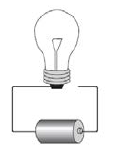
Which of these best completes the circuit?
a)
rubber band
b)
metal nail
c)
leather shoelace
d)
wooden toothpick
61.
Which energy transformation most likely occurs in a steam iron?
a)
electrical energy changes to heat energy
b)
electrical energy changes to sound energy
c)
mechanical energy changes to heat energy
d)
mechanical energy changes to light energy
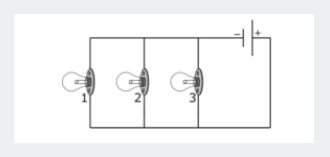
62.
If bulb 1 burns out, what will occur?
a)
bulbs 2 and 3 will go out
b)
bulbs 2 and 3 receive more volts
c)
bulbs 2 and 3 will stay lit
d)
nothing will happen
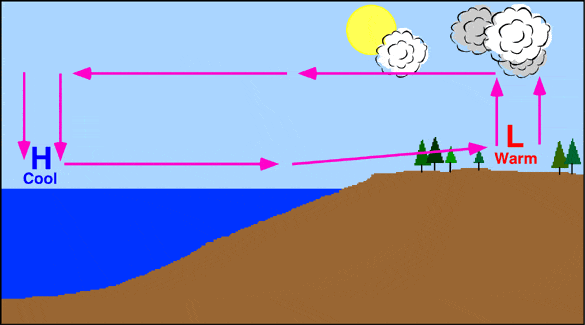
63.
Is this a land or a sea breeze?
a)
land breeze
b)
sea breeze
64.
The strength of a sea breeze depends on
a)
the heat of the day
b)
the difference between the temperature of the sea and the land
c)
the wind speed
d)
the amount of precipitation that day
65.
Why does warm air rise?
a)
Warm air is more dense than cooler air.
b)
Warm air has more pressure than cooler air.
c)
Warm air is less dense than cooler air.
d)
Warm air has a higher dew point than cooler air.