
 Worksheets
Earthquakes Review #1
Total questions: 30
Worksheet time: 15mins
Name
Class
Date
1.
What is the shaking of the Earth’s crust caused by a release of energy?
a)
Earthquake
b)
Epicenter
c)
Fault
d)
Plate
2.
Which of the following is NOT a cause of an earthquake?
a)
Collapse of Cavern
b)
Eruption of Volcano
c)
Lightning Strikes
d)
Moving Tectonic Plates
3.
What is a break in the lithosphere along which movement in an earthquake has first occurred?
a)
Earthquake
b)
Epicenter
c)
Fault
d)
Focus
4.
Where is the point at which the first movement occurs during an earthquake?
a)
Epicenter
b)
Focus
c)
Fault
d)
Plate
5.
Where is the point on the Earth’s surface directly above the focus of an earthquake?
a)
Epicenter
b)
Fault
c)
Hypocenter
d)
Tremor
6.
Which type of wave is the first to arrive after an earthquake occurs?
a)
P Wave
b)
Rayleigh Wave
c)
S Wave
d)
Shear Wave
7.
Which body waves cause particles of rock material to move at right angles to the direction in which the waves are traveling?
a)
Body Waves
b)
P Waves
c)
S Waves
d)
Surface Waves
8.
What is another term for P Wave?
a)
Compression Wave
b)
Principal Wave
c)
Shear Wave
d)
Secondary Wave
9.
What is a large ocean wave that results from an underwater earthquake, landslide, or volcanic eruption?
a)
Aftershock
b)
Liquefaction
c)
Seismic Gap
d)
Tsunami
10.

The outside layer of the earth is called ______________________.
a)
core
b)
crust
c)
mantle
d)
outer core
11.

The huge pieces of the earth's crust are called ____________________________.
a)
crust
b)
plates
c)
directions
d)
seismos
12.

This famous transform fault is located in the western United States creates significant earthquake activity for California
a)
New Madrid
b)
Denali Fault
c)
Ramapo Seismic Zone
d)
San Andreas
13.
Stretching rock so it becomes thinner in the middle is what kind of stress?
a)
tension
b)
compression
c)
shearing
14.
Squeezing rock until it breaks is what stress?
a)
tension
b)
compression
c)
shearing
15.
Which of these boundaries/stresses/faults all correctly go together? Choose all that apply.
a)
normal, divergent, tension
b)
reverse, convergent, shearing
c)
strike-slip, transform, compression
16.
A type of fault where rocks on either side move past each other sideways is called:
a)
normal fault
b)
reverse fault
c)
strike-slip fault
17.

a)
normal fault
b)
reverse fault
c)
strike-slip fault
18.

Stress that pushes masses of rock in opposite directions, in a sideways movement?
a)
shear
b)
compression
c)
tension
d)
constriction
19.

What type of fault is this?
a)
Normal
b)
Reverse
c)
Strike-Slip
20.

What process taking place in the asthensophere enables the plates to move?
a)
radiation
b)
subvection
c)
conduction
d)
convection
21.
The theory that pieces of Earth's lithosphere are in constant motion, driven by convection currents in the mantle.
a)
Plate tectonics
b)
Continental drift
c)
convection currents
d)
subduction zone
22.

Letter A is pointing to which Earth layer?
a)
Outer Core
b)
Mantle
c)
Crust
d)
Inner Core
23.

This picture shows which kind of Plate Boundary?
a)
Convergent Boundary
b)
Transform Boundary
c)
Divergent Boundary
24.

Which Plate Boundary does the picture illustrate?
a)
Divergent Boundary
b)
Transform Boundary
c)
Convergent Boundary
25.

Which Plate Boundary does the picture illustrate?
a)
Divergent Boundary
b)
Transform Boundary
c)
Convergent Boundary
26.
The area around the Pacific Ocean where lots of earthquakes and volcanoes happen.
a)
Ring of Earth
b)
Ring of Fire
27.
What type of stress occurs at a convergent boundary?
a)
Compression
b)
Tension
c)
Shearing
28.
A deep valley that forms along a divergent boundary.
a)
rift valley
b)
canyon
c)
mid-ocean ridge
d)
ocean valley
29.
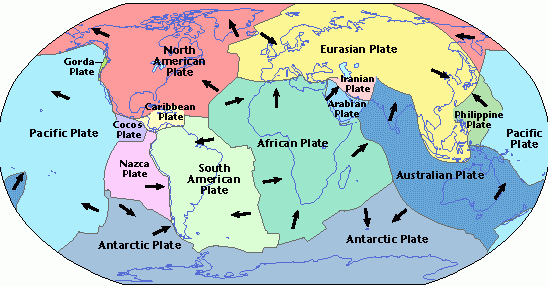
Many earthquakes happen along the borders of...
a)
Countries
b)
Tectonic Plates
c)
Climate Zones
d)
None of the above.
30.
Vibrations caused by an earthquake that carry earthquake’s energy away.
a)
earthquakes
b)
seismic waves
c)
stress
100 %

