wayground logo

Free Printable Worksheets

Font size

S
M
L
XL
Worksheets

Wave Behaviors Review

Total questions: 35

Worksheet time: 21mins
Name
Class
Date
1.
According to the Law of reflection, a light ray striking a mirror
a)
continues moving through the mirror in the same direction
b)
moves into the mirror at a slightly different angle
c)
bounces off the mirror toward the direction it came from
d)
bounces off the mirror at the same angle it hits.
2.
Why do you not see an image when light reflects off a rough surface?
a)
because not enough light is not reflected
b)
because the reflection is regular
c)
because the reflection is diffuse
d)
because the law of reflection does not apply
3.

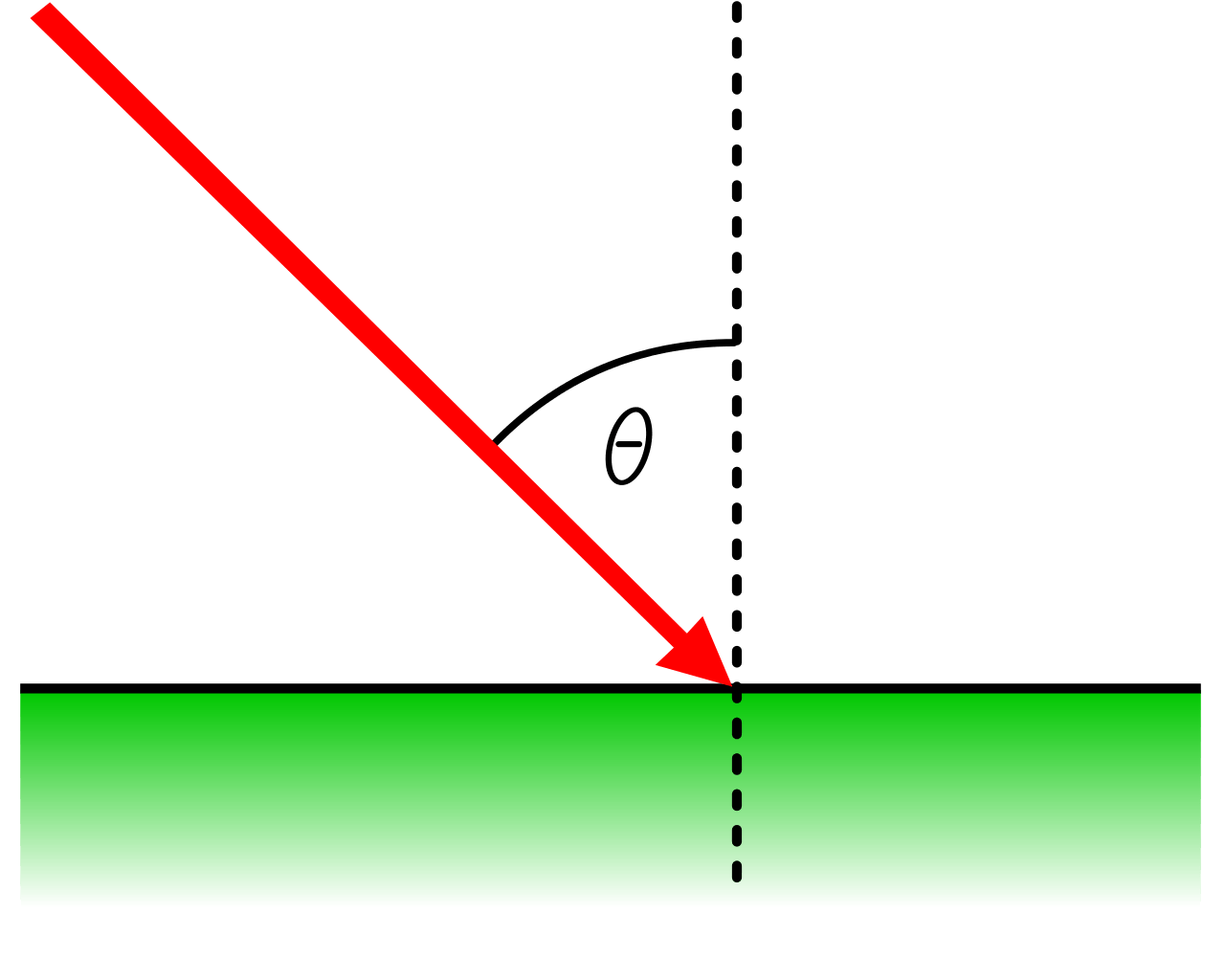
Which is the angle of incidence?

a)

Angle 1 (θ1)

b)

Angle 1 (θ2)

4.
An image that you can see when you look into a mirror, but does not really exist is called which of the following?
a)
Real Image
b)
Fake Image
c)
Virtual Image
d)
Digital Image
5.
All waves carry
a)
energy
b)
light 
c)
matter
d)
particles
6.
What do you see when water droplets refract and diffract sunlight?
a)
thunderstorm
b)
eclipse
c)
rainbow
d)
clouds
7.
Why would a wave change direction?
a)
Because it kept traveling through the same medium
b)
Because it went from one medium to another
c)
the amplitude was too large
d)
the frequency was too small
8.

A ray of white light passes through a prism. On the other side of the prism, you see a rainbow. What is this phenomenon called? (Choose all that apply)

a)

Reflection

b)

Refraction

c)

Medium

d)

Dispersion

9.
A ray of light is incident on a plane mirror and the angle of incidence is 25 degrees. What is the angle of reflection?
a)
A. 0 degrees
b)
B. 50 degrees
c)
C. 90 degrees
d)
D. 25 degrees
10.
The Law of Reflection:
The angle of incidence is _________ the angle of reflection
a)
bigger than
b)
the same as
c)
smaller than
11.
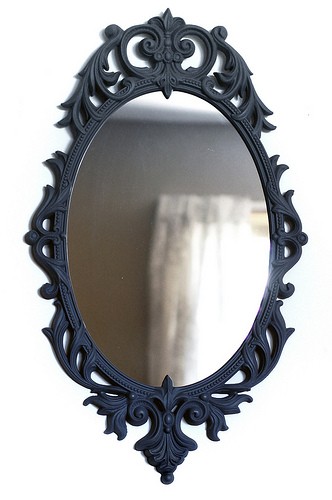
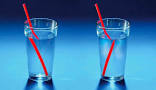
What is this called?
a)
refraction
b)
reflection
c)
reconstroction
d)
retraction
12.
When light passes at an angle to the normal from one material into another material in which its speed is lower
a)
it is bent towards the normal.
b)
it always lies along the normal.
c)
it is unaffected.
d)
it is bent away from the normal.
13.
Angles are always measured from the:
a)
Boundary
b)
Normal
c)
Incident Ray
d)
Reflected Ray
14.
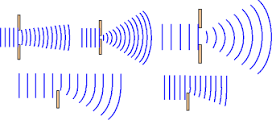
a)
Diffraction
b)
Interference
15.
When the crests of one wave overlap the crests of another wave or waves, this occurs.
a)
A. diffraction
b)
B. destructive interference
c)
C. constructive interference
d)
D. resonant frequencies
16.
The combination of two or more waves that result in a single wave
a)
A. diffraction
b)
B. resonance
c)
C. reflection
d)
D. interference
17.
a)

absorption

b)

diffraction

c)

reflection

d)

refraction

e)

interference

18.
What is a medium?
a)
something between a small and a large?
b)
the substance through which a wave can travel
c)
a pattern of vibration that simulates when a wave is standing still
d)
the distance from any point on a wave to an identical point on the next wave
19.

The orca uses this behavior of waves to locate food.

a)

Refraction

b)

Reflection

c)

Absorption

d)

Diffraction

e)

Interference

20.
Which wave behavior do noise cancelling headphones use?
a)
diffraction
b)
refraction
c)
constructive interference
d)
destructive interference
21.

A beam of light traveling through air hits the surface of a lake. Which of the arrows correctly show what happens to the light beam in water?

a)

A

b)

B

c)

C

d)

D

22.

The diagram shows a series of wave fronts approaching an opening in a barrier. Point P is located on the opposite side of the barrier. The wave fronts reach point P as a result of

a)

resonance

b)

refraction

c)

reflection

d)

diffraction

23.

A wave is diffracted as it passes through an opening in a barrier. The amount of diffraction that the wave undergoes depends on both the

a)

amplitude and frequency of the incident wave

b)

wavelength and speed of the incident wave

c)

wavelength of the incident wave and the size of the opening

d)

amplitude of the incident wave and the size of the opening

24.

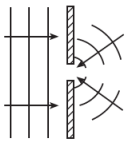
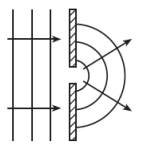
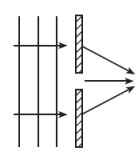
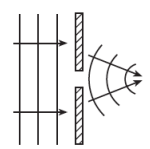
Which diagram best represents the shape and direction of a series of wave fronts after they have passed through a small opening in a barrier?
a)
b)
c)
d)
25.

Parallel wave fronts incident on an opening in a barrier are diffracted. For which combination of wavelength and size of opening will diffraction effects be greatest?

a)

short wavelength and narrow opening

b)

short wavelength and wide opening

c)

long wavelength and narrow opening

d)

long wavelength and wide opening

26.

A beam of light bends when it passes from air into water, and then bends even more when it passes from water into glass. What can you conclude from this fact?

a)

Air is denser than glass

b)

Water is denser than glass

c)

Glass is denser than water

d)

Air is denser than water

27.

What type of stuff can be refracted? Choose the best answer

a)

Light

b)

Sound

c)

Heat

d)

Anything that travels in waves

28.

Why does white light from the sun form a colorful rainbow when it passes through water droplets in the atmosphere?

a)

The droplets of water in the air have different densities

b)

White light diffracts when it encounters water

c)

The colors that make up white light refract at different angles

d)

Different-sized water droplets refract white light at different angles

29.
In ________ interference, the energy of the combined wave is greater than the energy of each of the two waves.
a)
destructive
b)
rarefaction
c)
resonance
d)
constructive
30.

Where does deconstructive interference occur

a)

Blue

b)

Black

c)

Yellow

d)

Red

31.
What is happening in this picture?
a)
Reflection
b)
Refraction
c)
Diffraction
d)
Absorption
32.
Waves with the longest wavelength have the ____ frequency. 
a)
lowest
b)
higest
33.
Why does the lower part of the child appear so much different in size from the upper part?
a)
The light rays that travel through water and then into air are refracted.
b)
The light rays that travel through water and then into air are enlarged.
c)
The light rays that travel through air and then into water are reflected.
d)
The light rays that travel through air and then into water are reduced.
34.
When light/waves move from one medium to another, change in ____ can be observed.
a)
speed, direction, frequency
b)
speed, direction
c)
frequency
d)
amplitude
35.
Refraction is the bending of a wave disturbance as it passes from one _________ into another.
a)
glass
b)
medium
c)
area
d)
boundary