
 Worksheets
Algebra 1 Review: Functions
Total questions: 84
Worksheet time: 3hrs 46mins
Name
Class
Date
1.

What is the domain of the graph?
a)
1≤ x ≤ 4
b)
1 < x < 4
c)
1≤ y ≤ 4
d)
1 < y < 4
2.
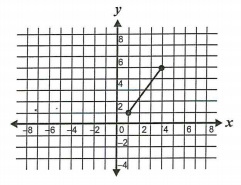
What is the range of the graph?
a)
1 ≤ x ≤ 5
b)
1 < x < 5
c)
1 ≤ y ≤ 5
d)
1 < y < 5
3.

Is this a function? Explain.
a)
Yes; it passes the horizontal line test.
b)
No; it is not a straight line.
c)
Yes; it passes the vertical line test.
d)
No; there is a line connecting the dots.
4.

a)
Function
b)
Not a Function
5.

a)
Function
b)
Not a Function
6.
If h(a) = 3 - 2a
Find h(-3).
Find h(-3).
a)
12
b)
-2
c)
-3
d)
9
7.
Given f(x) = -4x - 10 and f(x) = 10. Find x
a)
x = -5
b)
x = 5
c)
x = -50
d)
x = 30
8.

.
a)
Function
b)
Not a Function
9.

.
a)
Function
b)
Not a Function
10.
If f(x)=6x2-4,
what is f(0)?
what is f(0)?
a)
-4
b)
4
c)
0
d)
2
11.
If f(x)=6x2-4,
what is f(1)?
what is f(1)?
a)
13
b)
0
c)
12
d)
2
12.
Let w(x) = 3x - 7. If w(x) = 14, find x.
a)
7
b)
35
c)
2.33333
d)
-49
13.

What is x if
f(x) = -2?
f(x) = -2?
a)
4
b)
0
c)
3
d)
8
14.

What is f(1)?
a)
1
b)
5
c)
0
d)
4
15.
The function h(t) represents the height in inches of a plant after t weeks. What does the notation h(4) = 5 mean?
a)
After 5 week the plant is 4 inches tall
b)
The plant grows at a rate of 5/4 inch per week
c)
After 4 weeks the plant is 5 inches tall
d)
The plant grows at a rate of 1 inch per week
16.
The function c(m) = 1.45m + 3.50 represents the cost of a taxi for m miles.
What does c(7) represent?
What does c(7) represent?
a)
A cost of $7 to ride the taxi
b)
The cost to ride 7 miles
c)
The minimum distance to ride a taxi
d)
The minimum cost of a taxi
17.
The function c(m) = 1.45m + 3.50 represents the cost of a taxi for m miles.
What does c(m) represent?
What does c(m) represent?
a)
Total Cost of a taxi
b)
Total Miles in taxi
18.
Derek works at Subway making $9.25 an hour. The function d(x)=9.25x tells us how much money Derek makes after x hours of working. What is the meaning of d(4)=37?
a)
After 4 hours of work, Derek makes $37.
b)
Derek needs $4 more to have $37 total.
c)
After working for 4 days, Derek makes $37 total.
d)
After 4 hours of work, Derek now makes $37 an hour instead of $9.25.
19.
Ms. Brackemyer is collecting pencils. The function p(x)=5x+12 tells us the total amount of pencils Ms. Brackemyer has after collecting for x number of days. What is the meaning of p(8)=52?
a)
Ms. Brackemyer starts with 8 pencils and ends with 52.
b)
After 8 days, Ms. Brackemyer has 52 pencils.
c)
Ms. Brackemyer starts with 52 pencils and gets 4 more every day.
d)
Every day, Ms. Brackemyer gets 4 new pencils until she has 52.
20.
A company is selling bubble gum. The function g(x)=3x+4 tells the company how much to charge if someone buys x packages of bubble gum. Find g(8) and tell what it means within the context of the problem.
a)
g(8)=8. This means that after 8 packages of gum, the company makes $8.
b)
g(8)=42. This means that 8 packages of gum costs $42.
c)
g(8)=28. This means that 8 packages of gum costs $28.
d)
g(8)=24. This means that 8 packages of gum costs $24.
21.

Does the graph represent a function?
a)
Yes, because the vertical line test shows there are no repeating input values
b)
No, because the vertical line test shows there are repeating input values
22.

a)
F
b)
G
c)
H
d)
J
23.

Is this graph a function or not a function?
a)
Function
b)
Not a Function
24.

Is the graph pictured a function?
a)
Yes
b)
No
25.

Which graph does NOT pass the vertical line test?
a)
Graph 1
b)
Graph 2
c)
Graph 3
d)
Graph 4
26.

a)
Function
b)
Not a Function
27.
For the function {(0,1), (1,-3), (2,-4), (-4,1)}, write the domain and range.
a)
D: {1, -3, -4,}
R: {0, 1, 2, -4}
R: {0, 1, 2, -4}
b)
D:{0, 1, 2, -4}
R:{1, -3, -4}
R:{1, -3, -4}
c)
D:{0, 1, 2, 3, 4}
R:{1, -3, -4}
R:{1, -3, -4}
28.

What is the range of the graph?
a)
x≤0
b)
y≥0
c)
y≤0
d)
All real numbers
29.

What is the range of the following graph?
a)
all real numbers
b)
all integers
c)
any real number greater than zero
d)
it can not be determined
30.

What is the domain of the graph?
a)
-7 ≤ x < 5
b)
-3 ≤ x < 1
c)
-3 ≤ y < 1
d)
-7 ≤ y < 5
31.

Range?
a)
(-8, ∞)
b)
[-8, ∞)
c)
(-∞, ∞)
d)
(∞, -8)
32.

What is the x-intercept for the given graph?
a)
1
b)
-2
c)
2
d)
1/2
33.

What are all the x-intercepts?
a)
(−2.55, 0), (2.55, 0)
b)
(−3,0), (−2,0), (2,0), (3,0)
c)
(0, 36)
d)
(−∞,∞)
34.

Where is the function increasing?
a)
[4, ∞)
b)
[−4, ∞)
c)
[6, ∞)
d)
4 < x < 6
35.

When is this function increasing?
a)
-2.5 < x < 2.5
b)
0 < x < 5
c)
0 < x < 55
d)
-5 < x < 0
36.

Is this a function?
a)
No; because it does not pass the vertical line test.
b)
Yes; because it does pass the vertical line test.
c)
No; because it's not in one straight line.
d)
Yes; because it has 5 points.
37.

List the intercepts of the graph.
a)
(2, 0), (0, 2), (0, 1), (0, −5)
b)
(2, 0), (1, 0) (−5, 0), (0, 2)
c)
(−2, 0), (1, 0), (5, 0), (0, 2)
d)
(2, 0), (0, −2), (0, 1), (0, 5)
38.

Where is the function decreasing?
a)
(-∞, -1)
b)
(-1, ∞)
c)
(-∞, 3)
d)
(-∞, ∞)
39.

Which statement is true about this function?
a)
The function is never constant
b)
The function is always increasing
c)
The function is never decreasing
d)
The function increases on the interval 11:00 < x < 15:00
40.

What is the domain of the graph?
a)
[-7,5)
b)
(5, -7]
c)
[-3,1)
d)
(-∞, ∞)
41.

What is the decreasing interval for this function?
a)
(-5, 3)
b)
(-∞, ∞)
c)
(-6, -2)
d)
(-2, 6)
42.

What is the domain of this graph?
(There are no arrows!)
(There are no arrows!)
a)
[-3, 2]
b)
[-1, 1]
c)
[-5, 5]
d)
(-∞, ∞)
43.
Is the graph an even, odd, or neither function
f(x) = 4x3
f(x) = 4x3
a)
Even
b)
Odd
c)
Neither
44.

What interval is the function decreasing over?
a)
(-2, 1)
b)
(1, 4)
c)
(3, -6)
d)
(-6, 3)
45.
Which one of the following functions is even?
a)
f(x) = x⁴ + x³
b)
g(x) = x⁴ + x²
c)
h(x) = x⁵ + x³
d)
k(x) = x³ + x
46.
Is the graph an even, odd, or neither function
f(x) = x2 + 2
f(x) = x2 + 2
a)
Even
b)
Odd
c)
Neither
47.
Is the graph an even, odd, or neither function
f(x)=x3-x2
f(x)=x3-x2
a)
even
b)
odd
c)
neither
48.
f(x) = -3x5 + 5x4 - 7x3 + 2x - 12
a)
UP and UP
b)
DOWN and DOWN
c)
UP and DOWN
d)
DOWN and UP
49.

Which function has this end behavior?
a)
-1x4-3x3+3
b)
-2x7+2x4+4
c)
3x8+3x5-4x+7
d)
4x5-4x4+2x3-9
50.

What is the degree?
a)
Positive
b)
Negative
c)
Odd
d)
Even
51.
Find the axis of symmetry for
f(x) = 2x2- 8x + 15.
f(x) = 2x2- 8x + 15.
a)
x = -4
b)
x = 2
c)
y = 4
d)
y = -4
52.
Does the equation open or or down?
Y = -3x2 +7x - 2
Y = -3x2 +7x - 2
a)
up
b)
down
c)
left
d)
right
53.
What is the y-intercept of
f(x)=2x2 + 4x + 6
f(x)=2x2 + 4x + 6
a)
2
b)
4
c)
-6
d)
6
54.
What is the y intercept for the equation:
y = -8x2 + 3x - 7
y = -8x2 + 3x - 7
a)
-8
b)
3
c)
7
d)
-7
55.
What direction is the following equation opening?
y=5x2+6x+9
y=5x2+6x+9
a)
Up
b)
Down
c)
left
d)
right
56.
What direction is the following equation opening?
y=-3x2-7x+8
y=-3x2-7x+8
a)
Up
b)
Down
c)
left
d)
right
57.

.How many zeros does this parabola have?
a)
3
b)
2
c)
0
d)
1
58.

What is the equation for axis of symmetry?
a)
y=3
b)
x=3
c)
x=5
d)
x=1
59.
What do we call the highest or lowest point of a quadratic?
a)
parabola
b)
vertex
c)
graph
d)
point
60.
Does the equation have a max or min?
y = 2x2 + 7x + 5
y = 2x2 + 7x + 5
a)
max
b)
min
61.

What is the vertex?
a)
(2, 4)
b)
(3, -1)
c)
(0, 8)
d)
(4, 2)
62.
What is the definition for a vertex?
a)
mirror line in a quadratic
b)
place where the curve changes direction
c)
place where the curve crosses the x axis
d)
place where the curve crosses the y axis
63.
What is the definition of an axis of symmetry?
a)
the mirror line in a quadratic
b)
place where the curve changes direction
c)
place where the curve crosses the x axis
d)
place where the curve crosses the y axis
64.
Which equation below is a quadratic?
a)
y=9x+5
b)
y=3x2-6
c)
y=5x3+6
d)
x=3x
65.

If each mark on the x-axis represents one second, when did the object reach its maximum height?
a)
2.5 seconds
b)
2 seconds
c)
5.5 seconds
d)
3 seconds
66.

If each mark on the x-axis represents one second, when did the object reach the ground?
a)
2.5 seconds
b)
6 seconds
c)
5.5 seconds
d)
5 seconds
67.

What are the x- intercepts?
a)
x= 0 and x= -4
b)
x= 0 and x= 4
c)
y= 0
d)
x= 2
68.

How many solutions does this graph have?
a)
one
b)
two
c)
no solutions
d)
cannot be determined
69.

Use the graph to determine the solutions.
a)
-1 and -3
b)
1 and -3
c)
1 and 3
d)
-1 and 3
70.

What is the end behavior as x → -∞ f(x)→ ?
a)
-∞
b)
∞
71.

What is the range of this quadratic function?
a)
All real numbers.
b)
[2, infinity)
c)
[4, infinity)
d)
(negative infinity, 4]
72.

What is the range of this function?
a)
All real numbers.
b)
[2, infinity)
c)
[-2, infinity)
d)
[0, infinity)
73.

Does this graph have a maximum or minimum value?
a)
maximum
b)
minimum
c)
neither
d)
both
74.
All of the y-values or outputs are called what?
a)
Domain
b)
Range
c)
Relation
d)
Function
75.

Is the relation a function? Why.
a)
Yes, because every y-value has an x-value.
b)
No, because the x-value 11 has two y-values pair with it.
76.

Identify the increasing interval:
a)
(0, 4)
b)
(1, 0) U (1, 4)
c)
(-1, 1)
d)
(-∞, -1) U (1, ∞)
77.
Find the sum.
(2x2 + 5x - 7) + ( 3 - 4x2 + 6x)
(2x2 + 5x - 7) + ( 3 - 4x2 + 6x)
a)
2x2 + 3x +1
b)
-2x2 - 11x -4
c)
2x2 + 5x -7
d)
-2x2 + 11x -4
78.
Find the difference.
(3- 2x + 2x2) - (4x -5 +3x2)
(3- 2x + 2x2) - (4x -5 +3x2)
a)
x2 + 6x + 8
b)
2x2 + 5x - 7
c)
-x2 -6x + 8
d)
-2x2 + 11x - 4
79.
Add the polynomials.
(2x + 5y) + (3x - 2y)
(2x + 5y) + (3x - 2y)
a)
3x + 5y
b)
5x + 3y
c)
5x + 7y
d)
7xy + 1xy
80.
Simplify the expression.
(4n4 - 8n + 4) - (8n2 + 4n4 + 1)
(4n4 - 8n + 4) - (8n2 + 4n4 + 1)
a)
-8n2 - 8n + 3
b)
-7n2 - 8n + 3
c)
-6n2 - 8n + 3
d)
-7n2 - 4n + 3
81.
Simplify:
(x - 7)(x + 7)
(x - 7)(x + 7)
a)
x2 + 7x - 49
b)
x2 - 7x + 49
c)
x2 - 49
d)
x2 + 49
82.
(4x+1)(5x−2)
a)
20x2 + 3x − 2
b)
20x2 − 11x + 5
c)
20x2 − 18x + 2
d)
20x2 − 3x − 2
83.
Multiply
(x2-2x+1)(x+1)
(x2-2x+1)(x+1)
a)
x3-x2-x+1
b)
x3-2x+2
c)
x3+x2+x+1
d)
x3-3x2-3x+1
84.
Simplify
(p − 8)2
(p − 8)2
a)
p 2 − 16p − 64
b)
p 2 + 16p + 64
c)
p 2 − 16p − 8
d)
p 2 − 16p + 64
100 %

