
NEW
Font size
S
M
L
XL
 Worksheets
0654 B4+6 Enzymes & Chemical Digestion
Total questions: 28
Worksheet time: 28mins
Name
Class
Date
1.
Enzymes are made of
a)
Lipids
b)
Carbohydrate
c)
Protein
d)
Nucleic Acid
2.
Where do substrates bind on an enzyme?
a)
voltage-gated channels
b)
surface receptor
c)
calcium channels
d)
active site
3.

What is structure A?
a)
Substrate
b)
Active site
c)
Enzyme
d)
Products
4.

What is structure D?
a)
Substrate
b)
Active site
c)
Enzyme
d)
Products
5.

What is structure C?
a)
Substrate
b)
Active site
c)
Enzyme
d)
Products
6.

What is structure E, F, G?
a)
Substrate
b)
Active site
c)
Enzyme
d)
Products
7.
What is a substance called if it speeds up a chemical reaction?
a)
reusable
b)
catalyst
c)
specific
d)
fragile
8.
Each enzyme only has 1 substrate that will fit its active site. What is this called?
a)
reusable
b)
catalyst
c)
specific
d)
fragile
9.
Once a new product leaves an enzyme, the enzyme is unchanged and ready for the next substrate. What is this called?
a)
reusable
b)
catalyst
c)
specific
d)
fragile
10.
What 3 letters do enzymes typically end in?
a)
-ose
b)
-ase
c)
-ese
d)
-tic
11.
What is the name for the mechanism of enzyme activity?
a)
Lock and key
b)
jigsaw puzzle
c)
hammer and nail
d)
two hands pattern
12.
Which chemical is classified as an enzyme?
a)
Galactose
b)
Lipid
c)
Protease
d)
Manganese dioxide
13.
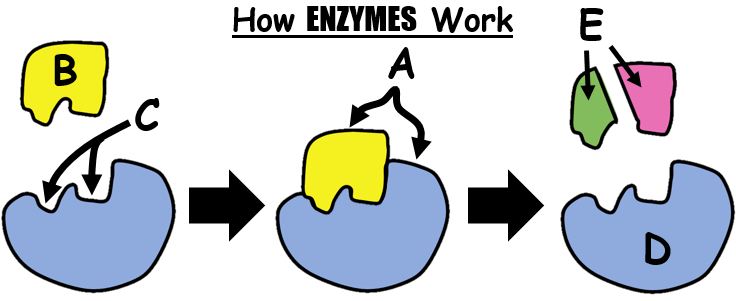
In the diagram, what is letter A?
a)
product
b)
substrate
c)
enzyme-substrate complex
d)
active site
14.
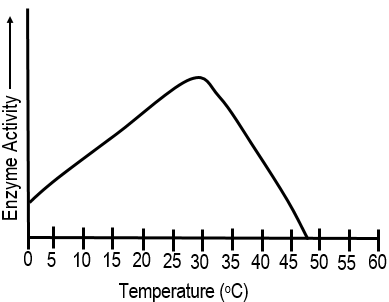
Based on the graph, what is the optimal temperature for this enzyme?
a)
15oC
b)
40oC
c)
30oC
d)
35oC
15.
What happens when enzymes are heated to a high temperature?
a)
The enzymes die.
b)
The shapes of the enzyme are altered denature
c)
The enzymes' amino acid sequence changes.
d)
The enzymes remain the same
16.
Which of these is most likely an enzyme?
a)
Sucrose
b)
Galactose
c)
Fructose
d)
Amylase
17.
What is another name for enzymes?
a)
chemical catalysts
b)
microorganisms
c)
biological catalysts
d)
inorganic catalysts
18.
The pH at which an enzyme is most efficient is called the _________ pH of an enzyme.
a)
neutral
b)
optimum
c)
minimum
d)
experimental
19.
What are the products of lipase?
a)
amino acids
b)
fats
c)
glucose
d)
glycerol and fatty acids
20.
Which chemical reaction takes place in the stomach?
a)
Proteins are digested by proteases
b)
Proteins are digested into fatty acids
c)
Starch is digested into amino acids
d)
Starch is digested by lipase
21.
Lipids (fats and oils) are made up of which two substances?
a)
Fatty acids and glycogen
b)
Amino acids and glycerol
c)
Lipases and glucose
d)
Fatty acids and glycerol
22.
Chemical digestion begins in the ....
a)
Stomach
b)
Oesophagus
c)
Small Intestine
d)
Mouth
23.
What are the products of the breakdown of fat molecules?
a)
amino acids
b)
glucose and glycerol
c)
fatty acids
d)
fatty acids and glycerol
24.
What are the products of the breakdown of protein molecules?
a)
amino acids
b)
glucose and glycerol
c)
fatty acids
d)
fatty acids and glycerol
25.
What are the products of the breakdown of carbohydrate (starch) molecules?
a)
amino acids
b)
glucose
c)
fatty acids
d)
fatty acids and glycerol
26.
What enzyme breaks down fat molecules?
a)
amylase
b)
protease
c)
lipase
d)
maltase
27.
What enzyme breaks down protein molecules?
a)
amylase
b)
protease
c)
lipase
d)
maltase
28.
What enzyme breaks down starch molecules?
a)
amylase
b)
protease
c)
lipase
d)
maltase
Reset

