
 Worksheets
STAAR REVIEW
Total questions: 70
Worksheet time: 7hrs 43mins
Name
Class
Date
1.
The non-living factors in an ecosystem such as rocks, water and temperature.
a)
natural selection
b)
biotic
c)
biodiversity
d)
abiotic
2.
The living organisms in an ecosystem such as plants and animals
a)
adaptation
b)
biotic
c)
decomposer
d)
abiotic
3.
Organisms that make their own food. Also called autotrophs.
a)
Producer
b)
Parasite
c)
Scavenger
d)
Decomposer
4.
Organisms that eat other organisms (heterotroph).
a)
Producer
b)
Parasite
c)
Consumer
d)
Scavenger
5.
When people run long distances, their muscles require increased amounts of oxygen. Which system is responsible for carrying this oxygen to the muscles?
a)
Nervous
b)
Respiratory
c)
Digestive
d)
Circulatory
6.

a body system that controls growth and homeostasis by secreting hormones from glands.
a)
skeletal system
b)
nervous system
c)
endocrine sytem
d)
integumentary system
7.
Where is DNA stored in a cell?
a)
Lysosomes
b)
Golgi Complex
c)
Ribosomes
d)
Nucleus
8.
Which organelle is only found in a plant cell?
a)
nucleus
b)
chloroplast
c)
mitochondria
d)
cell membrane
9.
the organism in an ecosystem that hunts, kills and eats another organism
a)
predator
b)
prey
c)
parasite
d)
host
10.
the organism in an ecosystem that gets hunted and eaten
a)
predator
b)
prey
c)
parasite
d)
host
11.
Which 2 systems are involved in exchanging gas between the blood and the lungs?
a)
digestive and respiratory
b)
circulatory and respiratory
c)
endocrine and digestive
d)
circulatory and nervous
12.
Biodiversity refers to
a)
extinct species
b)
the variety of species on Earth
c)
nonrenewable resources
d)
the rate of species decline
13.
The organelle inside a plant cell that converts sunlight into energy.
a)
Chloroplast
b)
Photosynthesis
c)
Parasite
d)
Cell Wall
14.

(8.7A) Earth would not have seasons if it-
a)
no longer tilted on its axis
b)
stopped rotating on its axis
c)
took and additional month of orbit the sun
d)
revolved around the sun in the opposite direction.
15.

(8.10C) Hurricanes and similar storm systems begin over oceans. The map below shows average surface temperatures of the oceans in the summer.
Based on the map, which area probably produced the most violent storm systems?
Based on the map, which area probably produced the most violent storm systems?
a)
Area 1
b)
Area 2
c)
Area 3
d)
Area 4
16.

(8.7A) Which of these locations on Earth experiences the least change in the number of daylight hours throughout the year?
a)
Equator
b)
North Pole
c)
Tropic of Cancer
d)
Tropic of Capricorn
17.

What is this moon phase?
a)
This is the waxing crescent phase.
b)
This is the full moon phase.
c)
This is the waxing gibbous phase.
d)
This is the last quarter moon.
18.

When the Northern Hemisphere of Earth is Leaning away from the Sun, What season is the Southern Hemisphere experiencing?
a)
Summer
b)
Winter
c)
Spring
d)
Fall
19.
All stars begin as a __________?
a)
giant
b)
black hole
c)
white dwarf
d)
nebula
20.
A boundary where two plates slide past each other.
a)
convergent boundary
b)
convergent boundary
c)
transform boundary
d)
sergent boundary
21.

At which point is the Northern Hemisphere experiencing winter?
a)
position 1
b)
position 2
c)
position 3
d)
position 4
22.

What moon phase is this picture?
a)
This is the full moon phase.
b)
This is the waxing crescent moon phase.
c)
This is the waning gibbous moon phase.
d)
This is the waning crescent moon phase.
23.
(8.10C) What is one condition that is necessary for the hurricane to form?
a)
Warm ocean water
b)
A strong cold front
c)
Cold ocean water
d)
A strong warm front
24.
Subduction is:
a)
process by which ocean crust is taken into the trenches and back to the mantle
b)
theory that new seafloor is formed when magma is forced upward toward the surface at a mid ocean ridge
c)
plates slide past each other in opposite directions
d)
a gradual movement of the continents across the Earth's surface over time
25.
Tectonic plates are:
a)
largest section of Earth's layers - composed of three layers
b)
Earth's crust and part of the upper mantle that are broken into sections
c)
lowest or deepest layer of the mantle - semi rigid
d)
landmass in which all continents were once joined together
26.

What phase comes AFTER this one?
a)
Waning Crescent
b)
Waning Gibbous
c)
Waxing Crescent
d)
Third Quarter
27.
The cycle of the moon lasts about a _.
a)
day
b)
year
c)
week
d)
month
28.
Scientist use Light years to measure objects in space rather than units such as Miles or Kilometers because of how massive the Galaxy and Universe is.
a)
True
b)
False
29.
Low pressure will usually bring what kind of weather?
a)
Sunny
b)
Calm
c)
Stormy
30.
A _____________ tide occurs when the moon, sun, and Earth are aligned. This is a period of the highest high tides and lowest low tides.
a)
neap
b)
spring
c)
slack water
d)
ebb
31.
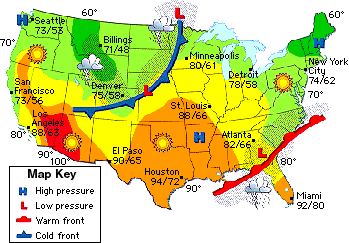
A high pressure system is located north of New York City. What type of weather will be experienced there?
a)
clear, sunny skies
b)
cloudy and rainy
32.

This symbol represents
a)
a cold front
b)
an occluded front
c)
a stationary front
d)
a warm front
33.

What front does this symbol represent?
a)
warm front
b)
cold front
c)
stationary front
d)
occluded front
34.

What type of front does this symbol represent?
a)
warm front
b)
cold front
c)
stationary front
d)
occluded front
35.

Element R and Q have the same number of valence electrons. These elements both have similar chemical behavior, but element R has fewer energy levels than element Q. Which statement best describes their position on the periodic table>
a)
They are in the same period, with element R first element in the period and element Q the last element
b)
The two elements are side by side in the same period, with element Q to the left of R
c)
The two elements are in the same group, with R just above Q
d)
The two elements are in the same group, with Q at the tops fo the group and R at the bottom
36.
Coal contains carbon and other elements. Carbon dioxide forms when coal burns in the presence of oxygen. Which of the these is best evidence that a chemical reaction occurs when coal burns?
a)
The shape of the coal changes
b)
Oxygen in present
c)
A new substance is produced
d)
Coal is made up of more than one element
37.
This part of the atom has very little mass but takes up most of the space of the atom (contains negatively charged particles).
a)
Positron
b)
Proton
c)
Electron
d)
Neutron
38.
What is the mass of an atom with 7 protons, 8 neutrons, and 7 electrons?
a)
1
b)
7
c)
15
d)
22
39.
What is the atomic number of an atom with 13 protons, 14 neutrons, and 10 electrons?
a)
1
b)
13
c)
27
d)
37
40.

How Many Valence Electrons does this family of elements have?
a)
1
b)
2
c)
3
d)
4
41.

There is competition for resources between:
a)
Brittle Brush and Saguaro Cactus
b)
Armadillo and Peccary
c)
Stomach Worm and Gila Monster
d)
Banded Gecko and Peccary
42.
Seafloor spreading and rift valleys occur at _________ plate boundaries
a)
Convergent
b)
Divergent
c)
Transform
d)
Subduction Zones
43.
The positive particles of an atom are called:
a)
electrons
b)
positrons
c)
neutrons
d)
protons
44.
2H2O + 2N → 4H + 2NO
The chemical symbols on the LEFT are called:
The chemical symbols on the LEFT are called:
a)
products
b)
reactants
c)
yields/produces
45.
2H2O + 2N → 4H + 2NO
The chemical symbols on the RIGHT are called:
The chemical symbols on the RIGHT are called:
a)
products
b)
reactants
c)
yields/produces
46.

a)
The activities prevent most of the water from evaporating into the atmosphere.
b)
Pollutants from the activities percolate through the soil and enter the water table.
c)
The activities replace the groundwater used.
d)
All of the above
47.

Which of the following is a producer-consumer relationship in the food web?
a)
phytoplankton-squid
b)
leopard seal-cod
c)
zooplankton-squid
d)
phytoplankton-krill
48.

How many organisms in this food web eat only producers?
a)
1
b)
2
c)
3
d)
4
49.
What does the rotation of Earth on its axis cause?
a)
seasons
b)
day and night
c)
equinox
d)
solstice
50.
What type of geological feature will be found at a divergent boundary in the ocean?
a)
valley
b)
volcanic islands
c)
trench
d)
mid ocean ridge
51.
What determines how chemically reactive an element is?
a)
electrons
b)
valence electrons
c)
protons
d)
neutrons
52.
Periods on the periodic table ..........
a)
are verticle
b)
go from left to right
c)
are families
d)
go up and down
53.

What element is represented in this Bohr Model?
a)
Carbon
b)
Hydrogen
c)
Aluminum
d)
Lithium
54.

What is found in the nucleus of atoms?
a)
Protons and electrons.
b)
Protons, neutrons, and electrons.
c)
Protons and neutrons.
d)
Neutrons and electrons.
55.
How many valence electrons does Sodium (Na) have?
a)
1
b)
2
c)
3
d)
4
56.
Which is the correct formula for:
three hydrogen (H)
one sulfur (S)
four oxygen (O)
three hydrogen (H)
one sulfur (S)
four oxygen (O)
a)
H3SO4
b)
HSO4
c)
H4S3O
d)
H2O
57.
How many elements are in C6H12O6?
a)
1
b)
2
c)
3
d)
4
58.
Is C2H12O3 an organic or Inorganic Compound?
a)
Inorganic
b)
Organic
59.
Organisms that live in or on another organism and benefit at the host's expense.
a)
Parasite
b)
Producer
c)
Scavenger
d)
Decomposer
60.
Struggle between organisms of the same or different species for food, space, light, water, etc.
a)
Interdependence
b)
Natural Selection
c)
Adaptation
d)
Competition
61.
Process by which an animal or plant species becomes fitted to its environment to help them survive.
a)
Interdependence
b)
Natural Selection
c)
Adaptation
d)
Competition
62.
Photosynthetic plant that is the beginning of the food chain for many aquatic animals.
a)
Phytoplankton
b)
Parasite
c)
Producer
d)
Consumer
63.
Variety of life
a)
Natural Selection
b)
Ecological Succession
c)
Interdependence
d)
Biodiversity
64.

What phase comes BEFORE this one?
a)
Waxing Crescent
b)
Waxing Gibbous
c)
Waning Gibbous
d)
Waning Crescent
65.

Pushing a child on a swing is easier than pushing an adult on the same swing.
a)
1st Law
b)
2nd Law
66.
Which of Newton's laws is illustrated when a magician pulls a tablecloth out from under the dishes without disturbing them?
a)
first
b)
second
c)
third
d)
fourth
67.
What is Newton's First Law
a)
F=ma
b)
Every action has an equal and opposite reaction
c)
An object at rest stays at rest, an object in motion stays in motion.
d)
Friction
68.
Which of the following IS NOT an example of work being done?
a)
Pushing a cart in a store
b)
Shooting a basketball
c)
A stand off in tug of war
d)
Running a mile
69.
Consumer that eats plants
a)
heterotroph
b)
herbivore
c)
producer
d)
community
70.
Felipe is observing how acetic acid (vinegar) and sodium bicarbonate (baking soda) react with one another in a volcano model. What evidence can Felipe look for to indicate a chemical reaction has taken place?
a)
The volume of the acetic acid increases.
b)
The density of the baking soda decreases.
c)
Gas bubbles are produced.
d)
The baking soda is dissolved.
100 %

