
 Worksheets
Integrating Prior Knowledge
Total questions: 37
Worksheet time: 26mins
Name
Class
Date
1.
The 0 degree line of latitude is the ___________.
a)
Equator
b)
Prime Meridian
c)
International Date Line
d)
Contour line
2.
The 0 degree mark of longitude is known as the ___________ ______________ measure from Greenwich England.
a)
Equator
b)
Prime Meridian
c)
International Date Line
d)
Contour Line
3.
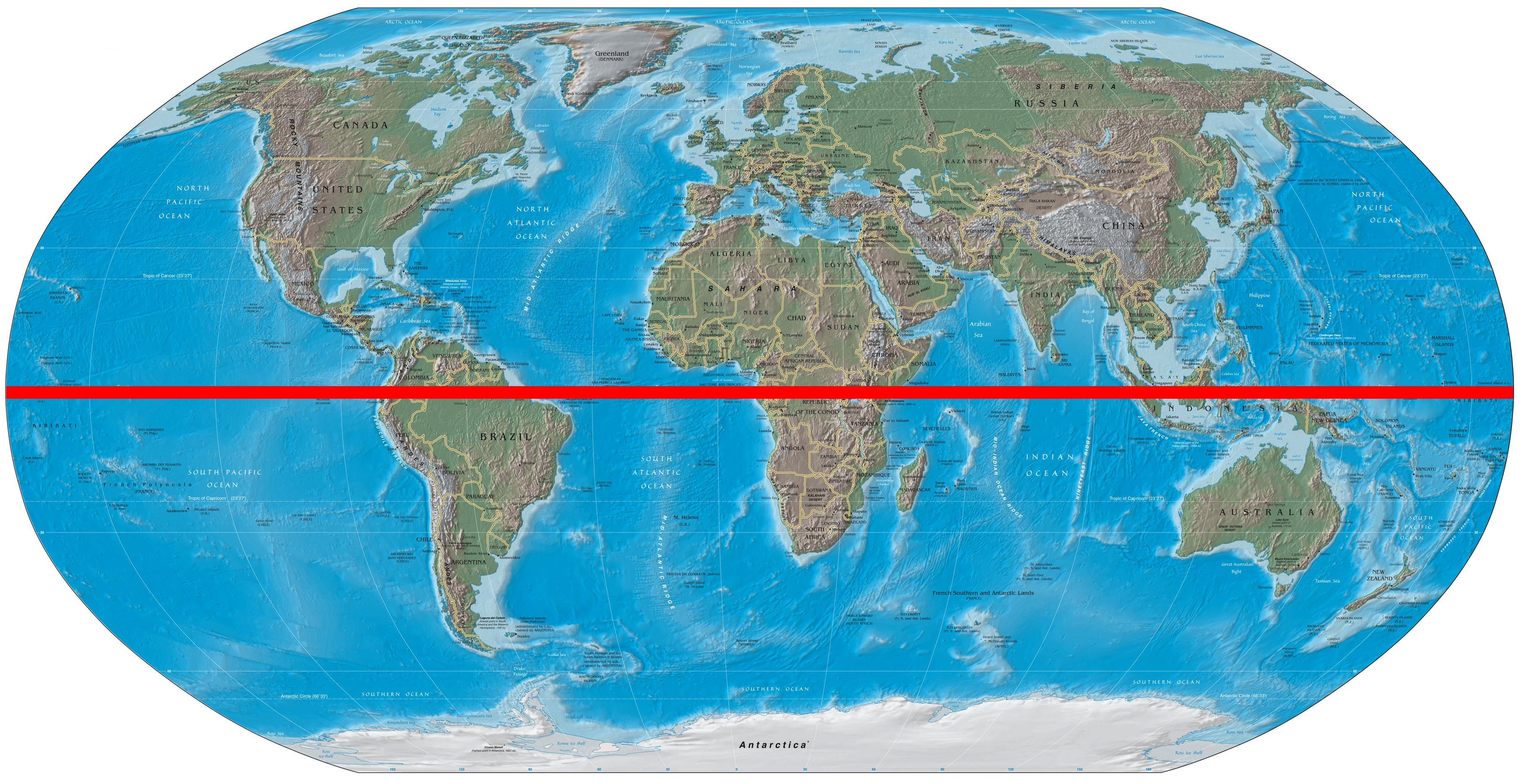
What is the name of this line at 0 degrees latitude?
a)
Prime Meridian
b)
Equator
c)
North Pole
d)
South Pole
4.
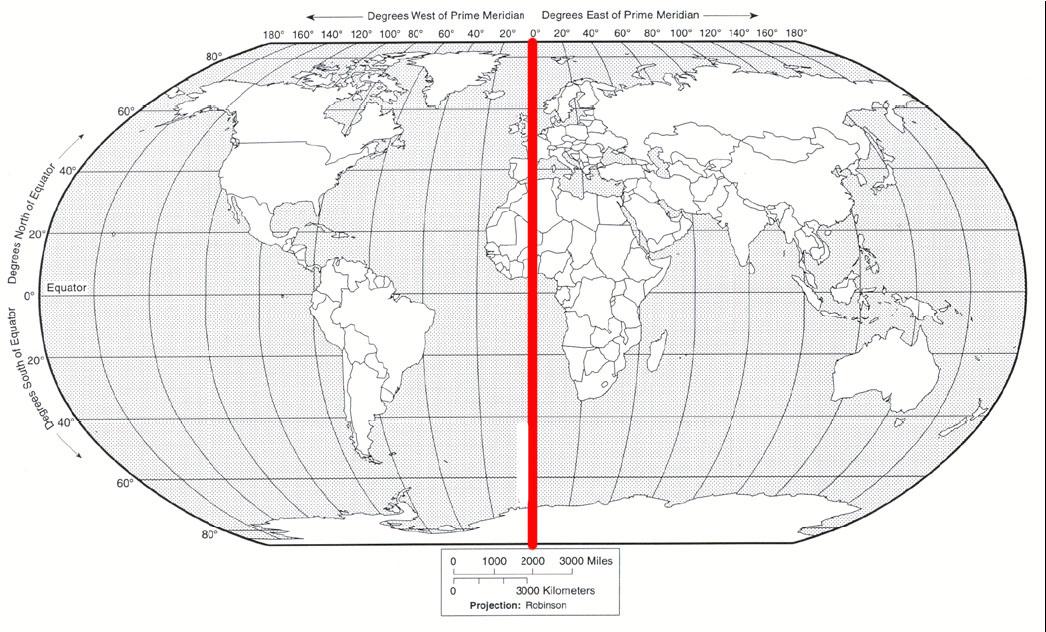
What is the name of the line at zero degrees longitude?
a)
Equator
b)
Prime Meridian
c)
North Pole
d)
South Pole
5.
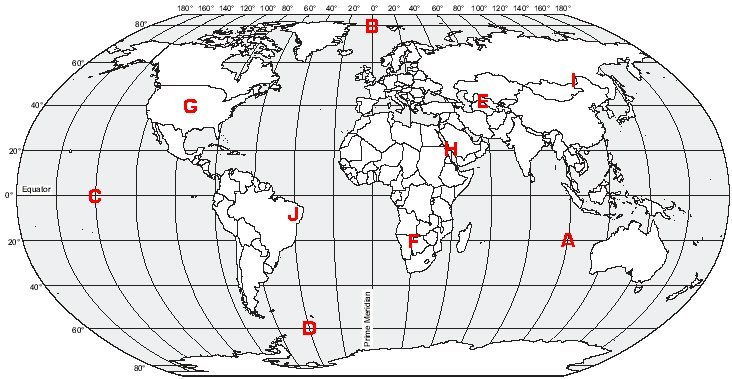
What is the approximate location of letter B?
a)
80oN, 0o
b)
0o, 80oW
c)
80oS, 0o
d)
0o, 80oE
6.
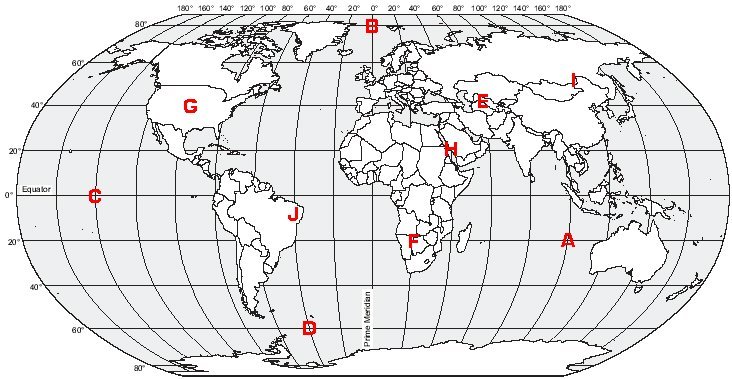
What is the approximate location of G?
a)
100oW, 40oN
b)
40oN, 100oW
c)
40oS, 100oW
d)
40oN, 100oE
7.

Which of the following letter is at approximately 60 degrees S, 40 degrees W?
a)
A
b)
D
c)
E
d)
H
8.

Which letter would you find at 15oS, 60oW?
a)
A
b)
C
c)
L
d)
H
9.
What are the 3 major climate zones in order from equator to the poles?
a)
arctic, temperate, tropical
b)
tropical, temperate, arctic
c)
temperate, arctic, tropical
10.
What is the condition of the Earth's atmosphere at a certain time and place?
a)
climate
b)
temperature
c)
weather
d)
air pressure
11.
Which BEST describes why latitudes closest to the equator have warmer climates?
a)
they are at lower elevations
b)
they receive more solar energy
c)
they are nearer to ocean currents
d)
they get more winds that carry energy in the form of heat
12.
What is the height of an area above sea level?
a)
elevation
b)
topography
c)
latitude
d)
longitude
13.
What is the weather conditions in an area over a long period of time?
a)
climate
b)
temperature
c)
elevation
d)
precipitation
14.
These clouds are wispy or curly, white, thin & feather-like
a)
cumulus
b)
cumulonimbus
c)
cirrus
d)
stratus
15.
These clouds are puffy and white and sometimes appear to have a flat bottom.
a)
cumulus
b)
cumulonimbus
c)
cirrus
d)
stratus
16.
These clouds appear in blanket-like layers.
a)
cumulus
b)
cumulonimbus
c)
cirrus
d)
stratus
17.
These clouds can bring thunderstorms, heavy rain, lightening, and sometimes hail.
a)
cumulus
b)
cumulonimbus
c)
cirrus
d)
stratus
18.
Rain, snow, sleet, and hail are all forms of _____.
a)
precipitation
b)
condensation
c)
evaporation
d)
climate
19.

A _____ is a large, swirling, low-pressure system that forms over the Atlantic Ocean.
a)
blizzard
b)
cold front
c)
tornado
d)
hurricane
20.

What part of the illustration shows Evaporation?
a)
1
b)
2
c)
3
d)
4
21.

Which number illustrates Condensation?
a)
1
b)
2
c)
3
d)
4
22.
What are the daily conditions of temperature, humidity and precipitation?
a)
weather
b)
climate
23.
What are the yearly conditions of temperature, precipitation and humidity?
a)
weather
b)
climate
24.
What imaginary line divides our world into the northern and southern hemispheres?
a)
equator
b)
international date line
25.
As your distance from the equator increases, what happens to temperature?
a)
temperature increases
b)
temperature decreases
26.
Which climate zone gets the least amount of direct sunlight and is the coldest?
a)
tropical
b)
temperate
c)
arctic
27.
Which climate zone gets the most amount of direct sunlight and rainfall and is the warmest?
a)
tropical
b)
temperate
c)
polar
28.
Which climate zone has moderate temperatures and rainfall year round?
a)
tropical
b)
temperate
c)
polar
29.
As altitude increases, what happens to temperature?
a)
temperature increases
b)
temperature decreases
30.
Which factor does not affect climate?
a)
longitude
b)
distance from large bodies of water
c)
latitude
d)
altitude
31.

This weather tool is used to measure...
a)
Rainfall
b)
Wind Direction
c)
Wind Speed
d)
Temperature
32.

What type of cloud is pictured?
a)
Cirrus
b)
Stratus
c)
Cumulous
d)
Nimbus
33.
This severe weather indicates lightening, thunder, and possibly hail
a)
thunderstorm
b)
tornado
c)
hurricane
d)
blizzard
34.

The layer of the atmosphere where weather occurs is the _.
a)
thermosphere
b)
stratosphere
c)
mesosphere
d)
troposphere
35.

Which statement best describes the difference between weather and climate?
a)
Weather is the conditions when you look outside while climate is the conditions you can expect for the next 6 months.
b)
Climate is the current condition outside while weather is what you can expect for the next 6 months.
36.
The weight of air as it presses down on Earth's surface
a)
front
b)
air pressure
c)
air mass
d)
evaporation
37.

Which direction will the low front move over the next 12 hours?
a)
Northeast
b)
Southeast
c)
Northwest
d)
Southwest
100 %

