wayground logo

Free Printable Worksheets

Font size

S
M
L
XL
Worksheets

7th Grade Science

Total questions: 90

Worksheet time: 1hrs 16mins

Name
Class
Date
1.
Research Question: Does the type of gasoline put in a car effect how fast the car can drive. What is the independent variable?
a)
Type of gasoline
b)
which car the gas is put into
c)
how fast the car can drive
d)
how much gas is put into the car
2.
Ms. S set up an experiment to see how the mass of a ball affects the distance it rolls off a ramp. What is the dependent variable?
a)
Distance traveled by the ball
b)
Height of the ramp
c)
Mass of the ball
d)
Where the experiment took place.
3.

Law of conservation of matter states that

a)

matter is created

b)

matter is destroyed

c)

matter is neither created nor destroyed

d)

matter does not change

4.

True or false. Law of conservation of matter means that the number of atoms of the products is more than the number of atoms in the reactants.

a)

True

b)

False

5.
REACTANTS are always on what side of the chemical equation?
a)
right
b)
left
c)
top
d)
bottom
6.
Which of the following are PRODUCTS?
H2O + CO→ HCO + HO
a)
H2O and CO2
b)
HCO and HO
c)
H2O ONLY
d)
HCO ONLY
7.
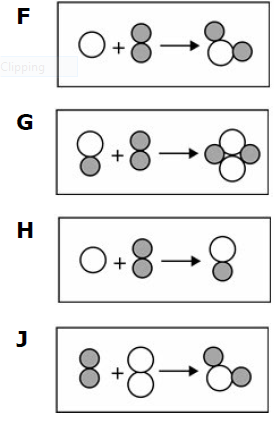
Which of the following models best demonstrates a balanced chemical equation?
a)
F
b)
G
c)
H
d)
J
8.
Coal contains carbon and other elements. Carbon dioxide forms when coal burns in the presence of oxygen. Which of these is the best evidence that a chemical reaction occurs when coal burns?
a)
The shape of the coal changes
b)
Oxygen is present
c)
A new substance is produced
d)
Coal is made up of more than one element
9.
The temperature of water is a characteristic property of water.
a)
True
b)
False
10.
Which of the following is a characteristic property?
a)
volume
b)
mass
c)
melting point
d)
weight
11.
Which of the following usually happens during a chemical change?
a)
Heat is released or absorbed
b)
The state of the matter changes
c)
The idenity of the matter stays the same
d)
No heat is released or absorbed
12.
A technology company has identified the need for a smaller laptop computer that weighs less, but they do not have enough knowledge about how to build it. 
What would be the next logical step engineers would take to design and produce this laptop computer?
a)
Build a new type of laptop battery
b)
Research current laptop technology
c)
Build a prototype computer
13.
An emergency-equipment company makes warning-signal flares. The company wants to redesign  a flare so that it produces light for a longer period of time. 
After the company thinks of ideas, what is the next step in the design process?
a)
Build a prototype
b)
Define the problem
c)
Decide on the best solution
14.
A group of engineers designed and constructed a flying car prototype. Their goal is for the car to enable people to safely fly to and from work instead of getting stuck in traffic jams.  
How will the engineers determine that this prototype meets their design requirements?
a)
Have a test pilot attempt to fly it from one location to another.
b)
See if the car can hover one meter above the ground for 20 minutes.
c)
Drive in the car at highway speeds on an interstate roadway at nighttime.
15.
What is the purpose of building a prototype?
a)
to test the product and make sure that it is the best solution to the problem
b)
to make sure that the product is in compliance with government regulations
c)
to determine the design constraints for the product
16.
Which of the following is the smallest unit of life that can carry out all life functions?
a)
the mitochondria
b)
the vacuoles
c)
the nucleus
d)
the cell
17.
Which cell structure is found in plant and animals cells and controls what can come into or leave a cell?
a)
cell membrane
b)
cytoplasm
c)
nucleus
d)
vacuole
18.
What is the function of the cell nucleus found in both plant and animal cells?
a)
to produce energy
b)
to control cell activity
c)
to remove waste products
d)
to allow molecules to enter the cell
19.
All cells need energy to function.  Which cell organelle is responsible for producing energy in the cell?
a)
chloroplasts
b)
mitochondria
c)
nucleus
d)
vacuoles
20.
What is the function of a cell wall?
a)
to protect and support the cell
b)
to perform different functions in each cell
c)
to prevent water from passing through it
d)
to prevent oxygen from entering the cell
21.
In what part of the plant cell does the process of photosynthesis take place?
a)
nucleus
b)
mitochondria
c)
chloroplasts
d)
vacuoles
22.
Plants need ________ for photosynthesis
a)
oxygen
b)
soil
c)
carbon dioxide
d)
sugar
23.
What are the products of photosynthesis?
a)
water and carbon dioxide
b)
oxygen and glucose
c)
oxygen and carbon dioxide
d)
oxygen and water
24.
What are the products of photosynthesis?
a)
Carbon dioxide and water
b)
Carbon dioxide and oxygen
c)
Glucose and oxygen
d)
Glucose and water
25.
Which statement about photosynthesis is correct?
a)
Plants get the energy they need for photosynthesis from water.
b)
Plants get the energy they need for photosynthesis from soil.
c)
Plants get the energy they need for photosynthesis from sunlight.
d)
Plants do not require energy to perform photosynthesis.
26.
The main source of energy for all life comes from ____.
a)
the Earth
b)
the moon
c)
the sun
d)
the food we eat/make
27.
Where does photosynthesis occur?
a)
mitochondria
b)
stomata
c)
xylem
d)
chloroplast
28.
What chemical reaction has almost the same products and reactants as cellular respiration but reversed?
a)
Rusting
b)
Photosynthesis
c)
Combustion
d)
Symphonies
29.
Where does cellular respiration take place in the cell?
a)
Cell Membrane
b)
Nucleus
c)
Mitochondria
d)
Vacuole
30.
What is the purpose of cellular respiration?
a)
to break down food
b)
to create energy in the body
c)
to release energy from food
d)
there is none; it's a waste of time
31.
The main purpose of the ____________ system is to break food particles into pieces that can be used.
a)
circulatory
b)
respiratory
c)
digestive
d)
skeletal
32.
What is responsible for delivering oxygen and removing carbon dioxide from the body?
a)
cell nucleus
b)
excretory system
c)
nervous tissue
d)
respiratory system
33.
The __________ is the main organ of the nervous system.
a)
heart
b)
lungs
c)
brain
d)
skin
34.
The circulatory system uses _________ to deliver oxygen to the rest of the body.
a)
blood cells
b)
lungs and nose
c)
blood vessels
d)
brain and spinal cord
35.
In multicellular organisms, tissues are comprised of _______.
a)
organs
b)
systems
c)
cells
d)
blood
36.
When tissues come together, they form ___________.
a)
cells
b)
atoms
c)
organs
d)
systems
37.
A(n) _________ is made of small parts connected together to make a whole.
a)
system
b)
problem
c)
evidence
d)
illustration
38.
Which of the following body systems work together for support, protection, and movement?
a)
respiratory and cardiovascular
b)
skeletal and muscular
c)
skeletal and integumentary
d)
digestive and respiratory
39.
Which of the following shows the levels of organization of an organism from LEAST to MOST complex.
a)
cells-tissues-systems-organs
b)
organs-cells-systems-tissues
c)
systems-organs-tissues-cells
d)
cells-tissues-organs-systems
40.
Tammy is the only one of her siblings to develop breast cancer. She undergoes genetic testing and there is no evidence of the BRAC gene. She is the only one of her siblings who is a long-term smoker. What causes this condition?
a)
Genetics only
b)
Environment only
c)
Neither
d)
Both
41.
Down Syndrome is caused by nondisjunction, when the chromosomes fail to separate during Meiosis. This results in an extra 21st chromosome. What causes this disease?
a)
Genetics only
b)
Environmental only
c)
Both
d)
Neither 
42.
People with PKU are born with a recessive gene for the disease. For these individuals eating protein will result in brain damage. However, if they control their diet and avoid protein they will not ever have any symptoms. The brain damage these people can get is caused by _____________.
a)
Genetics only
b)
Environment only
c)
An interaction of both genetics and environment
d)
Neither
43.

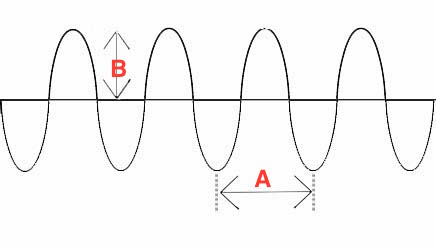
What property of this wave is represented by the letter "A"

a)

amplitude

b)

crest

c)

trough

d)

wavelength

44.
What property of the wave is represented by the letter "B"?
a)
amplitude
b)
crest
c)
trough
d)
wavelength
45.
The highest point on a wave is:
a)
the crest
b)
the trough
c)
the top
d)
the coast 
46.
The lowest point on a wave is the:
a)
Amplitude
b)
Crest
c)
Trough
d)
Wavelength
47.
The number of wavelengths that pass a point each per second is:
a)
frequency
b)
period
c)
longitudinal 
d)
transverse wave 
48.
When the frequency of a wave increases, what happens to the wavelength?
a)
The wavelength is not directly affected by the frequency of a wave.
b)
The wavelength increases.
c)
The wavelength decreases.
d)
More specific information is needed to form a conclusion about the wavelength.
49.
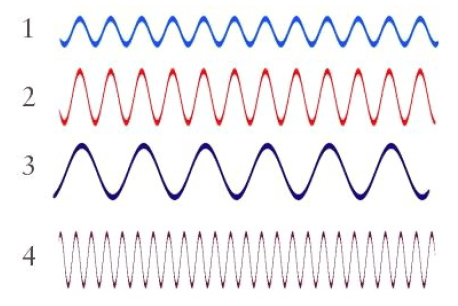
Which wave in the diagram has the greatest frequency?
a)
1
b)
2
c)
3
d)
4
50.
regular disturbances that carry energy through matter or space
a)
crest
b)
energy
c)
wave
d)
trough
51.
When a wave strikes and object and bounces off. (example echo)
a)
medium
b)
refraction
c)
reflection
d)
interference
52.
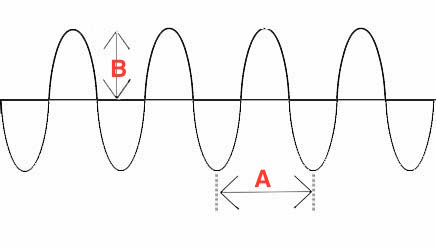
Which wave has a higher amplitude?
a)
The wave on top
b)
The wave on bottom
c)
They both have the same amplitude
53.
Light is a form of 
a)
energy
b)
radiation
c)
reflection
54.

When a wave transfers all of its energy into the material it strikes

a)

Absorption

b)

Diffraction

c)

Reflection

d)

Refraction

55.

When a wave passes through a transparent object.

a)

Absorption

b)

Transmission

c)

Diffraction

d)

Reflection

56.
a)

absorption

b)

diffraction

c)

reflection

d)

refraction

e)

transmission

57.
Why do we see objects as white?
a)
They absorb all light
b)
They reflect all light
c)
They absorb some light and reflect some light
58.
Absorb or Reflect all colors?
a)
Absorb
b)
Reflect
59.
Does the frog reflect or absorb green?
a)
Reflect
b)
Absorb
60.
Does the scarf reflect or absorb yellow?
a)
Reflect
b)
Absorb
61.
How does light travel?
a)
in a wavy path
b)
in a straight path
c)
in a zig zag path
d)
in all different directions
62.
What is true about a digital signal?
a)
They are easily distorted or affected by interference
b)
They take up more space
c)
They require more information
d)
They are generally considered more reliable
63.
Why are digital signals used by most modern electronics?
a)
They can be interpreted in multiple ways
b)
They need more power
c)
They can only be interpreted in one way
d)
They require more space
64.
Heat transfer always goes from-
a)
Cold to Hot
b)
Hot to Cold
c)
Heat doesn't transfer
d)
Freezing to Cold
65.
In what direction do hot liquids and gasses move?
a)
Side to Side
b)
Down
c)
Up
d)
Back and Forth
66.
What happens to particles as they heat up?
a)
They slow down
b)
Nothing
c)
They don't move
d)
They speed up
67.
What type of material makes the best conductor?
a)
Food
b)
Wood
c)
Styrofoam
d)
Metal
68.
What type of material makes the best insulators?
a)
Aluminum
b)
Copper
c)
Styrofoam
d)
Metal
69.
As you touch a hot stove the heat transfers -
a)
from your hand to the stove
b)
from the stove to your hand
c)
It doesn't transfer
70.
Which sentence explains why a cold metal spoon placed in a pot of boiling water becomes hot?
a)
Thermal energy is transferred from the spoon to the water.
b)
Thermal energy is transferred from the water to the spoon.
c)
Thermal energy in the water is transformed into kinetic energy in the spoon.
d)
Thermal energy in the spoon is transformed into kinetic energy in the water.
71.
The measure of average kinetic energy of all the particles within an object is called ____________. 
a)
temperature
b)
conduction
c)
radiation
d)
heat 
72.
What is Matter?
a)
Anything you can see.
b)
Anything you can feel.
c)
Anything that's heavy.
d)
Anything that takes up space and has mass.
73.
What is force?
a)
A push exerted on an object
b)
A push or pull exerted on an object
c)
A pull exerted on an object
d)
Nothing
74.
Forces that have a net force of zero ( the object is still).
a)
Balanced force
b)
Unbalanced force
75.
Which planet has the strongest gravitational pull towards the Sun?
a)
Jupiter
b)
Neptune
c)
Mercury
d)
Earth
76.
Distance and mass are two factors that affect
a)
Gravitational Force Fields
b)
Magnetic Force Fields
c)
Electric Force Fields
d)
Electrostatic Force Fields
77.
Surrounding every magnet is a __________  __________.
a)
magnetic field
b)
electrical current
c)
another magnet
78.
Opposite magnetic forces _____ each other.
a)
Attract
b)
Repel
79.

A positively charged pith ball is hanging from a string. A negatively charged rod is then held a short distance away. How will the pith ball be affected?

a)

It will not be affected because only the rod has an electrical field.

b)

The fields on the pith ball and the rod will interact, causing an attractive force.

c)

The fields on the pith ball and the rod will interact, causing a repulsive force.

d)

It will not be affected because the pith ball and the rod are not touching.

80.

Two charged objects are 10 cm apart. One is positively charged, and the other is positively charged. The electric field lines would be represented by arrows drawn _ each other. This drawing represents a/an _ attractive force.

a)

away; repulsion

b)

toward; repulsion

c)

away; attractive

d)

toward; attractive

81.

Two charged objects are 10 cm apart. One is positively charged, and the other is negatively charged. The electric field lines would be represented by arrows drawn _ each other. This drawing represents a/an _ force.

a)

toward; repulsion

b)

toward; attractive

c)

away; repulsion

d)

away; attractive

82.
What type of force is holding this balloon to the wall?
a)
Applied
b)
Gravitational
c)
Magnetic
d)
Electrical
83.
What force holds the planets in motion around the sun?
a)
Magnetic
b)
Electrical
c)
Gravitational
d)
Air Resistance
84.
What type of force causes these balloons to move toward or away from each other?
a)
Gravitational
b)
Applied
c)
Magnetic
d)
Electrical
85.
Gravitational potential energy depends on the ________ and ________ of the object. 
a)
Height and mass
b)
Friction and movement
c)
Mass and Movement
d)
Height and Friction 
86.
Can energy be destroyed
a)
no
b)
yes
87.
When a pendulum swings, at which point is kinetic energy highest?
a)
1
b)
2
c)
3
d)
4
88.
When a pendulum swings, at which point is potential energy at its greatest?
a)
1
b)
2
c)
3
d)
4
89.
Energy is the ability to do work.
a)
True
b)
False
90.
What is gravitational potential energy 
a)
Potential energy related to an object's height 
b)
Energy that results from the position or shape of an object
c)
The energy associated with objects that can be compressed or stretched.