
NEW
Font size
S
M
L
XL
 Worksheets
Earth's Changing Surface
Total questions: 42
Worksheet time: 35mins
Name
Class
Date
1.
Which of the following accurately describes erosion and weathering?
a)
Weathering breaks rocks apart; erosion moves the rock
b)
Erosion and weathering break rock into smaller pieces
c)
Erosion breaks rocks apart; weathering moves the rock
d)
Erosion is a physical process; weathering is chemical
2.
Which of the following actions causes the deposition of sand at a delta?
a)
river water slowing as it enters the ocean
b)
salt water & fresh water mixing together
c)
ocean waves transporting sand toward land
d)
ocean water slowing as it reaches the coast
3.
What is the movement of soil from one place to another?
a)
weathering
b)
deposition
c)
discharge
d)
erosion
4.
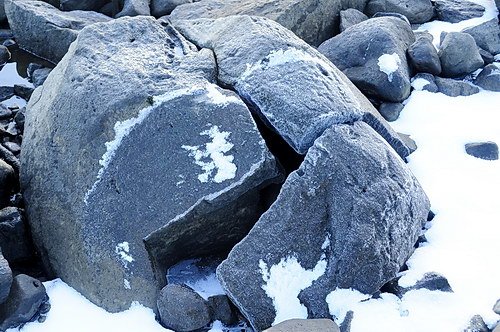
How does freezing water cause the weathering of rocks? The freezing water—
a)
keeps the rocks in place.
b)
makes the rocks last longer.
c)
expands cracks and breaks rocks.
d)
causes rocks to fall in landslides.
5.
The natural chemical or physical processes that breaks down rock on Earth's surface.
a)
weathering
b)
erosion
c)
deposition
d)
jackhammering
6.
Consists of small particles of rock or soil, or the remains of plants and animals
a)
rock
b)
sediment
c)
soil
d)
plants
7.
This type of weathering occurs when rocks weaken then break down due to chemical changes in the composition of the rock.
a)
mechanical weathering
b)
chemical weathering
c)
erosion weathering
d)
deposition
8.

These rocks were broken apart from the continuous freeze/thaw of water in the cracks of the rocks. This is an example of:
a)
ice wedging
b)
acid rain
c)
permeability
d)
abrasion
9.
A metal statue slowly turning green after years of being outside is an example of:
a)
mechanical weathering
b)
chemical weathering
10.
The breakdown of rock is called _____.
a)
Weathering
b)
Erosion
c)
Deposition
d)
Abrasion
11.
A glacier is a large mass of
a)
water
b)
soil
c)
rocks
d)
ice
12.
This type of weathering is an example of chemical weatheirng
a)
Land Slide
b)
Root Prying (wedging)
c)
Ice Wedging
d)
Acid Rain
13.

The outside layer of the earth is called ______________________.
a)
core
b)
crust
c)
mantle
d)
outer core
14.
The creation of sediments through exposure to wind, water, or biological organisms is known as...
a)
Depostion
b)
Erosion
c)
Weathering
d)
Disintegration
15.
The movement of sediments from one place to another is known as...
a)
Weathering
b)
Erosion
c)
Deposition
d)
Disintegration
16.
The dropping off of sediments in a new place is known as...
a)
Weathering
b)
Erosion
c)
Deposition
d)
Disintegration
17.

This arch was made by ____ erosion
a)
plant
b)
ice
c)
wind
d)
people
18.

This picture shows a
a)
landform made by depositon
b)
landform made by glacier
c)
landform made by wind
d)
landform made by weathering
19.
Deltas can be found when rivers ...
a)
move too slowly
b)
empty into the ocean
c)
move too quickly
d)
turn
20.
How are canyons formed?
a)
When ice, wind and water carve rock out of the floor of a valley.
b)
When water melted snow on the floor of a valley.
c)
When a river dried up on the floor of a valley.
d)
When ice, wind, and water swept sand into the floor of a valley.
21.
Which of these landforms were made by deposition?
a)
River mouth
b)
Delta
c)
Valley
d)
Canyon
22.
How does a delta form?
a)
ocean waves deposit it on the beach
b)
it's just a river that empties into an ocean or lake
c)
the current of the river speeds up at the mouth causing sediment to wash away
d)
the current of the river slows down causing sediment to deposit
23.
What does weathering mean?
a)
to move
b)
to settle in a new spot
c)
to break apart
d)
to sit still
24.
What does erosion mean?
a)
to break apart
b)
to settle in new spot
c)
to move
d)
to sit still
25.
What does deposition mean?
a)
to settle in a new spot
b)
to break apart
c)
to sit still
d)
to move
26.
The following are agents of erosion EXCEPT...
a)
wind
b)
water
c)
ice
d)
fire
27.
One of the first steps in the formation of a sedimentary rock is that other rocks must undergo...
a)
weathering, erosion, and deposition
b)
melting and cooling
c)
extreme heat and pressure
d)
compaction and cementation
28.
The Earth's surface does not change over time.
a)
True
b)
False
29.
The Earth has always been as it is now.
a)
True
b)
False
30.
The Earth has always been as it is now.
a)
True
b)
False
31.
Weathering is when rocks and sediment
a)
break down
b)
move
c)
stay in the same place
d)
become ice
32.
Erosion is when rocks, sediment and soil
a)
break down
b)
decompose
c)
move to a new place
d)
stay in the same place
33.
Deposition is when rocks, sediment and soil
a)
break down
b)
move to a new place
c)
sit in a new place
d)
become new soil
34.
The following things can cause erosion except for
a)
wind
b)
water
c)
animals
d)
heat
35.
In our experiment, the vinegar reacting with the limestone is an example of
a)
erosion
b)
deposition
c)
weathering
36.
In our experiment, the sand settling at the bottom of the pan is
a)
erosion
b)
deposition
c)
weathering
37.
If ice cracks a rock this is an example of
a)
erosion
b)
weathering
c)
deposition
38.
If a rocks gets pushed in a stream by water and slowly becomes smaller, this is an example of
a)
deposition and weathering
b)
erosion and deposition
c)
weathering and erosion
d)
only erosion
39.
Sand has built up along a stream into a large pile. This is an example of
a)
deposition
b)
erosion
c)
weathering
40.
When the sugar dissolved in the water, this is an example of
a)
erosion
b)
weathering
c)
deposition
41.
A rock falls down a hill and rests at the bottom. This is an example of
a)
erosion and weathering
b)
erosion and deposition
c)
deposition and weathering
42.
A rock falls down a hill, gets scratched and then comes to a complete stop at the bottom. In what order did these events happen?
a)
deposition, weathering, erosion
b)
erosion, deposition, weathering
c)
erosion, weathering, deposition
d)
weathering, erosion, deposition
Reset

