wayground logo

Free Printable Worksheets

NEW

Font size

S
M
L
XL
Worksheets

Electricity and Magnetism Review

Total questions: 21

Worksheet time: 17mins
Name
Class
Date
1.
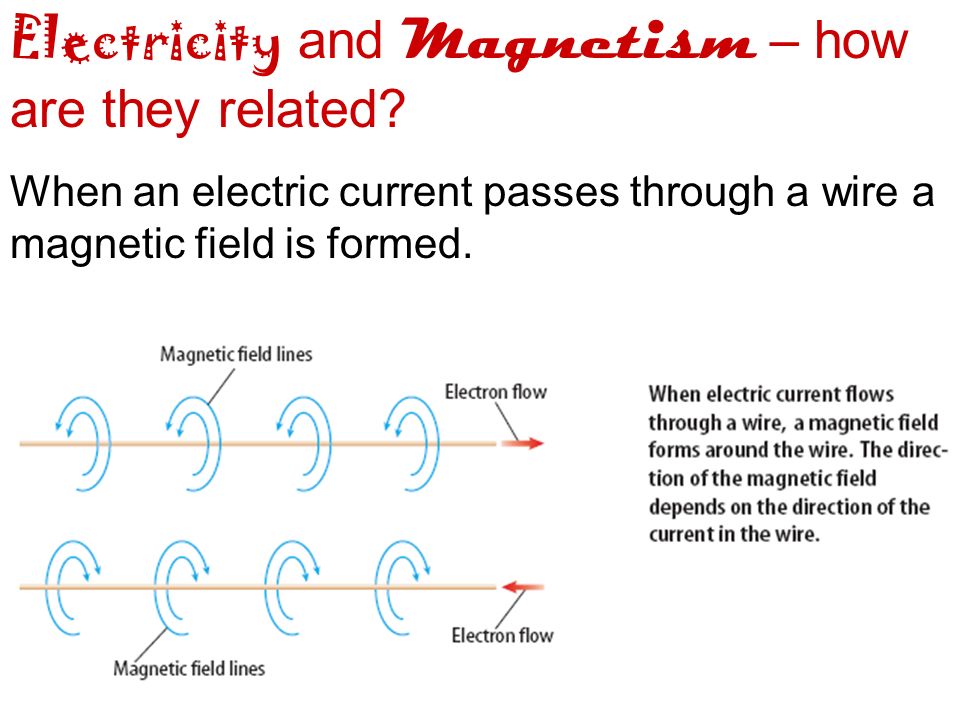
While electric current is flowing through a wire, what surrounds the wire?
a)
a magnetic field
b)
a glowing light
c)
neutrons
d)
protons
2.

What two forces are required for generators and electric motors to work?

a)

magnetism and thermal

b)

electricity and thermal

c)

electricity and magnetism

d)

magnetism and radiant

3.
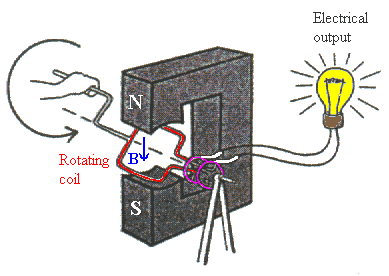
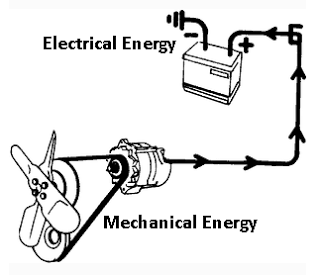
What is the transfer of electricity in a generator?
a)
Mechanical to Electrical 
b)
Physical to Potential 
c)
Electrical to Mechanical
d)
Yogurt to Light
4.
What is the transfer of electricity in a motor?
a)
chemical to mechanical 
b)
electrical to mechanical
c)
mechanical to electrical 
d)
physical to potential 
5.
This picture shows a turbine generator used to produce electricity at a geothermal power plant.
Electricity is produced by using steam to _____________.
a)
heat the turbine generators
b)
spin the turbine generators 
c)
reduce friction in the turbine generators
d)
reduce emissions from the turbine generators
6.

What would happen if you broke a bar magnet into 8 pieces?

a)

You would have 8 half magnets

b)

You would have 4 complete magnets

c)

You would have 8 complete magnets

d)

They wouldn't be magnets anymore

7.

A transformer actually transforms

a)

voltage

b)

magnetic field lines

c)

generators into motors

8.

A device that transforms mechanical energy to electrical energy is a

a)

generator

b)

motor

c)

transformer

d)

magnet

9.

A device that transforms electrical energy to mechanical energy is a

a)

generator

b)

motor

c)

transformer

d)

magnet

10.
The transformer shown is what type?
a)
step-up
b)
step-down
c)
current transformer
d)
isolation transformer
11.

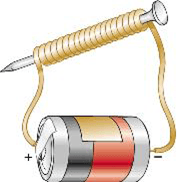
Why did this simple electric motor work?

a)

The current from the battery induces a magnetic field in the copper loop, turning it into an electromagnet that repels from/attracts to the permanent magnet

b)

The electromagnet on top of the battery pulls on the magnetic copper wire

c)

The magnet induces a current in the copper loop which makes it rotate.

d)

The magnetic field from the battery induces an electric current in the copper loop, turning it into an electromagnet that repels from/attracts to the permanent magnet

12.
An electric motor changes electrical energy to _________ energy. 
a)
mechanical 
b)
chemical
c)
potential
d)
free
13.

How are electromagnets different from permanent magnets?

a)

magnets can be turned on/off

b)

you can turn an electromagnet on/off

c)

magnets are more powerful

d)

magnets have a North and South pole

14.
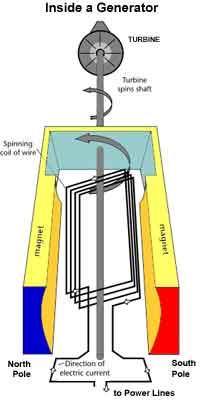
In large generators in power plants, ___________ rotate inside a coil of wire to produce an electric current.
a)
Wind
b)
Water
c)
Magnets
d)
Circuits
15.
Based on this picture, which side will have a higher voltage?
a)
Secondary
b)
Primary
c)
Both sides have the same voltage
d)
Cannot be determined
16.
A magnet is moved in and out of a coil of wire connected to a high-resistance voltmeter. If the number of coils doubles, the induced voltage 
a)
quadruples
b)
doubles
c)
is the same
d)
halves
17.

An ideal transformer has 12 V input voltage with 10 turns on the primary (input) coil, and 100 turns on the secondary coil has. What is the secondary voltage?

a)

0.12 V

b)

1.20 V

c)

12.0 V

d)

120.0 V

18.
What is the device seen here?
a)
generator
b)
electric motor
c)
electromagnet
d)
magnet
19.
When John plugs in a toy and turns it on, a marble is carried up to the top of a slide. At the top, a marble is released and it goes down a slide. What kind of energy transformation occurs to make this toy work?
a)
chemical to heat
b)
electrical to chemical
c)
sound to electrical
d)
electrical to mechanical
20.
A device that converts kinetic energy into electrical energy
a)
A. electric generator
b)
B. electric motor
c)
C. electromagnetic induction
d)
D. electricity
21.
What is the relationship between electrical current and magnetic field strength in an electromagnet?
a)
When current is increased, magnetic field strength increases
b)
When current is increased the strength of magnetic field decreases
c)
When the current is decreased, the strenght of the magnetic field is increased.
d)
There is an "indirect proportion," meaning, if the value of one goes up, the value of the other goes down.