
 Worksheets
FHMS Drama Summative 7th Grade Theatre
Total questions: 36
Worksheet time: 17mins
What is Blocking?
Planned stage movement.
Decorations or objects used on the stage.
To move from one location to another.
Acting with little or no preparation.
The personality created on stage that is different than your own personality.
What is a cross?
Planned stage movement.
Decorations or objects used on the stage.
To move from one location to another.
Acting with little or no preparation.
The personality created on stage that is different than your own personality.
What is a character?
Planned stage movement.
Decorations or objects used on the stage.
To move from one location to another.
Acting with little or no preparation.
The personality created on stage that is different than your own personality.
What is an improvisation?
Planned stage movement.
Decorations or objects used on the stage.
To move from one location to another.
Acting with little or no preparation.
The personality created on stage that is different than your own personality.
What is are props??
Planned stage movement.
Decorations or objects used on the stage.
To move from one location to another.
Acting with little or no preparation.
The personality created on stage that is different than your own personality.

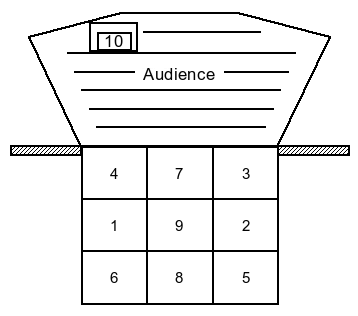

#2


#1
If your feet are facing downstage and the audience can see you entirely from the front, you are standing in what body position?
Full Front
Full Back
Profile Left or Profile Right
. ¼ Left or ¼ Right
¾ Left or ¾ Right
If your feet are facing the back wall and the audience sees your entire back, what position are you standing in?
Full Front
Full Back
Profile Left or Profile Right
. ¼ Left or ¼ Right
¾ Left or ¾ Right
If one of your feet are facing the audience and the other foot is facing stage right, what position are you in?
Full Front
Full Back
Profile Left or Profile Right
¼ Right
¼ Left
If one of your feet are facing the audience and the other foot is facing stage left, what position are you in?
Full Front
Full Back
Profile Left or Profile Right
. ¼ Left
. ¼ Right
If you are facing straight to the left or right side of the stage and the audience sees the side of your face, what position are you in?
Full Front
Full Back
Profile Left or Profile Right
. ¼ Left
. ¼ Right
Where did the term Downstage come from?
ancient Greek theatre
ancient Roman theatre
Elizabethan theatre
Medieval Theatre
If I ask you to move from one location onstage to another, you could class that as:
improvisation
pantomime
cross
hitting your mark
Blocking is never planned – you make it up as you go.
True
False
When you build a character it is never based on who you are or your own past experiences.
True
False
The first actors were cave dwellers.
True
False
Greek and Roman Theatre emerged at the same time, in the same region of the world, and are essentially the same in style and format.
True
False
William Shakespeare was a playwright, actor, and ran a theatre called the Swan.
True
False
The first part of the play where you learn who the characters are is called the:
Exposition
Rising Action
Falling Action
Climax
Resolution
The conflict is usually first introduced during this part of the plot:
Falling Action
Denouement
Exposition
Initial/Inciting Incident
Climax
The most exciting part of a play or story is called the:
Climax
Point of view
Connotative Meaning
Blocking
Playwright
What are the three parts of a speech?
Beginning, Middle, End
Introduction, Body, Conclusion
Start, Body, Stop
Exposition, Conflict, Conclusion
What is not one of the purposes of a speech?
Inform
Entertain
Persuade
Direct
Which delivery skills would you use while giving a speech?
Eye Contact
Posture
Volume
All of the above
What would the theatre be like if Shakespeare had never existed? This is an example of what kind of attention getter?
Quote
Rhetorical Question
Startling Statement
Fact

