
 Worksheets
Evolution Quiz
Total questions: 20
Worksheet time: 20mins
Name
Class
Date
1.

Which of the following is a term for a group of similar organisms that can reproduce fertile offspring?
a)
individual
b)
population
c)
species
d)
fossil
2.
Which of the following is a fossil?
a)
a plant that has recently died
b)
a group of organisms that can reproduce
c)
a structure or organ that no longer functions
d)
a trace of an organisms that existed in the past
3.
Over time, adaptions can lead populations to experience
a)
environmental changes
b)
genetic changes
c)
geological changes
d)
extinction
4.
In natural selection, the selective agent is the
a)
humans
b)
mutations
c)
breeders
d)
environment
5.

All rabbits living in a particular area would be an example of a(n)
a)
population
b)
species
c)
fossil
d)
individual organism
6.

a bird that can easily outcompete other birds for food and that can produce many eggs has a high
a)
life expectancy
b)
mutation rate
c)
fitness
d)
adaptability
7.

which of the folllowing is an exammple of a vestigial structure?
a)
the wings of a red-tailed hawk
b)
the hind limbs of a house cat
c)
the fins of sharks
d)
the wings of an ostrich
8.

Some organisms that share a common ancestor have features that have different functions, but similar structures. These are known as
a)
vestigial structures
b)
analogous structures
c)
homologous structures
d)
fossil structures
9.

If an organism has a vestigial structure, that structure likely once had a function in a(n)
a)
close relative
b)
early ancestor
c)
unrelated organism
d)
embryological stage
10.

Two organisms that are closely related would have
a)
very similar DNA sequence
b)
exactly the same DNA sequences
c)
no proteins in common
d)
completely different DNA sequence
11.
The more genetic variation a population has,
the more likely it is for some individuals to
a)
evolve
b)
migrate
c)
survive
d)
mutate
12.

Genetic variation can arise from a random change in the DNA of a gene. The change is called a(n)
a)
mutation
b)
gene flow
c)
gene pool
d)
allele
13.
Mutations are important because they bring about
a)
death of the organism in which they develop
b)
genetic variation needed for a population to evolve
c)
benefits for the individual, not for the population
d)
Hardey-Weinberg equilibrium within a population
14.

the hind leg bones in a whale are examples of
a)
homologous structures
b)
analogous structures
c)
fossils
d)
vestigals
15.
What is the process in which humans breed organisms for certain traits?
a)
natural selection
b)
inheritance
c)
artificial selection
d)
descent withOUT modification
16.

The table shows the survival rate of two types of beetles in the same environment over a period of three years.
Which statement about the beetles in this environment is best supported by the data?
Which statement about the beetles in this environment is best supported by the data?
a)
Brown beetles have a shorter life cycle than green beetles have
b)
Green beetles are more fit for their environment than brown beetles
c)
brown beetles are undergo more unfavorable mutations than green beetles
17.
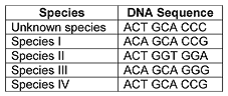
According to this data, the unknown bacterial species is most closely related to:
a)
Species I
b)
Species II
c)
Species III
d)
Species IV
18.
Why did Darwin's finches develop different beaks?
a)
individual birds changed their beaks based on what food they wanted to eat
b)
they developed in different countries and then migrated to different islands on the Galapagos
c)
To tell each other apart for mating
d)
The beaks are a feeding adaptation due to competition for scarce food
19.
Which describes natural selection?
a)
Some live and some die in each generation
b)
Only the largest and strongest survive
c)
Random assortment of genes results in better characteristics in the following generations
d)
The best adapted individuals survive and reproduce, contributing the most to the next generation
20.
Any variation that can help an organism survive in its environment is called a(n):
a)
Adaptation
b)
Characteristic
c)
Competition
d)
Vestigial structure
100 %

