
 Worksheets
Science Review #1
Total questions: 70
Worksheet time: 1hrs 15mins
Name
Class
Date
1.
A __________ includes all living and non-living things in an environment.
a)
population
b)
niche
c)
abitotic
d)
ecosystem
2.
_______ are consumers that eat only meat.
a)
Herbivore
b)
Omnivore
c)
Carnivore
3.
________ are consumers that eat plants and meat.
a)
Herbivore
b)
Omnivore
c)
Carnivore
4.
Which organism make their own food through the process of photosynthesis?
a)
decomposer
b)
consumer
c)
herbivore
d)
producer
5.
What are interconnected food chains called?
a)
consumers
b)
predators
c)
food web
6.
A lion, captures and eats other animals. What is he considered?
a)
prey
b)
predator
c)
producer
d)
healthy
7.
All the members of one species that live within an area of an ecosystem
a)
population
b)
community
c)
niche
8.
Organisms that make up the living part of an ecosystem.
a)
abiotic
b)
biotic factors
c)
ecology
d)
ecosystems
9.

Nonliving things found in an ecosystem.
a)
factories
b)
factor trees
c)
biotic factors
d)
abiotic factors
10.
What is a PUSH or PULL of an object?
a)
Motion
b)
Force
c)
Friction
d)
Gravity
11.
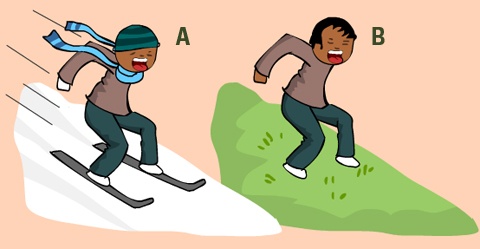
Why is it harder for the boy in Image B to get down the hill?
a)
Motion
b)
Friction
c)
Work
d)
Displacement
12.
Which force produces a change in motion?
a)
unbalanced force
b)
balanced force
c)
gravitational force
d)
frictional force
13.
_______________ is how fast an object changes over time.
a)
speed
b)
velocity
c)
momentum
d)
acceleration
14.
When you tell the direction and speed of an object, you give its
a)
motion
b)
velocity
c)
acceleration
d)
mass
15.
What are the three states of matter?
a)
solid, volume, mass
b)
density, volume, mass
c)
solid, liquid, gas
d)
density, gas, volume
16.
Something that takes up space and has mass.
a)
volume
b)
matter
c)
mass
d)
density
17.
A state of matter that has a definite volume and shape.
a)
solid
b)
liquid
c)
gas
d)
matter
18.
A measure of how much mass is contained in a given unit of volume.
a)
mass
b)
density
c)
volume
d)
matter
19.
The amount of space something takes up
a)
density
b)
volume
c)
mass
d)
matter
20.
Shape is a ____ that helps identify an object.
a)
physical property
b)
chemical property
c)
mass
d)
matter
21.
Iron + oxygen = rust is an example of a ___________.
a)
physical property/change
b)
chemical property/change
c)
mass
d)
volume
22.
The ability of a metal to allow heat or electricity to pass through it.
a)
conductivity
b)
insulator
c)
mass
d)
density
23.
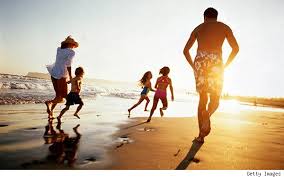
The sun shines down on this family as the play on the beach.
a)
conduction
b)
convection
c)
radiation
24.

A group of friends gather around a fire to stay warm.
a)
conduction
b)
convection
c)
radiation
25.
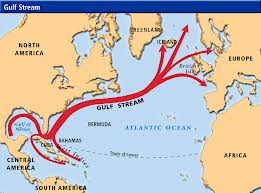
The Gulf Stream is a current that brings warm ocean water from the south to the north.
a)
conduction
b)
convection
c)
radiation
26.

Which direction will the heat flow while this person holds a hot cup of tea?
a)
from the cup to her hand
b)
from her hand to the cup
c)
no heat is transferred
27.
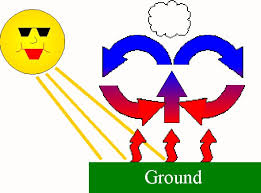
Warm air rises and the cool air sinks.
a)
conduction
b)
convection
c)
radiation
28.
Which biome is characterized by low temperatures and low amounts of rainfall?
a)
tundra
b)
desert
c)
temperate deciduous forest
d)
tropical rain forest
29.
Which biome covers most of the land mass near the Earth's equator?
a)
tundra
b)
desert
c)
grassland
d)
tropical rainforest
30.
Which type of trees is found in a temperate forest?
a)
deciduous
b)
evergreen
c)
ginko
d)
palm
31.
Which major biome is home to cacti, mesquite, white thorn, pack rats, small reptiles, and coyotes?
a)
desert
b)
taiga
c)
tundra
d)
grassland
32.
Which biome contains large populations of grazing herbivores, few species of birds, and deep, rich soil?
a)
taiga
b)
tundra
c)
deciduous forest
d)
grassland
33.

What part of the water cycle does this picture show?
a)
condensation
b)
precipitation
c)
evaporation
34.
Snow, sleet, hail, and rain are all examples of ________________.
a)
evaporation
b)
condensation
c)
accumulation
d)
precipitation
35.
When water _________, dew forms.
a)
Melts
b)
Evaporates
c)
Condenses
d)
Precipitates
36.

What does this symbol on a weather map indicate?
a)
High pressure system
b)
Low pressure system
c)
Cold front
d)
Warm front
37.

What does this symbol indicate on a weather map?
a)
High pressure system
b)
Low pressure system
c)
Cold front
d)
Warm front
38.
What kind of weather is usually associated with a high pressure system?
a)
Sunny weather
b)
Precipitation (rain, snow, etc.)
39.
Which weather tool measures air pressure?
a)
thermometer
b)
barometer
c)
anemometer
d)
psychrometer
40.
This weather tool measures wind speed and direction
a)
thermometer
b)
barometer
c)
anemometer
d)
psychrometer
41.
Which weather tool measures temperature?
a)
thermometer
b)
barometer
c)
psychrometer
d)
anememeter
42.
The boundary between two air masses is known as:
a)
front
b)
storm
c)
climate
d)
flood
43.

name this front
a)
warm front
b)
cold front
c)
stationary front
d)
occluded front
44.

A _____ is a large, swirling, low-pressure system that forms over the Atlantic Ocean.
a)
blizzard
b)
cold front
c)
tornado
d)
hurricane
45.

A violently rotating column of air called a _____ when it comes in contact with the ground.
a)
hurrican
b)
tornado
c)
trade wind
d)
local wind
46.

The amount of water vapor present in the air is called ________________.
a)
weather
b)
humidity
c)
air mass
d)
dew point
47.
The passing of traits from parent to offspring
a)
Heredity
b)
Genetics
c)
Hybrid
d)
Probability
48.
Which characteristic would most likely be inherited by a baby?
a)
brown hair
b)
crying a lot
c)
ability to jump high
d)
his ability to talk
49.
A dog rolls over and receives a treat. The dog rolls over again. This is an example of...
a)
learned behavior
b)
adaptive behavior
c)
inherited behavior
d)
instinctive behavior
50.
The following are inherited traits of humans EXCEPT...
a)
long hair
b)
blue eyes
c)
long eyelashes
d)
small dimples
51.
Which characteristic is inherited?
a)
hair color
b)
sleeping late
c)
enjoying hiking
d)
loving to read
52.
Characteristics passed from parents to their offspring.
a)
behavior
b)
learned trait
c)
inherited trait
d)
function
53.
A behavior that is developed by observing others or by being taught is a
a)
learned behavior
b)
inherited trait
c)
adaptation
d)
function
54.
What is NOT an example of an inherited TRAIT?
a)
eye color
b)
tongue rolling
c)
height
d)
speaking a language
55.
The main purpose of the muscular system is to....
a)
Keep the heart beating
b)
Move the body
c)
Hit the dab
d)
Transfer oxygen
56.
The bone marrow makes
_______________________ cells.
_______________________ cells.
a)
blood
b)
cancer
c)
large
d)
normal
57.
Which system permits blood to circulate and transports nutrients around the body?
a)
Nervous
b)
Respiratory
c)
Circulatory
d)
Digestive
58.

main organ of the nervous system. protected by the skull, and made of neurons, it is the control center for all actions, thoughts and emotions.
a)
brain
b)
electrical impulse
c)
gland
d)
heart
59.
What are the major parts of the respiratory system?
a)
muscles-involuntary and voluntary
b)
heart, blood, and blood vessels
c)
nose, trachea, lungs and diaphragm
d)
bones-skull, ribs and spine
60.
What are the main parts of the circulatory system?
a)
heart, blood, and blood vessels
b)
nose, trachea, lungs, and diaphragm
c)
brain, spinal cord, and nerves
d)
mouth, esophagus, stomach, intestines
61.
Which system helps move materials through the digestive system?
a)
Circulatory System
b)
Muscular System
c)
Respiratory System
d)
Skeletal System
62.
Which of the following is the smallest unit of life that can carry out all life functions?
a)
the mitochondria
b)
the vacuoles
c)
the nucleus
d)
the cell
63.
Chloroplasts in plant cells allow the plant to perform a function that animal cells cannot do. What is the main function of the chloroplasts found in plant cells?
a)
to absorb light energy and manufacture food
b)
to remove waste materials by active transport
c)
to manufacture chemical energy from food
d)
to control the shape of the cell
64.
What is the function of a cell wall?
a)
to protect and support the cell
b)
to perform different functions in each cell
c)
to prevent water from passing through it
d)
to prevent oxygen from entering the cell
65.
Unicellular means...
a)
having one cell
b)
having more than once cell
c)
riding a unicycle
d)
having less than one cell
66.
Which best explains how a single-celled organism can survive without other cells?
a)
They do not need to perform more than one function to survive.
b)
They are able to perform all necessary functions within one cell.
c)
They do not need any substance from outside of the cell.
67.
Which of the following is a sign that a chemical reaction has occurred?
a)
change in shape
b)
melting
c)
formation of a gas
d)
dissolving
68.
Which of the following is NOT an example of a physical change?
a)
crumpled paper
b)
pencil sharpening
c)
shrunken clothing
d)
rust
69.
Fizzing, foaming, and burning are all examples of
a)
Chemical change
b)
Physical change
70.
When you break a cracker into pieces it is a...
a)
Chemical change
b)
Physical change
100 %

