wayground logo

Free Printable Worksheets

NEW

Font size

S
M
L
XL
Worksheets

AP Physics Review

Total questions: 35

Worksheet time: 43mins

Name
Class
Date
1.
The graph respresents
a)
no motion
b)
constant velocity
c)
increasing velocity
d)
decreasing velocity
2.
At what time did runner A pass runner B?
a)
0 seconds
b)
1 second
c)
2 seconds
d)
3 seconds
3.
Calculate the acceleration for segment A.
a)
2 m/s2
b)
2 m/s
c)
-2 m/s2
d)
0 m/s2
4.
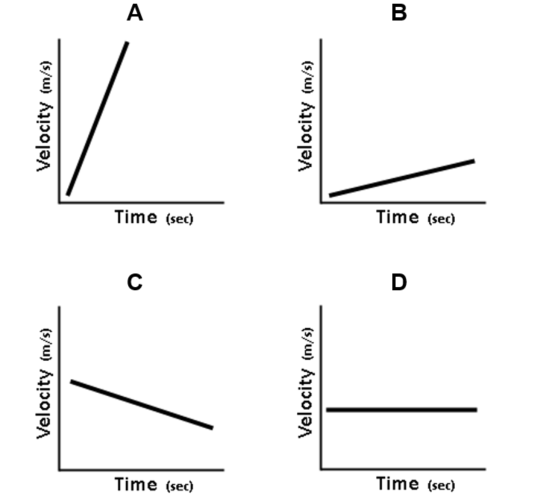
Which graph represents zero acceleration (constant velocity)?
a)
A
b)
B
c)
C
d)
D
5.
What is happening between 3 seconds and 4 seconds?
a)
The object is moving in a negative direction.
b)
The object is returning to its starting position.
c)
The object is slowing to a stop.
d)
The object is changing direction.
6.
As the angle of the incline increases, what happens to the normal force?
a)
The normal force increases
b)
The normal force decreases
c)
The normal force is not affected by the incline
d)
The normal force is only dependent on the force due to gravity
7.
The acceleration of an object is proportional to ...
a)
the net force acting upon it
b)
its position
c)
its velocity
d)
its mass
8.
Raymond is hover boarding down they hall at a constant velocity. Assuming there is friction, which of the following must be true?
a)
The force applied by the board must be greater than the frictional force
b)
The frictional force must equal the force applied by the board
c)
The force applied must equal zero
d)
There is not enough information
9.
If you throw a baseball straight up, what is its velocity at the highest point?
a)
9.8 m/s2
b)
9.8 m/s
c)
0 m/s
d)
4.9 m/s
10.
A 5 kg ball is lifted 12 m above the ground. It's gravitational potential energy is
a)
60 J
b)
600 J
c)
17 J
d)
2.4 J
11.
On a graph showing distance versus time, a horizontal line represents an object that is
a)
moving at constant speed
b)
decreasing its speed
c)
increasing its speed
d)
not moving
12.
A person has a mass of 24 kg on Earth. What is the persons mass on the Moon (1/6 of Earth's gravity)?
a)
24 kg
b)
144 kg
c)
6 kg
d)
4 kg
13.
What is the horizontal acceleration of a projectile?
a)
0 m/s2
b)
9.8 m/s2
c)
4.9 m/s2
d)
-9.8 m/s2
14.
What determines the strength of gravitational attraction between two objects?
a)
mass and distance
b)
size and mass
c)
density and mass
d)
density and size
15.
Which of the following objects has the most kinetic energy?
a)
A 20 kg toddler running at 5 m/s
b)
A 50 kg toddler running at  30 m/s
c)
A 90 kg toddler running at 30 m/s
d)
A 100 kg  toddler running at 2 m/s
16.
is it possible for forces to act on an object and still have a net force of zero?
a)
yes
b)
no
c)
depends on the type of force
17.
What happens to the velocity of a ball as it is dropped off a cliff? 
a)
It decreases at a uniform rate 
b)
It increases at a uniform rate 
c)
It is constant 
d)
It increases at a non-uniform rate
18.
How do you find a resultant if there are components at a right angle to each other, and you know two sides?
a)
Multiply
b)
Divide
c)
Pythagorean Theorem
d)
sins or cosine
19.
What is the correct equation to solve for x?
a)
tan (45) = x/13
b)
cos (45) = x/13
c)
sin (45) = 13/x
d)
sin (45) = x/13
20.
Find x
a)
20
b)
5.9
c)
33
d)
42
21.
Find the length of side w.
a)
21.4 cm
b)
18.0 cm
c)
36.5 cm
d)
43.6 cm
22.
A solid  metal bar is at rest on a horizontal frictionless surface. It is free to rotate about a vertical axis at the left end. The figures show forces of different magnitudes that are exerted on the bar at different locations. In which case does the bar's angular speed about the axis increase at the fastest rate?
a)
A
b)
B
c)
C
d)
D
23.
A roller coaster car is poised at the top of the first hill on its track. What type of energy is the car's total energy stored as?
a)
Kinetic
b)
Thermal
c)
Potential
d)
Mechanical
24.

A roller coaster car moves down the hill. Assuming that the track is frictionless, which option represents the transfer of energy?

a)

Potential to Kinetic

b)

Kinetic to Potential

c)

Mechanical to Thermal

d)

Mechanical to Potential

25.
A spring with a spring constant of 3 N/m is compressed by 4 cm. How much potential energy is stored in the spring?
a)
0.0024 J
b)
0.024 J
c)
2.4 J
d)
24 J
26.

The unit for energy and work is

a)

J

b)

N

c)

m/s

d)

m/s/s

27.
If you exert a force of 20 N to push a desk 10 m, how much work did you do to the desk?
a)
20 N
b)
200 N
c)
200 J
d)
2 J
28.
The law of conservation states that
a)
every action has an equal and opposite reaction
b)
all matter has thermal energy
c)
energy cannot be created or destroyed, only changes form
d)
heat moves from an object of higher temperature to an object of lower temperature
29.
The ability to do work is called
a)
energy
b)
thermal
c)
kinetic
d)
potential
30.
Mechanical energy can be either potential or ________.
a)
Motion
b)
Kinetic
c)
Chemical
d)
Light
31.

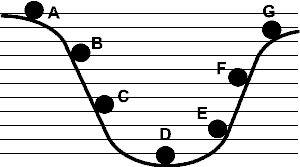
Which position has the most kinetic energy? Assume the ball is rolling down the halfpipe from left to right.

a)

A

b)

G

c)

D

d)

B

32.

Which position has the most potential energy? Assume the ball is rolling down the halfpipe from left to right.

a)

A

b)

G

c)

C

d)

D

33.

Which of the following is the best example of work being done?

a)

You lift a heavy box off the floor

b)

You stand still holding a heavy box

c)

Work is being done in both lifting and holding a heavy box

d)

No work is being done for either lifting nor holding a heavy box

34.

Energy stored in a compressed spring is

a)

kx

b)

kx2

c)

1/2 kx2

d)

mgh

35.
An object with a mass of 2000 kg at rest has what momentum?
a)
2000 kg m/sec
b)
0 kg m/sec
c)
2000 kg
d)
2000 m/sec