
Font size
S
M
L
XL
 Worksheets
Reconstruction, WE, Industrial Revolution, World Power
Total questions: 97
Worksheet time: 2hrs 12mins
Name
Class
Date
1.
The 13th amendment to the Constitution was the first of the "Reconstruction Amendments," What was the purpose of this amendment?
a)
to give women the right to vote
b)
to allow the Confederate States to re-enter the Union
c)
to give African Americans the right to vote
d)
to abolish slavery
2.
The 15th amendment to the Constitution was the last of the "Reconstruction Amendments," and it was ratified in 1870. What was the purpose of this amendment?
a)
to give African American men the right to vote
b)
to establish a federal income tax
to establish a federal income tax
c)
to give women the right to vote
to give women the right to vote
d)
to officially end the "Reconstruction Era"
3.
Strict punishment of Confederate veterans and financial assistance to African Americans were policies pushed by which of the following group during the Reconstruction Era?
a)
Radical Democrats
Radical Democrats
b)
Moderate Republicans
c)
Radical Republicans
d)
Moderate Democrats
4.
The 14th amendment to the Constitution was the second of the "Reconstruction Amendments." What was the purpose of this amendment?
a)
to give African Americans the right to vote
b)
to give all American citizens equal protection under the law
c)
to abolish slavery
d)
to officially terminate the government of the Confederate States of America
to officially terminate the government of the Confederate States of America
5.
One of the most heavily debated programs of Reconstruction was the Freedman's Bureau. While it had mixed results, the primary goal of this program was to:
a)
prevent the African American population from voting in federal elections.
b)
establish the "sharecropping" system to make sure that white farmers continued to employ African Americans.
c)
provide newly freed slaves with food, shelter, work, and education.
d)
to enforce "Black Codes," or laws that treated African Americans as second-class citizens
6.
The members of Congress battled with both presidents because they felt that the Presidential Reconstruction Plans:
a)
were too focused on helping the freed African slaves, but not on helping the poor, white farmers.
b)
were too strict to allow the Union to ever be reunited as it was prior to the Civil War.
c)
were too lenient on the Southern states that had rebelled against the Union.
d)
were created too quickly without consulting the former leaders of the Confederate states.
7.
Which of the following describes Abraham Lincoln's "10 percent" plan?
a)
A Confederate state could re-enter the Union whenever it repaid 10 percent of the damages that were suffered in the state during the Civil War
b)
A Confederate state could re-enter the Union 10 percent of the states already included in the United States agreed that it could enter.
c)
A Confederate state could re-enter the Union only if it agreed that it would be given 10 percent less representation in the federal government than it had prior to the Civil War
d)
A Confederate state could re-enter the Union whenever 10 percent of its voters took a vow of allegiance to the United States
8.
These people proposed that the federal government should preside over these areas, and the freed African slaves should be helped at the expense of the white population. People who felt this way were probably members of which political group?
a)
Red Shirt Democrats
b)
Ku Klux Klan
c)
Tillmanites
d)
Radical Republicans
9.
Who wanted to readmit states to the Union when 10% of the voters took an oath of allegiance?
a)
Andrew Johnson
b)
Andrew Jackson
c)
Abraham Lincoln
d)
The Radical Republicans
10.
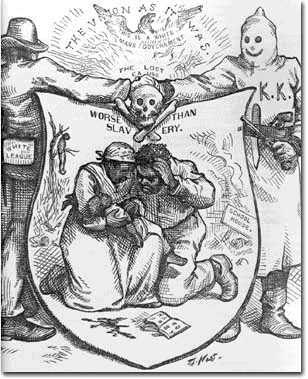
What does this photo say about how newly freed slaves were treated during Reconstruction?
a)
Everyone was getting along, regardless of race
b)
They were treated worse than slaves
c)
They were provided more opportunities
d)
Whites worked with African Americans to fix the problems of the South
11.
What ended Reconstruction?
a)
Plessy v. Ferguson
b)
the Civil Rights Cases
c)
Compromise of 1877
d)
Lincoln's assassination
12.
Which of the following was NOT a goal of A. Lincoln?
a)
He wanted 10% of the people in the state to pledge their allegiance to the USA.
b)
keep slavery
c)
abolish slavery
d)
protect the rights of African Americans
13.
Which of the following is NOT A. Johnson's goals for Reconstruction?
a)
humiliate the south
b)
required southerners to ask for presidential pardons
c)
be treated like a king
d)
gave African Americans full rights
14.
What was the main aim of the southerners, despite not being willing to grant rights to the freedmen?
a)
freedom
b)
returning to normal lives
c)
gaining equality
15.
What was the aim or aims of African Americans during Reconstruction?
a)
Reunite with their families
b)
Enjoy the freedom that had been denied to them
c)
Establish strong communities and places to worship
d)
All of these
16.
While congress was not in session, allowed southern states to form new state governments.
a)
Lincoln
b)
Johnson
c)
African Amercans
d)
southerners
17.
elected former confederates to congress
a)
southerners
b)
congress
c)
African Americans
d)
Johnson
18.
refused to allow former confederates who were elected to congress to take their seats.
a)
southerners
b)
Johnson
c)
congress
d)
Lincoln
19.
passed the 14th amendment which granted citizenship to African Americans
a)
congress
b)
southerners
c)
Lincoln
d)
Johnson
20.
Many southern states passed laws after the Compromise of 1877. The laws that legalized the segregation of whites and blacks were called
a)
Jim Crow Laws
b)
Black Codes
c)
Freedman's Bureau
d)
Reconstruction
21.
created the Freedman's Bureau
a)
Johnson
b)
African Americans
c)
southerners
d)
congress
22.

Completed in 1869 that linked the east and west coasts of the US and helped to move people, products, and raw materials across the continent...
a)
Erie Canal
b)
Norfolk-Southern Railroad
c)
Transcontinental Railroad
d)
Panama Canal
23.

Used by settlers in place of wood to make fences on the Great Plains
a)
Barbed Wire
b)
Steel Plows
c)
Homestead Act
d)
Sod Houses
24.
St. Louis, MO was also called the....
a)
Gateway Arch
b)
Gateway to the North
c)
Gateway to the West
d)
Gateway to the East
25.

Number '3' on the map is showing which geographical feature that affected travel to the West?
a)
Mississippi River
b)
Columbia River
c)
Snake River
d)
Colorado River
26.
Due to the heavy winter snows and spring rains, what geographic feature was an obstacle to settlers moving west?
a)
the Snake River
b)
the Grand Canyon
c)
the Great Desert
d)
the Rocky Mountains
27.
How did the weather impact the settlement to the West?
a)
Dry summers brought droughts and dust storm.
b)
Unpredictable hailstorms ruined crops
c)
Tornadoes destroyed homes and crops
d)
all of the above
28.
One of the changes in technology that helped the Great Plains farmers to survive was
a)
Stronger plows
b)
New models of windmills
c)
Barbed wire
d)
All of the above
29.
One reason that the farmers and the ranchers did not get along was...
a)
lack of fencing caused the cattle to sometimes the farmers crops.
b)
The cattle carried diseases that the people caught.
c)
The ranchers were mean.
d)
The farmers would not cooperate.
30.
The pioneers that took advantage of the Homestead Act were called...
a)
homesteaders
b)
ranchers
c)
sodbusters
d)
scalawags
31.
The Homestead Act gave settlers...
a)
money when they got to the West.
b)
land for a small fee if they stayed for 3 years.
c)
land for a small fee if they stayed for 5 years.
d)
free homes.
32.
How were Chinese immigrants discriminated against?
a)
Paid less
b)
Worked in bad conditions
c)
Dealt with discrimination
d)
All of the above.
33.
Chinese immigrants came to the United States...
a)
to see something new
b)
to build homes
c)
family reasons
d)
for gold and to help build the transcontinental railroad.
34.
What 3 geographical features affected travel to the west?
a)
Rain, Snow, Tornadoes
b)
Cities, Farms, and Towns
c)
Scarce food, diseases, no water
d)
Rocky Mountains, Rivers, Great Plains
35.
What is another name for the Battle of Little Bighorn?
a)
"Custer's Last Stand"
b)
"Custer's First Stand"
c)
Chief Joseph takes a stand
d)
"Bighorn's Last Stand"
36.
The ___________ was used to bring scarce water to the surface.
a)
Windmill
b)
Mechanical Reaper
c)
Steel Plow
d)
Barbed Wire
37.
How did the Transcontinental Railroad affect development in the West?
a)
It encouraged trade.
b)
It discouraged new immigrants from settling in the West.
c)
it limited the development of towns.
d)
It eliminated the need to travel by covered wagon.
38.
What did the Transcontinental Railroad do?
a)
Brought new settlers to the West.
b)
Allowed for trade.
c)
Created air pollution.
d)
All of the above.
39.
Cowboys and ranchers worked together to start...
a)
the horse industry.
b)
the cattle industry.
c)
the big industry.
d)
the goat industry.
40.

Battle between Sioux and Cheyenne tribes and the soldiers led by Colonel George A. Custer in which the soldiers were defeated and all killed
a)
Battle of Wounded Knee
b)
Battle of Bull Run
c)
Trail of Tears
d)
Battle of Little Bighorn
41.

Apache warrior and leader who led his band of warriors in fierce raids against the settlers
a)
Sitting Bull
b)
Crazy Horse
c)
Geronimo
d)
Cochise
42.
Which of the following was a social effect of westward expansion on the Native Americans?
a)
NA could not get enough supplies and this lef to poverty
b)
NA were forced to live on reservations, which separated from white pioneers
c)
NA could no longer access the rich mineral deposits found in the Black Hills
d)
NA culture became widely accepted by white settlers
43.

The Great Plains can be found in what area?
a)
Area 1
b)
Area 2
c)
Area 3
44.

Most Westward Expansion pioneers came from what area?
a)
Area 1
b)
Area 2
c)
Area 3
45.

Which region on the map includes the Rocky Mountains?
a)
Area 1
b)
Area 2
c)
Area 3
46.
What was the purpose of the mechanical reaper?
a)
It tilled the hard packed earth
b)
It brought scarce, hard to find water to the surface
c)
It allowed pioneers to quickly travel across the Great Plains
d)
It made the harvest possible
47.
What was the purpose of the steel plow?
a)
It tilled the hard packed earth
b)
It brought scarce, hard to find water to the surface
c)
It allowed pioneers to quickly travel across Great Plains
d)
It made the harvest possible
48.
Mass production led to:
a)
Products being more superior in quality
b)
goods became less expensive
c)
laborers received higher wages
d)
industries moved to rural areas
49.
What is the movement from rural to urban areas called?
a)
Moving
b)
colonization
c)
inflation
d)
urbanization
50.
The _________ was invited by Samuel Morse in order to help the railroads.
a)
Telegraph
b)
Telephone
c)
Telescope
d)
Television
51.
What refers to new ideas about how to do something as well as the equipment needed to do it?
a)
Technology
b)
Biology
c)
Astrology
d)
Zoology
52.
What innovation increased the transportation of goods and people?
a)
Flying Shuttle
b)
Spinning Jenny
c)
Steam Engine
d)
Water Frame
53.
How did the Industrial Revolution affect the cities?
a)
Made the crime rate decrease
b)
Led to an increase in farm workers
c)
Make the cities cleaner and safer
d)
Led to an increase in population in the cities
54.
Henry Ford revolutionized which of the following industries?
a)
Agriculture
b)
Railroad
c)
Automobile
d)
Education
55.
What was the Industrial Revolution?
a)
a change from making things in factories to making them by hand
b)
a change from making things by hand to making them in factories
c)
a time where many inventions changed how the world operated
d)
a time where many people immigrated to the United States
56.
18th Amendment
a)
Gave women the right to vote
b)
Popular election of US senators
c)
Legalized federal income tax
d)
Established prohibition
57.
19th Amendment
a)
Gave women the right to vote
b)
Popular election of US senators
c)
Legalized federal income tax
d)
Established prohibition
58.
What was the major effect of the invention of the telephone?
a)
It improved transportation throughout the U.S.
b)
It made communication better, faster, and easier.
c)
It made it easier to light factories once the sun went down.
d)
It let to economic improvement for our country.
59.
Why was the Bessemer Process so important to the development of our country?
a)
It made it cheaper to travel back and forth across the U.S
b)
It made it easier to convert iron into steel; steel was needed for skyscrapers and railroad tracks.
c)
It made the assembly line a faster and better way of producing cars.
d)
It made it possible to purchase one part of a cow or pig instead of the entire thing.
60.
What is a monopoly?
a)
A business that converts iron ore into steel.
b)
A company that has no competition.
c)
When more than one business tries to sell the same goods or service.
d)
A business in which many people own shares.
61.
The growth of Big Business was both a cause and an effect of _______.
a)
monopolies
b)
Jim Crow laws
c)
immigration
d)
progressivism
62.
Which invention improved by Thomas Edison most changed the way factories operated in the late 19th century?
a)
The refrigerator
b)
The light bulb
c)
Ford Motor vehicles
d)
John Deere farm equipment
63.
How did Orville and Wilbur Wright contribute to the rise of the United states as a world power?
a)
They started the aircraft industry with their experiments in manned flight
b)
They allowed women to do work usually done by men usually
c)
The aircraft industry was hardly a success
d)
By improving the Model - T vehicle
64.
Who developed the Bessemer process which converted iron into steel?
a)
Lewis Latimer
b)
Thomas Edison
c)
Andrew Carnegie
d)
John D. Rockefeller
65.
How did electricity change business in the United States?
a)
Every American could afford electricity for their homes
b)
Electricity was immediately available to all US citizens
c)
Homes needed more candles
d)
Stores and factories could stay open longer to make more products and money
66.
Why did immigrants settle in cities on the east coast?
a)
They were tired of traveling
b)
They were afraid of the Native Americans
c)
They didn't know any people living in the West
d)
They didn't have the money to travel west or purchase land
67.
Andrew Carnegie and John D. Rockefeller developed business practices that let them take total control of a specific industry.
This practice was called
This practice was called
a)
Monopoly
b)
Technology
c)
Labor unions
d)
Urbanization
68.
Which is one of the many challenges urban ares faced as a result of increased in population?
a)
Cities became overcrowded and diseases spread rapidly
b)
The air became cleaner to breathe
c)
There was less pollution in the cities
d)
There was a decrease inthe amount of crime
69.
What did southern governments do to discriminate against African American voters, purposefully trying to prevent them from being able to vote?
a)
require literacy tests to vote
b)
allow only males above 50 years of age to vote
c)
require all slaves to vote for a specific candidate
d)
allow all males unable to read special help in voting
70.
Discriminatory laws were passed by all southern state governments. These laws made separate facilities for African Americans in schools, housing, theaters, on trains and everywhere else mandatory. What were they called?
a)
Jim Crow Laws
b)
Slave Codes
c)
Black Codes
d)
Supreme Codes
71.
Henry Ford found he could produce cars less expensively and more quickly by doing which of the following?
a)
using the assembly line
b)
using designs made in Japan
c)
using plastic instead of steel
d)
hiring only immigrants
72.
What was the impact of the "Plessy vs. Ferguson" rule on African Americans?
a)
The "separate but equal" doctrine was quickly extended to cover many areas of public life, such as restaurants, theaters, restrooms, and public schools
b)
African Americans were forced back into slavery but they were paid wages
c)
African Americans could use any facilities, such as parks, if they were outdoors
d)
The Plessy decision was not put into effect in any state because it discriminated against African Americans
73.
In the late nineteenth and early twentieth century, most immigrants came from...
a)
Eastern and Southern Europe
b)
Western Europe
c)
Canada
d)
Korea
74.
All of the following are push factors EXCEPT...
a)
Discrimination
b)
Lack of food
c)
Religious freedom
d)
Lack of jobs
75.
The United States gained territory after the Spanish-American War. Which of the following territories were gained?
a)
Panama, Guam, and Puerto Rico
b)
Puerto Rico, Panama, and Costa Rica
c)
Guam, Puerto Rico, and the Philippines
d)
the Philippines, Columbia, and the Bahamas
76.
The decision of the United States to declare war on Spain was based on all the following EXCEPT...
a)
economic involvement in Cuba
b)
wanting to take over and rule Spain
c)
humanitarian concerns for the Cuban people
d)
a desire to demonstrate American power in the world
77.
What was built to allow American commercial and war ships to travel from the Atlantic to the Pacific more quickly?
a)
the Rio Grande
b)
the Snake River
c)
the Gulf of Mexico
d)
the Panama Canal
78.
What was NOT a main factor in the United States entering World War I?
a)
wartime propaganda
b)
the sinking of a series of neutral ships
c)
the death of the heir to the Italian throne
d)
the unrestricted submarine warfare by Germans
79.
Who was the United States allied with during World War I?
a)
Great Britain and France
b)
Hungary and Germany
c)
Germany and Austria
d)
Germany and Sweden
80.
Why didn't the United States approve the Treaty of Versailles at the end of World War I?
a)
they were afraid Hitler would become president
b)
they thought it would give the president too much power
c)
senate refused because they would not have as much territory
d)
senate refused because they thought it would compromise the right to declare war
81.
What was one of the major factors that brought the U.S. to enter WWI in 1917?
a)
Sinking of the Maine
b)
Sinking of the Titanic
c)
Sinking of the Lusitania
d)
Sinking of the Arizona
82.
What forced Germany to give up territory to Belgium, Czechoslovakia, Denmark, France and Poland?
a)
Treaty of Paris
b)
Treaty of Versaille
c)
Treaty of Berlin
d)
Germany did not give up territory
83.
President Theodore Roosevelt sent American workers to build the ________ canal in central america to improve trade.
a)
Cuba
b)
Panama
c)
Spanish
d)
U.S.
84.
The exaggerated reporting of false reporting is known as ....
a)
Yellow Journalism
b)
Fraud
c)
Treaty
d)
Annexing
85.
Which one of the US Presidents battled in the Spanish American War?
a)
Theodore Roosevelt
b)
"Teddy" Wilson
c)
Woodrow Wilson
d)
Andrew Jackson
86.
Which of the following lands were not annexed as a result of the Spanish American War?
a)
Guam
b)
Puerto Rico
c)
Philippines
d)
Hawaii
87.
Why did American want to build the Panama Canal?
a)
Trading and Military Purposes
b)
To have an advantage at war.
c)
To control Panama
d)
To prevent future wars
88.
Who were the Rough Riders?
a)
a group of pilots who fought for America
b)
the crew from the USS Maine
c)
a cavalry unit during the Spanish American War led by Theodore Roosevelt.
d)
A group of African Americans that fought bravely during the Spanish American War.
89.
What was the United States warship called that exploded killing over 200 American sailors?
a)
U S Maine
b)
USS Maine
c)
USS Maybe
d)
US Maritime
90.
What was a result of Yellow Journalism?
a)
Economic growth for the readers
b)
Public opinion for the war increased
c)
Public outcry against the war increased.
d)
US won the Spanish American War
91.
Who was president during the Spanish American War?
a)
Lincoln
b)
McKinley
c)
Roosevelt
d)
Wilson
92.
__________ is the belief of a God given right to expand across the country/world.
a)
Treaty of Versailles
b)
Manifest Destiny
c)
Annexation
d)
Deceleration of Independence
93.
France, Great Britain and the U.S. were a part of the _________.
a)
Allies
b)
Liberty
c)
Central Powers
d)
Germany
94.
Germany, Austria Hungary and the Ottoman Empire were a part of the ___________.
a)
Central Powers
b)
Allies
c)
Great Britain
d)
Liberty Pride
95.
How did the Hawaiian Islands become part of the United States?
a)
Hawaii was ceded by Spain.
b)
Hawaii was purchased from Japan.
c)
The United States annexed Hawaii.
d)
The Hawaiian people chose to be part of the United States.
96.
He was the "peacekeeping" president who thought sanctions on Germany were too tough. He also helped redraw the boarders of Europe.
a)
Woodrow Wilson
b)
Abraham Lincoln
c)
Franklin D. Roosevelt
d)
Herbert Hoover
97.
The United States got involved in WWI because:
a)
The Zimmerman Telegram
b)
Unrestricted Submarine Warfare
c)
The sinking of the Lusitania
d)
All of the Above
Reset

