
 Worksheets
FOSS Earth and Sun Investigation 3
Total questions: 69
Worksheet time: 40mins
Name
Class
Date
1.

This weather instrument is a...
a)
thermometer
b)
anemometer
c)
rain gauge
d)
barometer
2.
Temperature is measured in...
a)
degrees
b)
inches
c)
centimeters
d)
feet
3.
This instrument measures air pressure.
a)
anemometer
b)
barometer
c)
rain gauge
d)
thermometer
4.
This tool measures the wind speed.
a)
barometer
b)
anemometer
c)
thermometer
d)
my dog when he sticks his head out the window
5.
Hygrometers measure:
a)
Humidity
b)
Wind Direction
c)
Air temperature
d)
Air pressure
6.
If the air feels sticky and your hair frizzes up, you may want to check a
a)
Barometer
b)
Thermometer
c)
Anemometer
d)
Hygrometer
7.
Someone who studies the weather.
a)
rain gauge
b)
taxonomists
c)
meterologist
d)
satellites
8.
This tool measures in millibars or inches of mercury.
a)
anemometer
b)
thermometer
c)
barometer
d)
wind vane
9.
Which tool measures humidity or the amount of moisture in the air?
a)
wind vane
b)
barometer
c)
anemometer
d)
hygrometer
10.
Which tool measures wind speed?
a)
Anemometer
b)
Hygrometer
c)
Barometer
d)
Wind Vane
11.
What does a barometer measure?
a)
measures high and low pressure in the air
b)
measures humidity in the air
c)
measures speed of the wind
d)
measures the amount of rain that has fallen
12.
The amount of water vapor in the atmosphere is called __________.
a)
Humidity
b)
Condensation
c)
Saturation
d)
Precipitation
13.
The air pressure is _____ when closest to the earth's surface.
a)
low
b)
stinky
c)
high
d)
thin
14.
78% of earth's atmosphere is composed of ____?
a)
methane
b)
oxygen
c)
argon
d)
nitrogen
15.
Which atmospheric layer is the closest to Earth's surface?
a)
Stratosphere
b)
Troposphere
c)
Ionosphere
d)
Exosphere
16.
What is the hottest layer in the atmosphere?
a)
Ionosphere
b)
Stratosphere
c)
Thermosphere
d)
Mesosphere
17.
The lowest layer of the atmosphere, this is also where weather occurs.
a)
Mesosphere
b)
Stratosphere
c)
Troposphere
d)
Thermosphere
18.
Rain, snow, sleet, hail, etc
a)
rocks that fall out of the sky
b)
tornado
c)
precipitation
d)
forecast
19.
A scientist who studies and forecasts weather
a)
weatherologist
b)
news reporter
c)
zoologist
d)
meteorologist
20.
Instrument used to measure relative humidity
a)
thermometer
b)
wind vane
c)
hygrometer
d)
rain gauge
21.
All the air surrounding the earth
a)
atmosphere
b)
hydrosphere
c)
mesosphere
d)
air
22.
The weight of air in the atmosphere pressing down upon Earth
a)
scale
b)
measurement
c)
air pressure
d)
wind gauge
23.
The atmospheric layer directly above the troposphere . Ozone is located in this layer.
a)
Stratosphere
b)
Mesophere
c)
Thermosphere
d)
Troposphere
24.
The layer of the atmosphere that protects the Earth from meteoroids.
a)
Thermosphere
b)
Mesophere
c)
Troposphere
d)
Stratosphere
25.
Which one of the following is an accurate relative humidity reading?
a)
32 degrees
b)
24 mL
c)
45%
d)
15 NW
26.

This weather instrument is a...
a)
anemometer
b)
Christmas ornament
c)
wind vane
d)
barometer
27.
This tool is used with a wind vane to determine the direction of the wind.
a)
wrench
b)
screwdriver
c)
compass
d)
telescope
28.
Which instrument tells you the direction from which the wind is blowing?
a)
compass
b)
wind vane
c)
anemometer
d)
a compass and a wind vane
29.

In gases the molecules _______________.
a)
stay close togehter
b)
spread out
30.

The air we breathe is a ________. It is made of Oxygen and Carbon Dioxide.
a)
gas
b)
solid
c)
liquid
31.
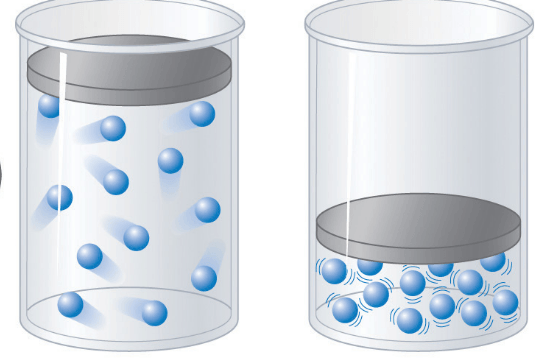
Which container will have a lower pressure?
a)
left
b)
right
c)
they both have the same pressure
d)
I don't know
32.
Matter is
a)
everything that has density
b)
everything made of atoms
c)
elements
d)
anything that has mass and takes up space
33.
A layer of gases that surrounds the Earth.
a)
atmosphere
b)
revolution
c)
orbit
d)
weather
34.

A force is a ......
a)
Push
b)
Pull
c)
Push or a Pull
35.
The moon’s surface has many more craters than the Earth’s. What best explains the difference in the number of craters on the surface of the Moon and the Earth?
a)
The Moon rarely gets impacted by meteorites.
b)
The Earth’s atmosphere protects it from impacts.
c)
The Moon’s gravity attracts more meteorites than Earth's.
d)
The Earth rotates on its axis more quickly than the Moon.
36.
Condition of Earth's atmosphere at a particular time & place
a)
climate
b)
biogeography
c)
precipitation
d)
weather
37.
Two gases that make up 99% of Earth's atmosphere
a)
carbon dioxide & oxygen
b)
nitrogen & carbon dioxide
c)
nitrogen & oxygen
d)
nitrogen & water vapor
38.
Form in which nitrogen is found in the Earth's atmosphere
a)
solid
b)
liquid
c)
gas
d)
crystal
39.
Element that forms ozone
a)
nitrogen
b)
oxygen
c)
hydrogen
d)
carbon
40.
Water in the form of gas is called
a)
ice
b)
graupel
c)
sleet
d)
water vapor
41.
Percentage of Earth's atmosphere that carbon dioxide makes up
a)
less than 1%
b)
5%
c)
20%
d)
80%
42.
Layer of Earth's atmosphere where weather occurs
a)
thermosphere
b)
mesosphere
c)
stratosphere
d)
troposphere
43.
Layer of Earth's atmosphere where most of the water vapor and carbon dioxide is found
a)
thermosphere
b)
mesosphere
c)
stratosphere
d)
troposphere
44.
Layer of Earth's atmosphere in which we live
a)
thermosphere
b)
mesosphere
c)
stratosphere
d)
troposphere
45.
Earth's ozone layer is important because it absorbs
a)
visible light
b)
ultraviolet radiation
c)
x-rays
d)
radio waves
46.
Layer of Earth's atmosphere that contains most of the ozone
a)
thermosphere
b)
mesosphere
c)
stratosphere
d)
troposphere
47.
True or False? Air is real.
a)
False
b)
True
48.
Fill in the blank: A syringe ___________ air in the chamber when the plunger is pushed.
a)
pressure
b)
pulls
c)
compresses
d)
shortens
49.
True or False? Air has no mass.
a)
True
b)
False
50.
Which is proof that air is real?
a)
Air is invisible.
b)
Wind moves leaves.
c)
You cannot see air.
51.
True or False? Air takes up space.
a)
True
b)
False
52.
When air particles are compressed, they ____________.
a)
get further apart
b)
do not move
c)
get pushed together
d)
explode
53.
True or false? We need nitrogen gas to live.
a)
True
b)
False
54.
True or False? Oxygen and nitrogen are permanent gases.
a)
True
b)
False
55.
True or False? Water vapor is a variable gas (the amounts of the gas in the air can change/vary).
a)
True
b)
False
56.
Where do the four seasons occur?
a)
Stratosphere
b)
Thermosphere
c)
Troposphere
d)
Mesosphere
57.
The atmosphere ________________ Earth.
a)
lifts
b)
pulls
c)
protects
58.
Which gas in our atmosphere is most abundant?
a)
Argon
b)
Oxygen
c)
Nitrogen
d)
Carbon Dioxide
59.
What percentage of our atmosphere is made up of other gases such as argon, carbon dioxide, methane and helium?
a)
1%
b)
21%
c)
78%
d)
17%
60.
What is the percentage of oxygen in Earth's atmosphere?
a)
99%
b)
21%
c)
78%
d)
15%
61.
What is the percentage of nitrogen in Earth's atmosphere?
a)
17%
b)
21%
c)
78%
d)
90%
62.

What DECREASES as you travel up in the atmosphere?
a)
Altitude
b)
Atmosphere
c)
Meteors
d)
Air Pressure
63.
Which of the following is NOT a reason why the atmosphere is important?
a)
It is made of many layers.
b)
It provides gases living things need.
c)
It provides warm temperatures.
d)
It protects us from UV rays and meteors.
64.
In what layer of earth's atmosphere do meteoroids burn up?
a)
Mesosphere
b)
Thermosphere
c)
Tropsphere
d)
Stratosphere
65.
The air in the troposphere has a greater density than the air in any other layer of the atmosphere,
a)
True
b)
False
66.
Which of the following is the correct order of the atmosphere layers from Earth to space?
a)
troposphere, stratosphere, mesosphere, thermosphere, exosphere
b)
troposphere, mesosphere, thermosphere, exosphere, stratosphere
c)
thermosphere, stratosphere, mesosphere, troposphere, exosphere
d)
troposphere, stratosphere, mesosphere, exosphere, thermosphere
67.
From Earth to space, the main layers of the atmosphere are
a)
Mesosphere, Troposphere, Ionosphere, Thermosphere
b)
Troposphere, Stratosphere, Mesosphere, Thermosphere
c)
Troposphere, Mesosphere, Ionosphere, Thermosphere
d)
Stratosphere, Troposphere, Ionosphere, Thermosphere
68.
A mixture of gases and particles that surround a planet, held by gravity is called the-
a)
greenhouse effect
b)
atmosphere
c)
jet stream
d)
blanket
69.
This is the source of all heat energy in our atmosphere
a)
Moon
b)
Sun
c)
Water
100 %

