Wayground logo

Free Printable Worksheets

Font size

S
M
L
XL
Worksheets

APE

Total questions: 173

Worksheet time: 2hrs 36mins

Name
Class
Date
1.

Isotopes have the same number of _____, but a different number of __________.

a)

protons; neutrons

b)

protons, electrons

c)

electrons, neutrons

d)

protons; bosons

2.

The bonds between water molecules are:

a)

Ionic

b)

Hydrogen

c)

Covalent

d)

Bioluminescent

3.

Which of the following is associated with bases?

a)

Solution has more H+ ions than OH- ions

b)

Solution has a pH of 2

c)

Solution has more OH- ions than H+

d)

Pure water is an example

4.

Click all of the autotrophs

a)

trees

b)

humans

c)

cyanobacteria

d)

moss

5.

Choose the secondary consumer in the following food chain

a)

phytoplankton

b)

zooplankton

c)

Whale Shark

d)

Bacteria

6.

If 50,000 kJ of energy is available to the primary producers in an ecosystem, how much will be available to the tertiary consumers?

a)

5,000 kJ

b)

500 kJ

c)

50 kJ

d)

5 kJ

7.

As you burn firewood, the energy stored in the firewood goes from a highly ordered state to a less ordered state. Which law does this demonstrate?

a)

The 1st Law of Thermodynamics

b)

The 2nd Law of Thermodynamics

c)

Newton's 2nd Law

d)

Pascal's Wager

8.

What type of plate boundary is this?

a)

Convergent

b)

Divergent

c)

Transform

d)

Strike/Slip

9.

Which of the following are possible consequences of convergent plate boundaries?

a)

Glaciers

b)

Trenches

c)

Rift Valleys

d)

Mountains

10.

Identify the correctly paired rock types and examples:

a)

Formed under extreme temperature and pressure - Sedimentary

b)

Likely to harbor fossils - Metamorphic rock

c)

Cooled lava - Igneous Rock

d)

Formed when sediments undergo lithification - metamorphic

11.

Identify the correctly paired rock types and examples:

a)

Formed under extreme temperature and pressure - Sedimentary

b)

Likely to harbor fossils - Metamorphic rock

c)

Cooled lava - Igneous Rock

d)

Formed when sediments undergo lithification - metamorphic

12.

Atoms that emit radiation as they decay into more stable atoms:

a)

Radioactive bosons

b)

Radioisotopes

c)

Gravitons

d)

Higgs particles

13.

The majority of the atmosphere is made of which gas?

a)

Nitrogen

b)

Oxygen

c)

Carbon dioxide

d)

Water Vapor

14.

Identify all the characteristics associated with a high pressure system:

a)

Typically brings fair weather

b)

Often results in clouds and precipitation

c)

Warmer air rises

d)

Air descends because it is cool and spreads outward

15.

I. Polar cell

II. Ferrel Cell

III. Hadley Cell

Put in order from northernmost to southernmost.

a)

I, II, III

b)

III, II, I

c)

II, I, III

d)

III, I, II

16.

Weather systems rotate and tend to move diagonally, rather than moving directly north-south. This is because:

a)

The Earth is rotating

b)

The Coriolis Effect

c)

The Earth's equator is spinning faster than the poles

d)

All of the above

17.

Enabled citizens to sue parties violating air quality standards, provided funds for pollution control research, and imposed limits on emissions

a)

Clean Air Act of 1970

b)

Clean Air Act of 1990

c)

The Kyoto Protocol

d)

The Paris Climate Agreement

18.

Identify a negative economic effects of acid deposition

a)

Erodes stone buildings and gravestones

b)

Soil chemistry is altered and can kill microorganism life

c)

Nutrients such as calcium and magnsium are leached from the soil

d)

runoff can enter waterways and kill wildlife

19.

The Montreal Protocol of 1987 banned _______ to help solve _____

a)

Nitrogenous runoff; oceanic dead zones

b)

Carbon emissions; climate change

c)

CFC emissions, the ozone hole

d)

Aerosol emissions; global cooling

20.

Systems that remove some of the gases and/or particulates from factory exhaust

a)

Generators

b)

Skimmers

c)

Turbines

d)

Scrubbers

21.

Which of the following is a secondary pollutant?

a)

Carbon monoxide

b)

Sulfur trioxide

c)

Soot

d)

None of the above

22.

Which of the following water cycle process are connected to surface water on the Earth?

I. ground water flow

II. surface water runoff

III. evaporation

a)

I only

b)

I and II only

c)

II and III only

d)

I, II, and III

23.

Which of the following is a non-point source of water pollution?

a)

Effluent from a sewage treatment plant

b)

BP refiner in Indiana discharging ammonia in a river.

c)

Runoff of pesticides from regional farms into the Illinois River.

d)

Hot water discharges from a nuclear power plant.

24.

Which of the following is a probable impact of increased use of inorganic (lab-made) fertilizers in a watershed?

a)

Hypoxia in the Gulf of Mexico

b)

Increase in storm severity in southeastern U.S.

c)

Water shortages in California

d)

Saltwater intrusion on the East Coast.

25.

What is the health risks could be connected to eating some fish from lakes or the ocean?

a)

They may be invasive species that impact native fish species populations.

b)

The Omega-3 fatty acids found in some fish can have a negative impact on cardiovascular health.

c)

If they are high on the food chain they may contain high levels of mercury or PCB's.

d)

They may have been exposed to inorganic nutrients from fertilizers.

26.

What is the health risks could be connected to eating some fish from lakes or the ocean?

a)

They may be invasive species that impact native fish species populations.

b)

The Omega-3 fatty acids found in some fish can have a negative impact on cardiovascular health.

c)

If they are high on the food chain they may contain high levels of mercury or PCB's.

d)

They may have been exposed to inorganic nutrients from fertilizers.

27.

Which of the following are not a water treatment procedures used to disinfect and kill harmful bacteria?

a)

Distillation

b)

Chlorine

c)

UV rays

d)

Ozone

e)

Desalination

28.

Which law sets standards limiting pollutants for community's water supplies?

a)

Clean Water Act (CWA)

b)

Safe Drinking Water Act (SDWA)

c)

National Environmental Policy Act (NEPA)

d)

Resource Conservation and Recovery Act (RCRA)

29.
If a paper mill dumps a lot of paper wast into a nearby river all of the following are likely to happen EXCEPT:
a)
Increase in BOD
b)
Decrease in DO
c)
Algae growth
d)
Decrease in decomposers
30.

What is it called when a persistent pollutant (like mercury or PCBs) builds up in the tissues of an organism as they continue to eat something that contains the pollutant?

a)

Negative Feedback Loop

b)

Biomagnification

c)

Tragedy of the Commons

d)

Bioaccumulation

e)

Positive Feedback Loop

31.
This law regulates the discharges of pollutants into all waters that have a significant connection with navigable waterways.  Also, must have a permit to dump these pollutants. Also, requires certain steps in sewage treatment. 
a)
Safe Drinking Water Act (SDWA)
b)
Clean Water Act (CWA)
c)
Oil Pollution Act
d)
National Environmental Policy Act (NEPA)
32.
Strategies used to clean up oil spills include all of the following EXCEPT:
a)
Floating booms and boats to skim floating oil toward collectors
b)
Skimmers to absorb oil from the water
c)
Addition of limestone to neutralize the acidic water
d)
Chemical dispersants that break up the oil and help it to sink.
33.

What is the main source of mercury in the Great Lakes?

a)

Natural sources

b)

Coal-burning power plants

c)

Sewage effluent

d)

Automobile emissions

34.

Which of the following is a known endocrine disruptor connected to popular herbicides that is found in many of our waterways in the U.S.?

a)

Atrazine

b)

Mercury

c)

Nitrate

d)

Arsenic

e)

Lead

35.
What do we call the land area that supplies water to a river system?
a)
runoff
b)
recharge
c)
watershed
d)
valley
36.
What is the top of the water-filled spaces in the ground called?
a)
Groundwater
b)
Reservoir
c)
Water Table
d)
Well
37.

Which is not connected to acid deposition?

a)

It is primarily due to the burning of coal

b)

It is treated using limestone

c)

It can occur as a result of mining

d)

It causes increased solubility of many ions

e)

It leads to increased pH levels in waterways

38.

What is the difference between a point source and a nonpoint source of water pollution?

a)

A nonpoint source is easily identifiable.

b)

Point sources can be directly targeted for reduction.

c)

Nonpoint sources tend to be factory outputs.

d)

Point sources tend to be agricultural.

e)

Nonpoint sources are less harmful to the environment.

39.

Which is a type of wastewater?

I. Sewage water from toilets

II. Water from showering and bathing

III. Water from washing clothes

a)

I only

b)

II only

c)

III only

d)

I and II

e)

I, II, and III

40.

Human wastewater entering into bodies of water such as rivers or lakes can be dangerous because

I. it causes a drop in the biological oxygen demand.

II. it can lead to cultural eutrophication.

III. the wastewater can carry pathogens.

a)

I only

b)

II only

c)

III only

d)

II and III

e)

I, II, and III

41.

Which pollutant is most likely to be released into groundwater supplies without human intervention?

a)

Phosphates

b)

Lead

c)

Arsenic

d)

Mercury

42.

Polybrominated diphenyl ethers (PBDEs) are

I. often found in synthetic plastic and fabric.

II. incinerated to prevent carbon dioxide emissions.

III. commonly known as a flame retardant.

a)

I only

b)

II only

c)

III only

d)

II and III

e)

I, II, and III

43.

Which is NOT a criteria pollutant?

a)

Sulfur dioxide

b)

Lead

c)

Carbon dioxide

d)

Particulate matter

e)

Tropospheric ozone

44.

A secondary pollutant

a)

forms in the stratosphere.

b)

is transformed by sunlight or water.

c)

cannot be directly tracked.

d)

does not directly harm humans.

e)

forms primarily from incomplete combustion.

45.

Which is a source of sulfur dioxide found in nature?

a)

Forest fires

b)

Lightning strikes

c)

Plant emissions

d)

Volcanoes

e)

Soil

46.

Which size of particulate matter causes the greatest health concerns?

a)

PM2.5

b)

PM10

c)

PM100

d)

PM30

e)

PM15

47.

High levels of photochemical smog are due to

I. nitrogen dioxide.

II. sulfur dioxide.

III. VOCs

a)

I only

b)

I and II only

c)

II and III only

d)

I and III only

e)

I, II, and III

48.

Recent increases in acid deposition in the western United States are due to

a)

increased emissions in the United States.

b)

decreased precipitation due to climate change.

c)

increased emissions in China.

d)

increased precipitation due to climate change.

e)

increased emissions in Europe.

49.

Thermal inversions

a)

increase the rate of smog formation.

b)

trap high concentrations of pollution at ground level.

c)

result in increased levels of acid deposition.

d)

are caused by high levels of precipitation.

e)

reduce the negative effects of VOCs.

50.

Acid deposition forms as a result of

a)

nitrogen oxides and photochemical smog.

b)

carbon monoxide and VOCs.

c)

sulfur dioxide and VOCs.

d)

nitrogen oxides and sulfur dioxide.

e)

carbon monoxide and photochemical smog.

51.

Which method is used to reduce nitrogen oxide emissions?

a)

Installation of catalytic converters

b)

Increased temperature of combustion

c)

The addition of oxygen to combustion processes

d)

The use of fluidized bed combustion

e)

The use of calcium carbonate to absorb emissions

52.

Which is NOT used to prevent the emission of particulate matter?

a)

Gravitational settling

b)

Fabric filters

c)

Electrostatic preciptators

d)

Catalytic convertors

e)

Scrubbers

53.

Which pollution control method was proposed by an amendment of the Clean Air Act?

a)

Allowing tolls to limit the use of automobiles

b)

A market for sulfur emissions

c)

The regulation of radon emissions

d)

The use of catalytic converters

e)

Chemicals developed to prevent the formation of ozone.

54.

If carbon monoxide emissions decreased from 145 million tons annually to 80 million tons annually, by what percentage have emissions been reduced?

a)

41 percent

b)

45 percent

c)

47 percent

d)

52 percent

e)

55 percent

55.

The formation of ozone begins when an 02 molecule is split by

a)

UV-A radiation.

b)

UV-B radiation.

c)

UV-C radiation.

d)

UV-A or UV-B radiation.

e)

UV-B or UV-C radiation.

56.

Which is NOT a result of the reduction in stratospheric ozone?

a)

Reduced photosynthetic activity

b)

Increased skin cancer

c)

Increased eye problems

d)

Increased birth defects

e)

Suppressed immune systems

57.

Through international cooperation, the concentration of chlorine in the atmosphere

a)

has already decreased below 3 ppb.

b)

will stabilize around 3 ppb by 2030.

c)

has stabilized at 5 ppb.

d)

is expected to stabilize at 5 ppb by 2100.

e)

is expected to fall below 3 ppb by 2020.

58.

When is the Antarctic ozone hole largest?

a)

Early spring

b)

Late summer

c)

Mid-summer

d)

Late fall

e)

Early winter

59.

Which outdoor air pollutant is also a significant indoor air pollutant?

a)

Sulfur dioxide

b)

Nitrogen oxides

c)

Carbon monoxide

d)

Lead

e)

Ozone

60.

Anthropogenic ozone is formed and located in which layer?

a)

Troposphere

b)

Stratosphere

c)

Mesosphere

d)

Thermosphere

e)

Exosphere

61.

Greenhouse gases change the composition of this layer?

a)

Troposphere

b)

Stratosphere

c)

Mesosphere

d)

Thermosphere

e)

Exosphere

62.

Which of the following would be the best description secondary pollutants?

a)

They only harm a small vulnerable percentage of a population.

b)

They become harmful after reacting in the atmosphere.

c)

They are produced in lesser quantities than primary pollutants.

d)

They are less environmentally damaging than other pollutants.

e)

They are classified by the EPA as the second most dangerous and abundant.

63.

Which of the following would be classified as a volatile organic compound air pollutants? (Mark all that apply)

a)

benzene

b)

methane

c)

formaldehyde

d)

chlorofluorocarbons

e)

terpene

64.

Which of the following is the most likely route for mercury to enter the food web?

a)

Municipal waste → landfill → groundwater→ plants and vegetation

b)

Coal-burning emissions → deposition→ ocean → plankton → fishes

c)

Organic fertilizers →soil →groundwater→ lake → trout

d)

Medical waste incinerators → stratosphere→ grass → cows

e)

Mining waste → acid deposition → surface runoff → plants and vegetation

65.
The step in the nitrogen cycle where plants take up nitrate and use it to make biological molecules is:
a)
nitrification
b)
ammonification
c)
nitrogen fixation
d)
assimilation
66.
The step in the nitrogen cycle where bacteria convert ammonia (NH3) to nitrate (NO3-) is:
a)
nitrification
b)
ammonification
c)
nitrogen fixation
d)
assimilation
67.
The process where some bacteria remove nitrate from the soil by converting it to nitrogen gas is:
a)
nitrification
b)
nitrogen fixation
c)
denitrification
d)
nitrification
68.
What part of the nitrogen cycle deals with the conversion of nitrogen in waste products or dead organisms into ammonia?
a)
nitrification
b)
ammonification
c)
denitrification
d)
nitrogen fixation
69.
What is the first step in the nitrogen cycle, in which gaseous nitrogen is converted into ammonia?
a)
nitrification
b)
ammonification
c)
denitrification
d)
nitrogen fixation
70.
Nitrogen is essential for living organisms to make:
a)
Lipids
b)
Carbohydrates
c)
Proteins
d)
Fats
71.
Biogeochemical cycles: 
a)
only include processes conducted by or within living organisms.
b)
describe the movement of water and other materials throughout the abiotic and biotic environment.
c)
only pertain to exchanges and interactions that occur within the atmosphere.
d)
are used to describe the attempts of humans to recycle various pollutants.
72.
Which of the following is a Nitrite?
a)
NO3-
b)
NO2-
c)
N2
d)
NH3
73.
Which of the following is a Nitrate?
a)
NO3-
b)
NO2-
c)
N2
d)
NH3
74.
Which of the following is ammonia?
a)
NO3-
b)
NO2-
c)
N2
d)
NH3
75.
Which of the following is the only form of nitrogen algae, and plants can use?
a)
NO3-
b)
NO2-
c)
N2
d)
NH3
76.
Which of the following can naturally "fix" atmospheric nitrogen so plants can utilize it?
a)
only bacteria
b)
bacteria and lightening
c)
herbivores
d)
carnivores
77.
Fertilizer factories take _____ and chemically convert it to _____
a)
N2 ::  NH4+
b)
NO2  :: NH4+ 
c)
N2  ::  NO3-
d)
NO2 :: NO3- 
78.
Bacteria living in the nodules of legume plants take atmospheric nitrogen (N2) and break it down to ______ so plants can use it.
a)
N2
b)
NO3 
c)
NH3
d)
NH4+
79.

Carbon monoxide

a)

increases lung cancer rates.

b)

leads to the formation of photochemical smog.

c)

is most problematic in rural areas

d)

does not directly cause deaths.

e)

is produced by incomplete combustion.

80.

High levels of photochemical smog are due to

I. nitrogen dioxide.

II. sulfur dioxide.

III. VOCs

a)

I only

b)

I and II only

c)

II and III only

d)

I and III only

e)

I, II, and III

81.

This layer of the soil is made up of dead leaves and plants.

a)

topsoil

b)

bedrock

c)

subsoil

d)

litter

82.

This layer of the soil is composed of rock fragments, nutrients, air, water and decaying plant and animal matter.

a)

the litter

b)

the topsoil

c)

the bedrock

d)

the subsoil

83.

When the nutrients of a soil of an area becomes depleted crops cannot grow there. This is know as...

a)

bad luck

b)

dusty depot

c)

desertification

d)

land reclamation

84.

It is possible to replace land damaged by mining or erosion. This process is called

a)

land reclamation

b)

desertification

c)

strip mining

d)

salty springs

85.

This gas is given off by burning fuels and can be extremely dangerous to living organisms.

a)

Carbon Dioxide

b)

Sulfuric Dioxide Monoxide

c)

Carmon Monoxodious

d)

Carbon Monoxide

86.
Human activities alter the water cycle by... 
a)
Withdrawing large amounts of freshwater
b)
Clearing vegetation and eroding soils
c)
Polluting surface and underground water
d)
All of the choices 
87.
When a resource like timber is used as fast as or slower than it regrows it is being used ____.
a)
nonrenewably
b)
unsustainably
c)
sustainably
d)
synthetically
88.
What event lead to our current pattern of urbanization?
a)
Bubonic Pluage
b)
Industrial Revolution
c)
Green Revolution
d)
Agricultural Revolution
89.
Emma is studying the water quality in the Puget sound, her study includes many variables. Which example is a quantitative data example?
a)
The water is acidic.
b)
The water has low sediment content.
c)
The water has a high quantity of plastic debris.
d)
The water has an average temperature of 51.9 degrees F. 
90.
Which of these is not an example of a commons?
a)
Federal Parks
b)
The ocean
c)
Privately owned farms
d)
Highways
91.
True or false: As populations grow, the tragedy of the commons will become more of a problem.
a)
True
b)
False
92.
What can be done to solve problems related to the tragedy of the commons?
a)
Privatization
b)
Regulations, restrictions and quotas
c)
Public education
d)
All of the above
93.
Which of the following is a nonrenewable resource?
a)
Fisheries
b)
Timber
c)
Copper
d)
Fertile soil
94.
The _____ was not a direct result of the Industrial Revolution.
a)
overhunting of large mammals
b)
shift in the use of fossil fuels
c)
improved quality of life
d)
growth of cities
95.
The __________ Revolution was characterized by a shift from human and animal power to fossil fuels (coal and oil)
a)
Agricultural
b)
Industrial
c)
Tragedy of the Commons
96.
The term used to describe the productive area of Earth needed to support the lifestyle of one person in a particular country is called
a)
The Tragedy of the Commons
b)
Ecological Footprint
c)
Industrial Revolution
d)
Supply and Demand
97.
An important effect that hunter gatherer societies may have had on the environment was
a)
soil erosion
b)
extinction
c)
air pollution
d)
all of the above
98.
The first step in surface coal mining is 
a)
to remove and set aside the soil that covers the area to be mined
b)
to use heavy equipment to take core samples
c)
to test to see if quarrying would be more effective
d)
to make cuts in the coal for easier removal
99.
Minerals that contain valuable substances 
a)
native elements
b)
gangue minerals
c)
ore minerals 
d)
evaporites
100.
Which of the following is one reason why undersea mining has been largely unsuccessful to date?
a)
Magma exists under the ocean floor
b)
There is too much aggregate on the ocean floor
c)
Deposits at great water depths are difficult to work.
d)
Ocean water is too salty.
101.
mining method used when ore deposits are located closed to Earth's surface 
a)
ore minerals
b)
quarry
c)
placer deposits
d)
surface mining 
102.
the sinking of regions of the ground with litter or no horizontal movement 
a)
alloy 
b)
subsidence 
c)
ore minerals
d)
quarry
103.
minerals concentrated by wind and water movement into surface deposits
a)
aggregates 
b)
ore minerals 
c)
subsidence 
d)
placer deposits 
104.
Which of the following is not a way that ore minerals may form?
a)
cooling of magma 
b)
circulation of hydrothermal solutions through rocks
c)
flooding of empty streambeds and rivers
d)
evaporation of water that contains salts
105.
Solar evaporation is practical in order to obtain salt from sea water in climates where rainfall is exceeded by
a)
humidity.
b)
high-speed winds.
c)
evaporation.
d)
. snowfall.
106.
Mining companies can identify areas of valuable mineral resources by
a)
mineral exploration
b)
dredging.
c)
mineral excavation. 
d)
smelting.
107.
Which of the following is not affected when soil is removed from a surface mine?
a)
plant life
b)
animal habitat
c)
soil nutrients
d)
deep coal seams 
108.
process by which crushed ore is melted at high temperatures to separate impurities from molten metal 
a)
smelting
b)
aggregates
c)
ore mineral
d)
alloy
109.
A group of organisms that are similiar and reproduce to produce fertile offspring
a)
Species
b)
limiting factor
c)
predator
d)
parasite
110.
Moving into a population
a)
Biotic Factor
b)
Immigration
c)
Niche
d)
Commensalism
111.
All the living and non-living things that interact in an area
a)
Ecosystem
b)
community
c)
Natural Selection
d)
Symbiosis
112.
Which letter marks the peak of the pheasant population?
a)
A
b)
C
c)
B
d)
D
113.
How has the pheasant population changing at Point A?
a)
Increasing
b)
Decreasing
c)
Staying the same
114.
Which of the following is an example of a predator adaptation?
a)
a porcupine's needles
b)
a shark's powerful jaws
c)
a frog's bright colors
d)
a plant's poisonous chemicals
115.
Which of the following describes an interaction in which one organism kills and eats another
a)
competition
b)
symbiosis
c)
predation
d)
mutualism
116.
An organism's habitat must provide
a)
predators
b)
parasite
c)
food
d)
host
117.
When a jellyfish paralyzes a tiny fish with its poisonous tentacles, the fish is the
a)
predator
b)
host
c)
prey
d)
parasite
118.
The behaviors and physical characteristics of species that allow them to live successfully in their environment are called
a)
habitats
b)
adaptations
c)
limiting factors
d)
biotic factors
119.
A group of antelope leaving the herd in search of better grassland is an example of
a)
immigration
b)
emigration
c)
increasing birth rate
d)
decreasing birth rate
120.
Which of the following leads to a decrease in birthrates among women?
a)
Higher Education
b)
High Infant Mortality Rate
c)
No Prenatal Care
d)
No contraceptives
121.
Birthrate remains high, death rate begins to fall, total population increasing
a)
Stage 1 Demographic Transition
b)
Stage 2 Demographic Transition
c)
Stage 3 Demographic Transition
d)
Stage 4 Demographic Transition
122.
All of the following are density independent factors EXCEPT
a)
Limited food
b)
Earthquakes
c)
Hurricanes
d)
Torandoes
123.
The measure of the quality of life is also known as the
a)
Total Fertility Rate
b)
Replacement Level Fertility
c)
Infant Mortality Rate
d)
Birth Rate
124.
The most populous country in the world
a)
China
b)
India
c)
US
d)
Brazil
125.
A pyramid shaped age structure diagram would represent what type of growth?
a)
Declining
b)
Stable
c)
Rapid
126.
The number of children an average woman would have during her reproductive years
a)
Birthrate
b)
IMR
c)
TFR
d)
Life expectancy
127.
The number of individuals an environment can support is known as the
a)
Total Fertility Rate
b)
Exponential Growth
c)
Limiting Factor
d)
Carrying Capacity
128.
Biotic Potential has
a)
Limiting Factors
b)
Reached Carrying Capacity
c)
Has No limiting Factors
d)
Scarce Resources
129.
A country that represents stable growth
a)
Japan
b)
Germany
c)
Afghanistan
d)
Canada
130.
A country that represents Rapid Growth
a)
United States
b)
Russia
c)
China
d)
Iraq
131.
A population experiencing declining growth
a)
Russia
b)
Nigeria
c)
United States
d)
Australia
132.
A small community started out with 10 people in year 1.  During year 1 they had 10 births and 5 deaths.  What was this community's growth rate for year 1?
a)
50 %
b)
5 %
c)
75 %
d)
1.5 %
133.
In what year did exponential growth start to occur for the population on the graph?
a)
1850
b)
1900
c)
1825
d)
1800
134.
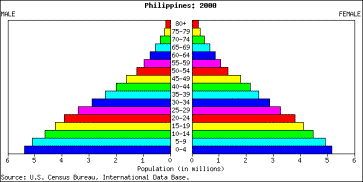
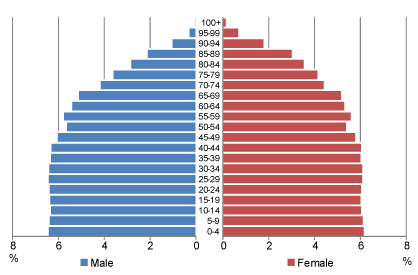
According to the population pyramid of this country, its population is most likely...
a)
growing slowly.
b)
growing rapidly.
c)
decreasing.
d)
not changing.
135.
What kind of growth is this country experiencing?
a)
Exponential Growth
b)
Stable Growth
c)
Declining Growth
136.
Which statement about human population growth is LEAST likely to be correct?
a)
Modern medicine has allowed human populations to extend well past the earth's carrying capacity, as more people survive for longer.
b)
Technological advances in farming and medicine will allow human populations to continue to grow without natural limits.
c)
Advances in agriculture have allowed the world's food supply to expand dramatically in the last 100 years.
d)
Worldwide, humans are reproducing more quickly than mortality is removing people from the population.
137.
The most populous country in the world are China, India, and
a)
Indonesia
b)
Russia
c)
The United States
d)
Mexico
138.
Factors that affect the total fertility rate of the human population include which of the following?
I. Cultural traditions
II. Government policies and economic incentives
III. Education level and economic opportunities for females
a)
I only
b)
II only
c)
I and II only
d)
I, II, and III
139.
What type of growth model is this?
a)
exponential growth model
b)
logistic growth model
c)
Type I curve
d)
Type III curve
140.
relationship in which two species live closely together
a)
resource
b)
mutualism
c)
succession
d)
symbiosis
141.
symbiotic relationship in which one organism benefits and the other organism is harmed 
a)
secondary succession 
b)
predation
c)
pioneer species 
d)
parasitism
142.
largest number of individuals of a population that the environment can support  
a)
carrying capacity
b)
primary succession 
c)
denitrification
d)
mutualism
143.
a relationship between two in which the predator feeds on the prey
a)
chemosynthesis
b)
predation
c)
cellular respiration 
d)
commensalism
144.
symbiotic relationship in which one organisms benefits and the other organism is not affected
a)
invasive (non-native) species
b)
mutualism 
c)
nitrogen fixation
d)
commensalism
145.
symbiotic relationship in which both organisms benefit
a)
competition
b)
Mutualism
c)
nitrogen fixation
d)
energy pyramid
146.
population numbers get too large for the environment to support it and growth slows
a)
Exponential growth
b)
Logistic growth
c)
Natality
d)
Emigration
147.
What factor describes when populations increase because animals are moving into a population?
a)
Emigration
b)
Limiting Factors
c)
Immigration
d)
Exponential Growth
148.
The graph of logistic growth can be described as...
a)
S-shaped
b)
J-shaped
c)
W-shaped
d)
U-shaped
149.
Which biome is characterized by low temperatures and low amounts of rainfall?
a)
tundra
b)
desert
c)
temperate deciduous forest
d)
tropical rain forest
150.
Which biome covers most of the land mass near the Earth's equator?
a)
tundra
b)
desert
c)
grassland
d)
tropical rainforest
151.
Which biome, because of its climate, has the largest number of species of plants and animals?
a)
tundra
b)
desert
c)
tropical rainforest
d)
pine forest
152.
One characteristic feature of tundra is that only the surface thaws in the summer and refreezes in the winter, leaving a layer of permanently frozen subsoil.  This characteristic is known as
a)
glaciation
b)
permafrost
c)
crystallization
d)
soilfrost
153.
Which major biome is home to cacti, mesquite, white thorn, pack rats, small reptiles, and coyotes?
a)
desert
b)
taiga
c)
tundra
d)
grassland
154.
Which biome receives between 0 and 25 centimeters of precipitation each year, has a temperature range from -27 to 5 degrees Celsius, has frozen soil, and is home to hares, caribou, and wolves?
a)
desert
b)
mountain
c)
savannah
d)
tundra
155.
Which of the following habitats probably has the greatest number of plant and animal species?
a)
the African savannah
b)
a rainforest in Brazil
c)
a temperate forest in China
d)
a temperate grassland in Kansas
156.
Which biome contains large populations of grazing herbivores, few species of birds, and deep, rich soil?
a)
taiga
b)
tundra
c)
deciduous forest
d)
grassland
157.
Which biome is MOST LIKE the "desert" in terms of precipitation?
a)
tropical rainforest
b)
temperate deciduous forest
c)
tundra
d)
coniferous forest
158.
Areas defined by their geographical location and ecological similarity are called?
a)
ecozones
b)
biotopes
c)
biomes
d)
biodomes
159.
Which is NOT a type of aquatic ecosystem?
a)
ocean
b)
estuary
c)
monastery
d)
wetland
160.
This means the amount of salt dissolved in water.
a)
salinity
b)
salutation
c)
saturation
d)
saltiness
161.
When soil washes into a river from a stream or from land, what is added to the water?
a)
dirt
b)
oxygen
c)
rocks
d)
nutrients
162.
What are areas where freshwater meets saltwater called?
a)
wetlands
b)
estuaries
c)
coastal byways
d)
intertidal zones
163.
Which element accumulates in the environment due to use of fertilizers?
a)
oxygen
b)
hydrogen
c)
nitrogen
d)
carbon
164.
Which has the least negative impact on wildlife habitat?
a)
agriculture
b)
development
c)
deforestation
d)
recreation
165.
Which is true of urban sprawl?
a)
it occurred in the 1800s
b)
it lasted 20 years in the 1990s
c)
it began in 1950 and continues until today
d)
it began in the 1990s and continues to today
166.
The large scale removal of trees by cutting or burning is called _______________.
a)
urbanization
b)
deforestation
c)
desertification
d)
overpopulation
167.
The movement of people from rural areas to big cities is called ________.
a)
urbanization
b)
deforestation
c)
desertification
d)
excommunication
168.
What are some bad things attributed to population growth?
a)
autism & genetic diseases
b)
religious conflict
c)
low wages & unemployment
d)
burning fossil fuels & increased CO2 production
169.
What are some reasons deforestation occurs?
a)
clearing land for agriculture, ranching, and mining
b)
just wanting to destroy things
c)
Population moving from rural areas to cities
d)
to make room for infrastructure
170.
Growing more than one crop in a field, especially in alternating rows. 
a)
Alley Cropping
b)
PolyCulture
c)
Interplanting
d)
Intercropping
171.
A hectare (ha) is an area equal to a square that is 100 meters on each side. If the plot of land is 300 m x 300 m, how many hectares is the plot?
a)
9
b)
90
c)
900
d)
9000
172.
The best example of a surface fire is
a)
the type of fire that burns seedlings, small trees, and leaf litter, but not mature trees and most animals
b)
fire that is deliberately set, frequently in the tropical rainforest, after the trees have been cut down
c)
fires that occur along newly exposed edges of forest after fragmentation has occurred 
d)
fire that allows dead wood, leaves, and other flammable ground litter to accumulate
173.
Which of the following is NOT an economic service provided by forests?
a)
provide habitat
b)
recreation
c)
lumber
d)
job opportunities