
 Worksheets
Social Studies Review
Total questions: 171
Worksheet time: 3hrs 32mins
Name
Class
Date
1.
What is a main reason immigrants came to the US in the late 1800s and early 1900s?
a)
Did NOT want religious freedom
b)
Hoped for economic opportunity (to make money)
c)
Wanted LESS diversity
d)
Wanted to live more simply
2.
How was Angel Island different from Ellis Island?
a)
Main station for European immigrants
b)
Main station for Chinese immigrants
c)
Located on the EAST coast
d)
People were only there a few hours
3.
Why did immigrants often live in neighborhoods with others from their homelands?
a)
It was illegal to live anywhere else
b)
They didn't want to be in the US
c)
It made their adjustment to their new life easier
d)
No other housing was avaliable
4.
What challenges did immigrants face in the US?
a)
They caught diseases
b)
Had trouble learning the language/faced prejudice
c)
Uncomfortable in the large homes in the US
d)
Difficult to study for the citizenship test
5.
How did prejudice create problems for some immigrants?
a)
Major companies wanted to hire them
b)
People laughed at their accents
c)
Were not allowed jobs because of their race/ethnicity
d)
Immigrant children were not allowed to attend school
6.
Where were most immigrants from?
a)
Italy
b)
Slavic Countries
c)
Mexico, Cuba, Puerto Rico
d)
Europe
7.
The first stop for immigrants from China.
a)
Ellis Island
b)
Angel Island
8.
Immigrants from Europe came here first. They were taken by ferry boat here.
a)
Angel Island
b)
Ellis Island
9.
Immigrants faced this from native born Americans. This means they were treated unfairly because of their race/ethnicity.
a)
diversity
b)
prejudice
10.
This means variety.
a)
diversity
b)
prejudice
c)
Laws
11.
The Statue of Liberty represented all of these EXCEPT what to immigrants?
a)
Freedom
b)
Excitement for a new life
c)
Opportunity to be successful
d)
Fear for a worse life
12.
Immigrants were checked for dangerous diseases because...
a)
They didn't want them to bring them into the US
b)
They were discriminating against immigrants
c)
They had prejudice and did it just to be mean
13.
Why did they ask immigrants difficult questions at Angel Island?
a)
To be exclusive and only let the best in
b)
To make sure they already had family in the US
c)
To make sure they wouldn't harm the US
14.
Why did the US decide to put a limit on immigration in 1924?
a)
The US was becoming hostile
b)
The US was discriminating
c)
The US had too many new citizens too quickly
15.
Immigrants felt they were entering a new world for all of the following EXCEPT:
a)
New freedom
b)
New diversity
c)
New opportunities
d)
New discrimination
16.

How many people immigrated to US 1880-1920?
a)
More than 10 million
b)
More than 20 million
c)
More than 30 million
d)
More than 50 million
17.

Brown v. Board of Education was famous because the court ruled that it is illegal
a)
allow children to work.
b)
to pay black people less than white people.
c)
to return a slave.
d)
to segregate schools.
18.

After the Civil Rights Act of 1964 was passed, it was no longer legal to
a)
let African Americans ride the bus.
b)
deny someone of a job because of their race.
c)
fire someone for not doing their job.
d)
kick someone out of the military.
19.
Court case that created "Separate-but-equal" doctrine.
a)
Sweatt v. Painter
b)
Brown v. Board of Education
c)
Plessy v. Ferguson
d)
Mendez v. Kirby ISD
20.
Nonviolent protest, where protesters occupied space in order to protest segregation.
a)
Sit-In
b)
Freedom Rides
c)
Selma March
d)
Filibuster
21.

What are Jim Crow Laws?
a)
Laws that placed freedom limitations on nonwhite people
b)
Laws that made all people work together towards a common goal
22.

Which US president signed the Voting Rights Act of 1965?
a)
Lyndon B. Johnson
b)
John F. Kennedy
23.

The federal law outlawing literacy tests, poll taxes, and other requirements that made it difficult for southern blacks to exercise their right for suffrage
a)
Civil Rights Act of 1964
b)
Voting Rights Act of 1965
24.

Person who was killed on April 4, 1968, while standing on the balcony outside his hotel room at Lorraine Motel in Memphis, Tennessee after trying to help black sanitation workers receive better working conditions
a)
Martin Luther King, Jr.
b)
Robert Kennedy
25.

Black nationalist leader who for awhile was a spokesman for the Nation of Islam; talked about black freedom “by any means necessary;” was assassinated on February 21, 1965, in NYC by Nation of Islam members
a)
Malcolm X
b)
Martin Luther King, Jr.
26.
Who was arrested for refusing to give up their seat on a bus?
a)
Charlayne Hunter
b)
Harriet Tubman
c)
Rosa Parks
d)
Rebecca L. Felton
27.

_______________ wrote "I Have a Dream" and delivered it to thousands in Washington, DC.
a)
Harry Belafonte
b)
Barack Obama
c)
Martin Luther King, Jr.
d)
Jesse Jackson
28.
In 1964, Martin received the _____________ for peace.
a)
Nobel Prize
b)
Oscar Award
29.
People who protest to call attention to a cause, like civil rights
a)
activist
b)
actor
c)
reporter
d)
scholar
30.
Keeping things or people SEparate
a)
prejudice
b)
union
c)
confederate
d)
segregation
31.
A form of nonviolent protest where people stop buying a product?
a)
march
b)
boycott
c)
sit in
d)
activist
32.
Thurgood Marshall was an important part of the Civil Rights Movement because:
a)
b. He was the first African American to be appointed Supreme Court Justice
b)
a. He was the lawyer of Linda Brown during Brown vs. Board of Education case
c)
He spoke during the march on Washington
d)
a. Both A and B
33.
How was the Montgomery Bus Boycott effective?
a)
It gave free transportation to African Americans
b)
It segregated buses in America
c)
It made Rosa Parks lots of money
d)
It helped de-segregate buses in America
34.
What are Civil Rights?
a)
Rights that only some citizens get
b)
Rights that all citizens get
c)
Rights that are civil
d)
Rights that are controlled by the president
35.
Martin Luther King Jr believed in
a)
Violent protests
b)
Really loud protests
c)
Non-violent protests
d)
Violence when needed protests
36.
The Amendment to the Constitution gave women the right to vote, ratified in 1920.
a)
13th Amendment
b)
15th Amendment
c)
19th Amendment
d)
23rd Amendment
37.
This man was running for president, but was assassinated before he ever got the chance to run.
a)
John F. Kennedy
b)
Robert F. Kennedy
c)
MLK
d)
FDR
38.
This U.S. president was president during the Cuban Missile Crisis and supported the Civil Rights Movement. He was also assassinated for his support.
a)
John F. Kennedy
b)
Robert F. Kennedy
c)
MLK
d)
FDR
39.
This man was the first person to land on the moon.
a)
Alan Shepard
b)
Neil Armstrong
40.
This law banned discrimination of any American because of race, gender, or religion.
a)
Voting Rights Act
b)
Civil Rights Act
c)
15th Amendment
d)
Civil Rights Movement
41.
In 1964, the 24th Amendment to the United States Constitution was added, outlawing poll taxes. How did poll taxes discriminate against African Americans?
a)
They kept many African Americans from voting.
b)
They prevented African Americans from attending certain schools.
c)
They kept many African Americans from finding employment.
d)
They segregated African Americans on buses and in restaurants.
42.
Who was responsible for the Cuban Missile Crisis?
a)
JFK
b)
FDR
c)
Nikita Khrushchev
d)
Joseph Stalin
43.
Why did the United States begin to send advisers and troops to Vietnam in the 1950s?
a)
to prepare for the United States invasion of Laos
b)
to defend American bases in the Gulf of Tonkin
c)
to help the South Vietnamese revolt against the French
d)
to prevent the spread of communism into South Vietnam
44.
How are dictators able to rise to power after countries suffer hardships?
a)
People want strong leaders to solve their problems.
b)
Dictators promise freedom.
c)
Dictators allow everyone to vote.
d)
Dictators promise to end fascism.
45.
Who was the dictator of Germany that rose to power with the Nazi Party?
a)
Joseph Stalin
b)
Winston Churchill
c)
Adolf Hitler
d)
Franklin D. Roosevelt
46.
In which WWII event did Japan use the strategy of surprise attack to bomb the United States?
a)
D-Day on the shores of France
b)
Pearl Harbor
c)
Invasion of Poland
d)
V-E Day
47.
When was the United States Navy seriously damaged and as a result President Roosevelt declared war on Japan?
a)
Iwo Jima
b)
Pearl Harbor
c)
D-Day
d)
Invasion of Poland
48.
____________ is when a country extends it's power through military force.
a)
Internment
b)
Holocaust
c)
Imperialism
d)
Democracy
49.
Which countries belonged to the Axis Powers?
a)
U.S., Italy, and Great Britain
b)
U.S., Great Britain, and France
c)
Germany, Italy, and Japan
d)
Germany, France, and Japan
50.
Victory in Europe (V-E Day) was a result of ________________.
a)
Japan surrendering
b)
The atomic bombings
c)
Germany surrendering
d)
the signing of the Treaty of Versailles
51.
Why were natural resources, like gasoline, scarce during WWII?
a)
The U.S. government did not want to spend money on natural resources.
b)
The U.S. had all the natural resources it needed.
c)
Natural resources were scarce because they were needed for the war effort.
d)
Americans were greedy and did not want to share the natural resources.
52.
What did allied forces do on D-Day, June 6, 1944?
a)
They sent thousands of troops to Berlin.
b)
They stormed the beaches of Normandy, France.
c)
The fought the Nazi troops in Russia.
d)
They took control of many Japanese islands.
53.
Which of the following is NOT true about the United States during World War II?
a)
The U.S. entered the war after the bombing of Pearl Harbor.
b)
Factories produced war goods and natural resources were rationed.
c)
Most women stayed home to raise children and tend to their husbands.
d)
The Tuskegee Airmen helped the allies defeat the Axis powers.
54.
Which WWII leader declared war on Germany and Japan, and was loved by many Americans for the programs he developed ?
a)
Winston Churchill
b)
Franklin D. Roosevelt
c)
Harry S. Truman
d)
Adolf Hitler
55.
Which famous WWII leader was the dictator of the Soviet Union that had an alliance with Germany at the beginning of the war but later joined forces with the allied powers.
a)
Benito Mussolini
b)
Adolf Hitler
c)
Winston Churchill
d)
Joseph Stalin
56.
Which famous leader in WWII was Emperor of Japan, ordered the attack on Pearl Harbor, and had a military alliance with Nazi Germany?
a)
Hirohito
b)
Winston Churchill
c)
Harry S. Truman
d)
Joseph Stalin
57.
Which WWII leader became President after FDR passed, wanted to save American lives in the Pacific, and decided to drop the atomic bombs?
a)
Franklin D. Roosevelt
b)
Winston Churchill
c)
Harry S. Truman
d)
Joseph Stalin
58.
Which WWII leader was the fascist dictator of Italy, believed in nationalism, and was an Axis ally?
a)
Joseph Stalin
b)
Benito Mussolini
c)
Winston Churchill
d)
Adolf Hitler
59.
What strategy did the United States develop to help defeat Japan?
a)
island hopping
b)
total war
c)
Anaconda plan
d)
blockade
60.
Which organization was created after World War II to help countries peacefully resolve conflicts?
a)
League of Nations
b)
Warsaw Pact
c)
North American Treaty Organization
d)
United Nations
61.
What role did women take during WWII?
a)
house wives that took care of the house and children
b)
drove tanks and fought in the war
c)
created black out curtains for everyone
d)
filled many traditionally male jobs
62.
Who was Rosie the Riveter?
a)
The first woman to work in a factory during WWII
b)
a representation of American women that went to work during WWII
c)
A pretty girl used for make-up advertisements
d)
A famous pilot
63.

What was Prohibition?
a)
A complete ban on the sale of food
b)
A complete ban on the sale of alcohol
c)
A complete ban on the sale of clothes
d)
A complete ban on the sale of cars
64.

Who built the Model T?
a)
Henry Ford
b)
Al Capone
c)
Charles Lindbergh
d)
Harry Truman
65.
The 1920s were characterized by
a)
Economic depression
b)
Wars
c)
Economic Prosperity
d)
none of the above
66.
What system allowed for mass production, the idea of products being created at a much faster pace?
a)
Ford System
b)
Assembly Line
c)
Mass Production
d)
Mass Media
67.

What type of music became a new trend during this time in the 1920s?
a)
Jazz
b)
Hip-hop
c)
Country
d)
Blues
68.

Who was one of the most famous baseball players during the 1920's?
a)
Amelia Earhart
b)
Babe Ruth
c)
Gertrude Ederle
d)
Derek Jeter
69.
The most direct result of the 18th Amendment(Prohibition) was that ________
a)
people were mostly in support of the amendment.
b)
organized crime in America increased
c)
organized crime in America decreased
d)
people stopped drinking alchohol
70.
During the 1920s people's lives changed because they began listening to the what?
a)
mass media
b)
movies
c)
radio
d)
music
71.
Which group fared particularly poorly during the 1920s?
a)
Farmers
b)
Women
c)
Bootleggers
d)
Jazz Musicians
72.
Which amendment gave women the right to vote?
a)
14th Amendment
b)
15th Amendment
c)
19th Amendment
73.
The _____ was the movement of African Americans from the South to cities in the North.
a)
Big Migration
b)
Great Migration
c)
Yellow Migration
74.
October 29th, 1929 – the day the Stock Market crashed
a)
Black Tuesday
b)
Black Friday
c)
Red Wednesday
d)
Red Day
75.
A movement celebrating and popularizing Black culture, including jazz music, poetry, art and literature.
a)
Red Scare
b)
Isolationism
c)
Brooklyn Rising
d)
Harlem Renaissance
76.

What type of economy did the Soviet Union have?
a)
socialist
b)
capitalist
c)
mercantile
d)
feudal
77.

What two nations were in competition with each other during the Cold War?
a)
Spain and Portugal
b)
England and France
c)
Germany and Italy
d)
United States and Soviet Union
78.

What was the term 'iron curtain' used to describe the division of?
a)
North and South Vietnam
b)
East and West Asia
c)
North and South Korea
d)
East and West Europr
79.

Why did the United States become involved in the Korean War?
a)
to contain communism
b)
to colonize Korea
c)
to spread communism
d)
to Christianize Koreans
80.

Where was Korea divided?
a)
18 parallel
b)
34 parallel
c)
38 parallel
d)
15 parallel
81.

In 1950, Korea fought a civil war over the spread of communism. Communists from the north tried to take over the south. What role did he US play in this war?
a)
The US and its allies went to Vietnam to fight Korean Communists.
b)
The US and its allies join the fight to keep communism from spreading.
c)
The US and its allies did not join the Korean War.
d)
The US and its allies fought to defend the North.
82.
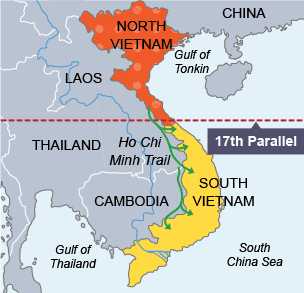
In the 1950s, the United States became involved in the Vietnam War. Why did the United States become involved in this war?
a)
to prevent the collapse of the government of North Vietnam
b)
to stop Vietnam from taking over Hong Kong
c)
to stop the spread of communism to South Vietnam
d)
to prevent attacks against United States shipping
83.

Who were the two participants in the Space Race?
a)
The US and Cuba
b)
China and US
c)
The USSR and US
d)
US and North Vietnam
84.

What was the name of the first satellite in space launched by the Soviet Union?
a)
Gagarin
b)
Apollo 11
c)
Sputnik
d)
Apollo 13
85.
On September 11th the USA remembers
a)
the worst natural disaster in American history.
b)
the most recent presidential assassination in American history.
c)
the worst terrorist attack on American soil.
d)
the awful World War 2 attack on Pearl Harbor, Hawaii.
86.
Who claimed responsibility for the attacks on September 11, 2001?
a)
Al-Qaeda
b)
Hamas
c)
Ku Klux Klan
d)
ISIS
87.
Who was the President of the United States on September 11, 2001?
a)
Bill Clinton
b)
George W. Bush
c)
Barack Obama
d)
Donald Trump
88.
The weapon used by terrorists on September 11, 2001 was/were
a)
cars.
b)
people as suicide bombers.
c)
planes.
d)
viruses via internet mail.
89.
How many planes were hijacked on September 11, 2001?
a)
3
b)
4
c)
5
d)
6
90.
Two planes crashed into buildings comprising the World Trade Center in ____________.
a)
Washington, D.C.
b)
Boston, MA.
c)
Manhattan, NY.
d)
Los Angeles, CA.
91.
One planed crashed into the Pentagon building in
a)
Boston, MA.
b)
Manhattan, NY.
c)
Los Angeles, CA.
d)
Washington, D.C.
92.
When passengers fought back, one plane crashed into
a)
the White House in Washington, D.C.
b)
the Statue of Liberty in New York Harbor.
c)
the Grand Canyon in Arizona.
d)
a field near Shanksville, Pennsylvania.
93.
After claiming responsibility for the attacks on the USA on September 11, 2001, Osama bin Laden was killed by US forces in
a)
2004 in Afghanistan.
b)
2009 in China.
c)
2011 in Pakistan.
d)
2015 in Iran.
94.
All male citizens have the right to vote regardless of race. Which amendment is this?
a)
15th
b)
3rd
c)
26th
d)
14th
95.
Repealed prohibition. Which amendment is this?
a)
21st
b)
18th
c)
27th
d)
4th
96.
No search and seizure without a warrant and probable cause. Which amendment is this?
a)
1st
b)
2nd
c)
3rd
d)
4th
97.
Ban of poll tax as a qualification to vote. Which amendment is this?
a)
23rd
b)
18th
c)
10th
d)
24th
98.
Any rights not given in the Constitution are reserved for the people. Which amendment is this?
a)
9th
b)
14th
c)
15th
d)
16th
99.
Slavery is abolished. Which amendment is this?
a)
13th
b)
15th
c)
24th
d)
19th
100.
Women's suffrage (right to vote). Which amendment is this?
a)
18th
b)
19th
c)
10th
d)
12th
101.
You have the right to a fair/speedy trial and an impartial jury. Which amendment is this?
a)
5th
b)
6th
c)
16th
d)
4th
102.
Freedom of speech, press, religion, assembly, and petition. Which amendment is this?
a)
1st
b)
2nd
c)
3rd
d)
4th
103.
No quartering of soldiers. Which amendment is this?
a)
8th
b)
3rd
c)
12th
d)
2nd
104.
Any powers not given to the federal government are given to the states. Which amendment is this?
a)
7th
b)
10th
c)
8th
d)
9th
105.
Prohibition of alcohol. Which amendment is this?
a)
15th
b)
18th
c)
22nd
d)
24th
106.
No excessive bail and cruel and unusual punishment.
a)
5th
b)
6th
c)
7th
d)
8th
107.
No double jeopardy. Which amendment is this?
a)
3rd
b)
4th
c)
5th
d)
6th
108.
Right to bear arms. Which amendment is this?
a)
1st
b)
2nd
c)
3rd
d)
4th
109.
Right to a trial by jury in civil cases over $20. Which amendment is this?
a)
4th
b)
5th
c)
6th
d)
7th
110.
Which statement BEST describes how banks make a profit?
a)
banks borrow money from the government
b)
banks charge interest on money from loans
c)
banks charge fees on personal savings accounts
d)
banks borrow money from people in the community
111.
The law of supply and demand is very important in economics. Which of the following correctly describes supply and demand?
a)
consumers will buy whatever is produced
b)
producers will make what consumers demand
c)
suppliers will make whatever they decide to
d)
investors will put money into any business
112.
People have different roles in our economic system:
-Producers
-Providers
-Consumers
-Investors
The person who buys a stock in a company is:
-Producers
-Providers
-Consumers
-Investors
The person who buys a stock in a company is:
a)
a producer
b)
a consumer
c)
an investor
d)
a provider
113.
Banks provide services in many areas that deal with an individual's money. What impact does a savings account have on an individual's money?
a)
interest is paid on money in a savings account
b)
savings accounts stopped being offered after WWII
c)
the government takes interest away each time a savings account is opened
d)
loans are given out to only those individuals who have a savings or checking account
114.
What is given up when a choice is made is:
a)
price incentive
b)
rationing
c)
specialization
d)
opportunity cost
115.
The cost a consumer pays to purchase a good or service from a producer
a)
price
b)
cost
c)
incentive
d)
income
116.
During the Civil War, the North had an advantage because it specialized in:
a)
agriculture
b)
tourism
c)
fishing
d)
manufacturing
117.
Taxes paid on money earned at work are called:
a)
income taxes
b)
estate taxes
c)
sales taxes
d)
property taxes
118.
____________ is a way to keep track of spending.
a)
a savings account
b)
a budget
c)
an investment
d)
a price incentive
119.
a person who starts and runs their own business
a)
investor
b)
producer
c)
entrepreneur
d)
inventor
120.
During the 19th Century Texas Ranchers sent cattle to eastern and northern cities, to make more money. This was an example of which economic concept?
a)
specialization
b)
opportunity cost
c)
supply and demand
d)
voluntary exchange
121.
What are the two MAIN elements of a personal budget?
a)
capital and labor
b)
needs and wants
c)
supply and demand
d)
income and expenses
122.

The Spanish-American war was the United States fighting which country?
a)
Spain
b)
Cuba
c)
Italy
d)
Great Britain
123.

False, exaggerated news stories were called -
a)
yellow journalism
b)
fake news
c)
untrue articles
d)
lies
124.

The main reason for the Spanish - American War was control over the country of _______.
a)
Cuba
b)
Puerto Rico
c)
Haiti
d)
Jamaica
125.
The reason for high cattle prices in the East was___________.
a)
low demand
b)
high supply
c)
high demand
126.
The reason cattle were cheap in Texas was because of ______________.
a)
high supply
b)
low supply
c)
high demand
127.
The first cattle trail was_____________.
a)
The Chisholm Trail
b)
The Great Western Trail
c)
The Texan Trail
128.
The Great Western Trail took cattle _____________.
a)
East
b)
South
c)
North
129.
Cattle were herded along trails and then put on ________________.
a)
planes
b)
boats
c)
trains
130.
Ranch owners were not interested in the color of your skin, but your _____________.
a)
skill
b)
age
c)
height
131.
The Panama Canal connects which two bodies of water?
a)
Atlantic/Indian
b)
Pacific/Atlantic
c)
Pacific/Indian
d)
Atlantic/Artic
132.
The United States wanted a quick ocean route from
a)
the east to the west
b)
the north to the south
c)
North America to South America
d)
the east to the south
133.
What phrase is used to describe America?
a)
blended
b)
melting pot
c)
adventurous
d)
lucky
134.
True of False: Immigrants made many positive contributions to the US.
a)
True
b)
False
135.

What does immigration mean?
a)
The action of coming to live permanently in a foreign country.
b)
Protecting your country.
c)
To move illegally.
d)
Fighting for your country.
136.

Who gave the Statue of Liberty to America?
a)
England
b)
France
c)
Mexico
d)
Canada
137.
How did Alexander Graham Bell change the world?
a)
He helped Southern Farmers live a better life
b)
He made it a lot easier for people to travel
c)
He made it easier for people to communicate
d)
He made it easier to work at night and increased the amount of work that a person could do in a day.
138.
Who invented the first airplane that could successfully hold a human and an engine in 1903.
a)
Alexander Graham Bell
b)
Thomas Edison
c)
George Washington Carver
d)
The Wright Brothers
139.
How did Thomas Edison change the world?
a)
He made it easier to work at night and increased the amount of work that a person could do in a day
b)
He made it a lot easier for people to communicate
c)
He made it a lot easier for people to travel.
d)
He helped southern farmers live a better life
140.
Where was the first flight
a)
Kitty Hawk, North Carolina
b)
Fort Sumter, South Carolina
c)
Charlotte, North Carolina
d)
Charleston, South Carolina
141.
Who was the African American scientist who created more than 300 products from peanuts and sweet potatoes?
a)
The Wright Brothers
b)
Alexander Graham Bell
c)
George Washington Carver
d)
Thomas Edison
142.

Who was George Washington Carver?
a)
He was a slave master.
b)
He was a scientist.
c)
He was a farmer.
143.
Carver invented over 300 uses for which plant?
a)
The peanut plant.
b)
The tomato plant.
c)
The cabbage plant.
144.
Who bombed Pearl Harbor
a)
Italy
b)
Germany
c)
Japan
d)
Canada
145.
What was the date of Pearl Harbor
a)
December 7 ,1941
b)
February 3 ,1956
c)
August 2 ,1478
d)
September 28 ,2000
146.
Who declared war on the Japanese the day after the attack?
a)
Franklin D. Rossevelt
b)
Ulysses S. Grant
c)
John F. Kennedy
d)
Herbert Hoover
147.
Where did they bomb?
a)
Pearl Harbor, HI
b)
New York City, NY
c)
Washington DC
d)
Anchorage, Alaska
148.
Why did Japan bomb Pearl Harbor?
a)
They were angry about WWI
b)
They wanted to be better than Germany
c)
They needed to destroy the US Navy to be able to take over the Pacific
d)
They wanted to be friends
149.
Why was Pearl Harbor important?
a)
It had many pearls around it
b)
It was a great tourist area
c)
It was an American Naval Base
d)
The President lived there
150.

Who did Hitler blame for most of the Germany's problems?
a)
Americans
b)
Christians
c)
Muslims
d)
Jews
151.

Who was the prime minister of England?
a)
Roosevelt
b)
Churchill
c)
Hitler
d)
Truman
152.

Who ruled as a dictator in Italy?
a)
Hitler
b)
Stalin
c)
Mussolini
d)
Churchill
153.
Emperor of Japan during WW2
a)
Mussolini
b)
Hirohito
c)
Hitler
d)
Khan
154.

How many Jews were murdered during the Holocaust?
a)
1 million
b)
6 million
c)
100'000
d)
60 million
155.

What does the term genocide mean?
a)
the killing of all the pets in a country
b)
The murder of all the children in a country
c)
The murder of a particular gender of people like all the males
d)
the deliberate killing of a large group of people, especially those of a particular ethnic group or nation.
156.

What was a concentration camp?
a)
a place where large numbers of people, especially political prisoners or members of persecuted minorities, are deliberately imprisoned
b)
A place where prisoners of war are placed
c)
A camp where people go to do work for the government
d)
A camp for students that have a hard time focusing on school
157.

Hostility to or prejudice against Jews is known as
a)
Pro-Judaism
b)
Anti-Judaism
c)
Anti-Jewishism
d)
Anti-Semitism
158.
Which Jews were spared during the Holocaust?
a)
Women
b)
Old Men
c)
Children
d)
None of the above
159.
What was the Holocaust?
a)
Ethnic killings in Rwanda between the Hutus and the Tutsis
b)
The systematic killing of Jews by Nazi Germany
c)
The destruction of Islamic holy sites in the Middle East
d)
The genocide in Kosovo
160.
The Holocaust occurred during which war?
a)
World War I
b)
Civil War
c)
World War II
d)
Cold War
161.
All of the following countries were trying to make an atomic bomb except:
a)
France
b)
The United States
c)
Japan
d)
Germany
162.
The country that won the race to build the first atomic bomb was
a)
Japan
b)
France
c)
Germany
d)
The United States
163.
During which war did the U.S. create the atomic bomb?
a)
World War I
b)
World War II
c)
Korean War
d)
Vietnam War
164.
What president made the decision to use the atomic bomb against Japan in World War II?
a)
Dwight D. Eisenhower
b)
Franklin D. Roosevelt
c)
Harry S. Truman
d)
John F. Kennedy
165.
Why did the United States decide to drop the bomb rather than invade Japan with soldiers?
a)
wanted to see if the bomb worked
b)
did not think they could defeat the Japanese
c)
did not have the soldiers or weapons left to attack Japan
d)
They estimated that 500,000 to 1 million Allied soldiers would die in an invasion
166.
Hiroshima and Nagasaki are the 2 cities bombed with the Atomic bomb?
a)
True
b)
False
167.
What was the name of the secret project in the United States to develop an atomic bomb?
a)
The New York Project
b)
The Manhattan Project
c)
The Nuclear Project
d)
The Atom Splitting Project
168.
What scientist wrote a letter to President Roosevelt telling him of the potential of an atomic bomb?
a)
J. Robert Oppenheimer
b)
Thomas Edison
c)
Albert Einstein
d)
Henry Ford
169.
What president made the decision to use the atomic bomb against Japan in World War II?
a)
Harry S. Truman
b)
Franklin D. Roosevelt
c)
John F. Kennedy
d)
Dwight D. Eisenhower
170.
What Japanese city was the atomic bomb first dropped on?
a)
Kobe
b)
Nagasaki
c)
Tokyo
d)
Hiroshima
171.
True or false: The American scientists were scared when they saw that their bombed worked as expected.
a)
TRUE
b)
FALSE
100 %