wayground logo

Free Printable Worksheets

Font size

S
M
L
XL
Worksheets

HBS EOC Complete Review

Total questions: 193

Worksheet time: 3hrs 51mins

Name
Class
Date
1.
The elbow is ___________ to the shoulder.
a)
proximal
b)
distal
c)
superior
d)
anterior
2.
The shoulder is ______________ to the chest.
a)
Anterior
b)
Posterior
c)
Medial
d)
Lateral
3.
Axillary is located at the
a)
head
b)
armpit
c)
foot
d)
sternum
4.
Buccal is located at the
a)
nose
b)
butt
c)
mouth
d)
throat
5.
The skull, vertebra, and sternum all refer to which skeleton?
a)
axial
b)
skeletal
6.
which one of these IS  a function of the skeletal system 
a)
vitamin D production
b)
fat storage
c)
movement
7.
The muscles tissue of this organ is called __________ and is __________.
a)
Smooth/Voluntary
b)
Cardiac/Voluntary
c)
Cardiac/Involuntary
d)
Skeletal/Voluntary 
8.
The muscle tissues of this system are called ________ and they are ________.
a)
Smooth/Involuntary
b)
Skeletal/Voluntary
c)
Cardiac/Involuntary
d)
Smooth/Voluntary
9.
Connective tissue in which fat is stored; has the cells distended by droplets of fat
a)
Adipose tissue
b)
Agarose tissue
c)
Peritumium
d)
Muscle Tissue
10.
Bones of the limbs and limb girdles that are attached to the axial skeleton
a)
Axial Skeleton
b)
Appendicular Skeleton
c)
Appendage Skeleton
d)
Superior Skeleton
11.
Sheets of tightly packed cells that line organs and body cavities
a)
Muscle Tissue
b)
Epithelial Tissue
c)
Adipose Tissue
d)
Connective Tissue
12.
The branch of physical anthropology in which anthropological data, criteria, and techniques are used to determine the sex, age, genetic population, or parentage of skeletal or biological materials in questions of civil or criminal law
a)
Anthropological Morphology
b)
Forensic Cytology
c)
Anthropological Geneology
d)
Forensic Anthropology
13.
An integrated group of cells with a common structure and function
a)
Organ group
b)
System
c)
Cell Group
d)
Tissue
14.
The separation of nucleic acids or proteins, on the basis of their size and electrical charge, by measuring their rate of movement through an electrical field in a gel.
a)
Gel Electrolysis
b)
Gel Electromagnetism
c)
Gel Bath
d)
Gel electrophoresis
15.
A degradative enzyme that recognizes specific nucleotide sequences and cuts up DNA.
a)
Restriction enzyme
b)
Induction Enzyme
c)
Control Enzyme
d)
Reduction Enzyme
16.
What muscle allows you to kiss?
a)
orbicularis oris
b)
orbicularis oculi
c)
buccinator
d)
triangularis
17.
What muscle allows you to wink or squint?
a)
orbicularis oris
b)
frontalis
c)
orbicularis oculi
d)
triangularis
18.
Which bone shape do you arms and legs belong to?
a)
Phalanges
b)
Long
c)
Flat
d)
Short
19.
What bones can be used to measure height
a)
Femur
b)
Radius
c)
Humerus
d)
All of the above
20.
Formulas for height change depending on age, race and gender
a)
True
b)
False
21.
Which bones are commonly used to identify gender?
a)
Skull and pelvis
b)
Pelvis and humerus
c)
Tibia and Femur
d)
Skull and femur
22.
Fingerprint scan, vein recognition, and facial recognition are just a few examples of
a)
biometrics
b)
forensic anthroplogy
c)
bioinformatics
d)
epigenetics
23.
Terms used to explain where one body structure is in relation to another
a)
Locational Terms
b)
Medical Local
c)
Omin-Directional Terms
d)
Directional Terms
24.
Away from the body surface; more internal
a)
Deep
b)
Distal
c)
Anterior
d)
Dorsal
25.
The distinguishing character or personality of an individual
a)
Characteristic
b)
Identifier
c)
Character
d)
Identity
26.
Of or relating to the side, especially of a body part
a)
Inferior
b)
Lateral
c)
Medial
d)
Posterior
27.
Situated next to or near the point of attachment or origin or a near a central point
a)
Medial
b)
Posterior
c)
Proximal
d)
Inferior
28.
Anatomical terms that refer to specific visible landmarks on the surface of the body
a)
Local Terms
b)
Body Region Terms
c)
Regional Terms
d)
Interior Terms
29.
A group of body organs or structures that together perform one or more vital functions
a)
Tissue
b)
Organ group
c)
System
d)
Cell Group
30.
A double-stranded, helical nucleic acid molecule capable of replicating and determining the inherited structure of a cell�s proteins.
a)
Ribonucleic Acid (RNA)
b)
Deoxyribonucleic acid (DNA)
c)
Diribonucleic Acid (DNA)
d)
Denaturedribonucleic acid (DNA)
31.
Differences in DNA sequence on homologous chromosomes that can result in different patterns of restriction fragment lengths (DNA segments resulting from treatment with restriction enzymes).
a)
Restriction fragment lethal polymorphism (RFLP)
b)
Reduction fragment length polymorphism (RFLP)
c)
Restriction fragment length polymorphisms (RFLPs)
d)
Restriction fragment leg polymorphism (RFLP)
32.

This system delivers nutrients and oxygen to the body cells

a)

respiratory

b)

digestive

c)

circulatory

d)

nervous

33.

This system helps get rid of germs and protects against diseases

a)

excretory

b)

endocrine

c)

skeletal

d)

immune

34.

This system produces egg/sperm cells; female supports a developing embryo

a)

muscular

b)

reproductive

c)

nervous

d)

lymphatc

35.

This system absorbs oxygen and gets rid of carbon dioxide

a)

circulatory

b)

immune

c)

respiratory

d)

excretory

36.

This system supports and protects the body and internal organs

a)

muscular

b)

excretory

c)

integumentary

d)

skeletal

37.

This system receives and sends electrical signals throughout the body

a)

digestive

b)

nervous

c)

skeletal

d)

endocrine

38.

This system secretes hormones that help regulate the other organ systems

a)

endocrine

b)

respiratory

c)

immune

d)

nervous

39.

This system returns fluid to the blood vessels

a)

digestive

b)

endocrine

c)

circulatory

d)

lymphatic

40.

This system protects the body from injury, infection, and dehydration

a)

skeletal

b)

circulatory

c)

integumentary

d)

reproductive

41.

This system removes waste from the body

a)

excretory

b)

nervous

c)

muscular

d)

immune

42.

This system enables the body to move

a)

muscular

b)

lymphatic

c)

integumentary

d)

respiratory

43.

Two or more tissues working together form a(n)

a)

organ

b)

organ system

c)

cell

d)

organism

44.

What is homeostasis?

a)

the sum of all metabolic activities within the body

b)

maintaining a constant internal environment

c)

the exchange of oxygen and carbon dioxide

d)

the breaking down of nutrients into smaller molecules

45.

Which of the following is a TRUE example of what your body does to maintain homeostasis?

a)

concentrated urine (yellow) when there is a high amount of water content

b)

sweat when hot

c)

dilute urine (less yellow) when there is a low amount of water content

d)

shiver when hot

46.
The circulatory system is made up of..
a)
heart, blood, capillaries
b)
heart, blood, plasma
c)
heart, blood, blood vessels 
d)
Heart, blood, lungs
47.
White blood cells
a)
help fight disease
b)
take up oxygen and deliver to cells 
c)
help form blood clots 
d)
helps carry nutrients
48.
Red blood cells 
a)
help fight disease
b)
take up oxygen and deliver to cells 
c)
help form blood clots 
d)
are the liquid part of blood
49.
The chewing and grinding of food into smaller pieces is an example of...
a)
Mechanical Digestion
b)
Chemical Digestion
50.
What is one secondary organ of the digestive system?
a)
Small Intestine
b)
Esophagus
c)
Gallbladder
d)
Stomach
51.
Bile is made by which digestive organ?
a)
Gallbladder
b)
Stomach
c)
Rectum
d)
Liver
52.
Which digestive organ makes digestive juices to help the small intestine absorb nutrients?
a)
Liver
b)
Gallbladder
c)
Pancreas
d)
Esophagus
53.
Nutrients from digested food are absorbed in which digestive organ?
a)
Small Intestine
b)
Stomach
c)
Large Intestine
d)
Gallbladder
54.
Number 4 is pointing to the....
a)
Anus
b)
Rectum
c)
Large Intestine
d)
Small intestine
55.
Number 5 is pointing to the...
a)
Liver
b)
Gallbladder
c)
Pancreas
d)
Stomach
56.
Number 3 is pointing to the...
a)
Small intestine
b)
Rectum
c)
Large intestine
d)
Stomach
57.
As waste moves through the digestive system, the ______ absorbs water before storing waste in the rectum.
a)
Small intestine
b)
Stomach
c)
Esophagus
d)
Large intestine
58.
Enzymes (chemicals) in your saliva help break down food while chewing.  This is...
a)
Mechanical digestion
b)
Chemical digestion
59.
Provides structure to hold tissues together
a)
Epithelial
b)
Connective
c)
Muscle
d)
Nerve
60.
What makes up tissues
a)
Cartilage
b)
Atoms
c)
Cells
d)
Muscle
61.
Which of the following is a function of epithelial tissue?
a)
Protection
b)
Absorption
c)
Secretion
d)
All the the above
62.
Based on these results whose blood was found in the blood stain at the crime scene?
a)
Bob
b)
Sue
c)
John
d)
Lisa
63.
Which sequence of DNA bases would pair with this partiaal strand
ATG TGA CAG
a)
ATG TGA CAG
b)
TAC ACT GTC
c)
GTA AGT GAC
d)
CAT TCA CTG
64.
Which DNA fragments move the farthest in a gel electrophoresis?
a)
smallest
b)
medium sized
c)
largest
d)
heaviest
65.
The stage of fusion of various bones within a skeleton can be used to estimate the ___________ of the deceased person. 
a)
age
b)
race
c)
gender
d)
height
66.
A man was injured in a car accident and fractured his certical vertebrae, his femur and his 5th metatarsul. Explain his condition.
a)
broken back, broken lower leg, and broken finger
b)
broken back, broken upper leg and broken finger
c)
broken neck, broken upper leg and broken pinky toe
d)
broken neck, broken upper leg and broken big toe
67.
What is the light blue area called?
a)
Temporal lobe
b)
Frontal lobe
c)
Occipital lobe
d)
Parietal lobe
68.
What is the green area called?
a)
Frontal lobe
b)
Parietal lobe
c)
Occipital lobe
d)
Cerebrum
69.
What is the yellow area called?
a)
Posterior lobe
b)
Lateral lobe
c)
Temporal lobe
d)
Occipital lobe
70.
What is the pink area called?
a)
Parietal lobe
b)
Temporal lobe
c)
Occipital lobe
d)
Cerebellum
71.
What is the function of the occipital lobe?
a)
Hearing
b)
Seeing
c)
Communication
d)
Coordination
72.
What is the red area called?
a)
Cerebrum
b)
Cerebellum
c)
Brain Stem
d)
Occipital lobe
73.
What is the entire brain called?
a)
Cerebellum
b)
Cerebrum
74.
The part of the brain composed of the midbrain, pons, and medulla oblongata and connecting the spinal cord with the forebrain and cerebrum.
a)
Brain Stem
b)
Cerebellum
c)
Brain Stump
d)
Brain Stick
75.
A convoluted ridge between anatomical grooves.
a)
Gyrium
b)
Gyrum
c)
Gyrus
d)
Jyrus
76.
A shallow furrow on the surface of the brain separating adjacent gyri.
a)
Ganglia
b)
Gyrus Corpus
c)
Fissure
d)
Sulcus
77.
A momentary reversal in electrical potential across a plasma membrane (as of a nerve cell or muscle fiber) that occurs when a cell has been activated by a stimulus.
a)
Electric Potential
b)
Potential Energy
c)
Action Potential
d)
Kinetic Potential
78.
A long nerve cell process that usually conducts impulses away from the cell body.
a)
Dendrite
b)
Axon
c)
Cell body
d)
Axial branch
79.
An atom or group of atoms that carries a positive or negative electric charge as a result of having lost or gained one or more electrons.
a)
Proton
b)
Ion
c)
Cation
d)
Anion
80.
A substance (as norepinephrine or acetylcholine) that transmits nerve impulses across a synapse.
a)
Norotransmitter
b)
Neurotransmitter
c)
Electrotransmitter
d)
Synoptictransmitter
81.
An automatic and often inborn response to a stimulus that involves a nerve impulse passing inward from a receptor to the spinal cord and thence outward to an effector (as a muscle or gland) without reaching the level of consciousness and often without passing to the brain.
a)
Reaction
b)
Reflex
c)
Reflection
d)
Reflects
82.
The place at which a nervous impulse passes from one neuron to another.
a)
Synaptic gap
b)
Neural gap
c)
Synapse
d)
Neuraltransmitter
83.
The ventral part of the vertebrate forebrain; functions in maintaining homeostasis, especially in coordinating the endocrine and nervous systems; secretes hormones of the posterior pituitary and releasing factors, which regulate the anterior pituitary.
a)
Lymbus
b)
Hypothyrus
c)
Hypoglandulus
d)
Hypothalamus
84.
loss of myelin; result in loss of muscle function, double vision, loss of balance, poor coordination, tremors, tingling, numbness
a)
Parkinson's
b)
cerebral palsy
c)
Belle's palsy
d)
Multiple Sclerosis
85.
condition in which abnormal, rapid impulses are released by brain cells, causing skeletal muscles to contract violently and uncontrollably
a)
encephalitis
b)
aphasia
c)
coma
d)
epilepsy
86.
What number on the graph represents the Depolarization phase?
a)
1
b)
2
c)
3
d)
4
87.
What number on the graph represents the Hyperpolarization phase?
a)
1
b)
2
c)
3
d)
4
88.
A gland (as the thyroid or the pituitary) that produces an endocrine secretion -- called also ductless gland, gland of internal secretion.
a)
Exocrine Gland
b)
Lymphatic Gland
c)
Digestive Gland
d)
Endocrine Gland
89.
The glands and parts of glands that produce endocrine secretions, help to integrate and control bodily metabolic activity, and include especially the pituitary, thyroid, parathyroid, adrenals, islets of Langerhans, ovaries, and testes.
a)
Lymphatic System
b)
Exocrine System
c)
Endocrine System
d)
Autonomic System
90.
A gland (as a sweat gland, a salivary gland, or a kidney) that releases a secretion external to or at the surface of an organ by means of a canal or duct.
a)
Endocrine Gland
b)
Exocrine Gland
c)
Limbic Gland
d)
Excretory Gland
91.
Any one of the many circulating chemical signals found in all multicellular organisms that are formed in specialized cells, travel in body fluids, and coordinate the various parts of the organism by interacting with target cells.
a)
Lymph fluid
b)
Neurotransmitter
c)
Hormone
d)
Fluid Transmitter
92.
An endocrine gland at the base of the hypothalamus; consists of a posterior lobe, which stores and releases two hormones produced by the hypothalamus, and an anterior lobe, which produces and secretes many hormones that regulate diverse body functions.
a)
Thyroid gland
b)
Pituitary gland
c)
Parathyroid gland
d)
Pancreas
93.
The automatic adjustment of the eye for seeing at different distances affected chiefly by changes in the convexity of the crystalline lens.
a)
Accommodation
b)
Degeneration
c)
Adjustment
d)
Myoptic Response
94.
A defect of an optical system (as a lens) causing rays from a point to fail to meet in a focal point resulting in a blurred and imperfect image.
a)
Myopia
b)
Astigmatism
c)
Dystopia
95.
The small circular area in the retina where the optic nerve enters the eye that is devoid of rods and cones and is insensitive to light.
a)
Myopic Spot
b)
Can't see Spot
c)
Blind spot
d)
Unfocused spot
96.
Any of the conical photosensitive receptor cells of the vertebrate retina that function in color vision.
a)
rod
b)
maculus
c)
tapetum
d)
cone
97.
The transparent part of the coat of the eyeball that covers the iris and pupil and admits light to the interior.
a)
Retina
b)
Iris
c)
Cornea
d)
Lens
98.
A condition in which visual images come to a focus behind the retina of the eye and vision is better for distant than for near objects -- called also�farsightedness.
a)
Hyperopia
b)
Myopia
c)
Non-nearsightedness
d)
Hyperpola
99.
A condition in which the visual images come to a focus in front of the retina of the eye because of defects in the refractive media of the eye or of abnormal length of the eyeball resulting especially in defective vision of distant objects -- called also nearsightedness.
a)
Hyperopia
b)
Myopic Nearsigtendess
c)
Myopius
d)
Myopia
100.
Any of the long rod-shaped photosensitive receptors in the retina responsive to faint light.
a)
Cones
b)
Color cells
c)
Rod
d)
Photons
101.
What is letter B
a)
Optic nerve
b)
Lens
c)
Cornea
d)
Retina
102.
What is letter I?
a)
Cornea
b)
Lens
c)
Vitreous humor
d)
Optic nerve
103.
The younger the individual, the ______ cartilage they have.
a)
More
b)
Less
104.
The frontal lobe controls
a)
memory, behavior, thinking
b)
memory, thinking, movement 
c)
language, thinking, memory
d)
movement, thinking, and memory
105.
The temporal lobe controls
a)
learning, memory, thinking
b)
learning, feelings, and hearing
c)
language, feelings and hearing
d)
learning, behavior, and feelings
106.
The parietal lobe controls
a)
sense of touch, and language
b)
language, feelings, and memory
c)
sense of touch and balance
d)
sense of touch, and movement
107.
The occipital lobe controls
a)
vision and touch
b)
vision and hearing
c)
vision
d)
vision and balance
108.
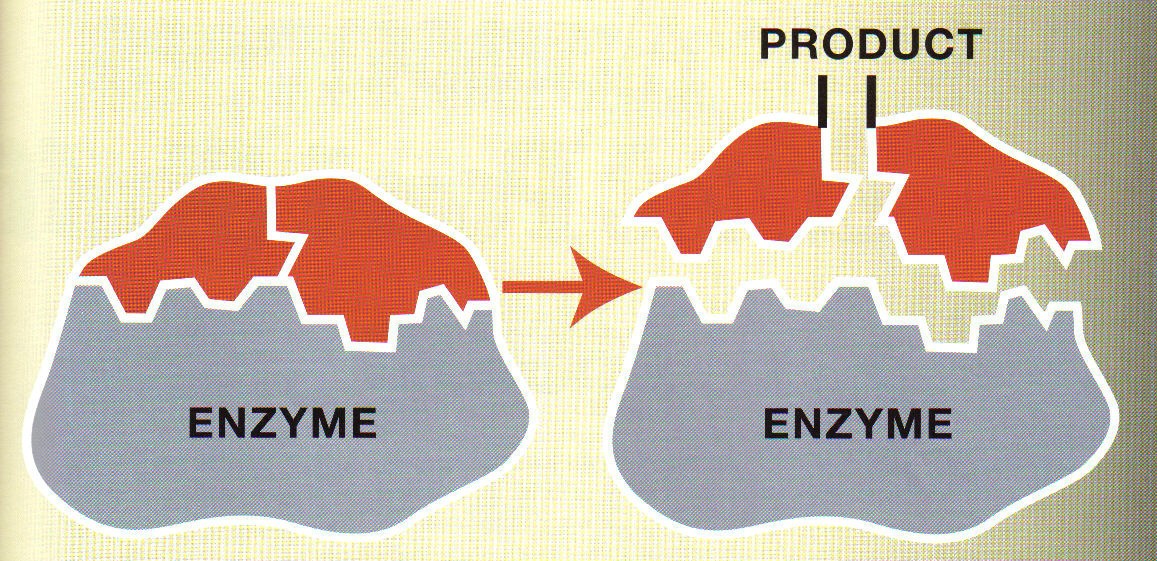
Any substance that is acted upon by an enzyme is called a(n)?
a)
Coenzyme
b)
Substrate
c)
Vitamin
d)
Polypeptide
109.
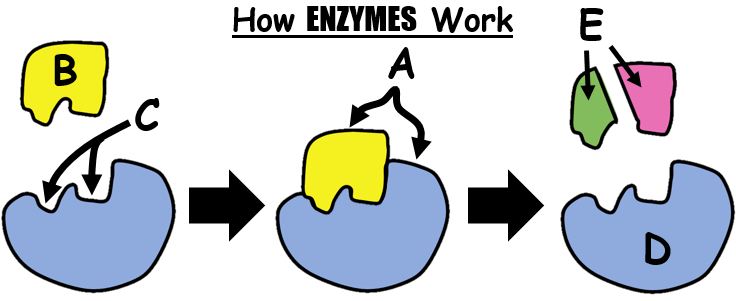
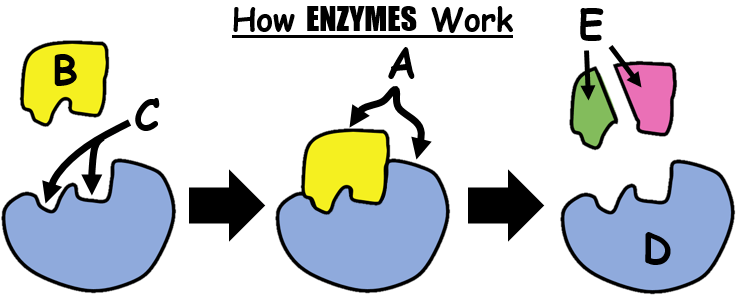
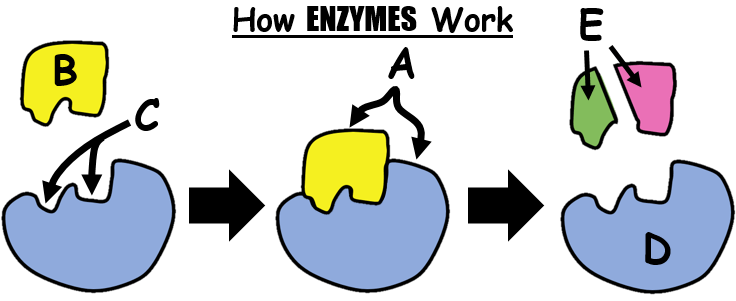
In the diagram, what is letter A? 
a)
product
b)
substrate
c)
enzyme-substrate complex
d)
active site
110.
What happens when enzymes are heated to a high temperature?
a)
The enzymes die.
b)
The shapes of the enzyme are altered or denatured
c)
The enzymes' amino acid sequence changes.
d)
The enzymes remain the same
111.
Which of these is most likely an enzyme?  
a)
Sucrose
b)
Galactose
c)
Fructose
d)
Amylase
112.
The pH at which an enzyme is most efficient is called the _________ pH of an enzyme.
a)
neutral
b)
optimum
c)
minimum
d)
experimental 
113.
The current model of enzyme action is referred to as the...
a)
Induced Fit Model
b)
Lock & Key Model
c)
Singer-Nicolson Model
d)
Davson-Danielli Model
114.
Letter D...
a)
active site
b)
enzyme
c)
substrate
d)
products
115.
Letter B...
a)
active site
b)
enzyme
c)
substrate
d)
products
116.
Organic molecules that temporarily bind to enzymes and enhance an enzyme's ability are called:
a)
CoFactors
b)
CoEnzymes
c)
Allosteric Inhibitors
d)
Allosteric Activators
117.
Cells can produce over one thousand different enzymes at a time.  Enzymes are critical to the metabolism of these cells, but why are so many different enzymes needed?
a)
Cells are completely unable to control what enzymes
they produce
b)
The variety of enzymes prevents their actions from being inhibited. 
c)
The active site of an enzyme can only bind to a specific substrate.
d)
The products of a reaction are always converted into new enzymes.
118.

What is needed to release the energy from an ATP molecule?

a)

glucose

b)

water

c)

oxygen

d)

carbon dioxide

119.

The sum of all chemical activity in an organism is

a)

BMR

b)

metabolism

c)

homeostasis

d)

BMI

120.

Decreased concentration of enzymes will cause the reaction to

a)

slow down

b)

speed up

c)

stay the same

d)

not occur

121.
Which of these necessary components is broken down to provide energy?
a)
food
b)
oxygen
c)
vitamins
d)
water
122.
Terminal air sacs that constitute the gas exchange surface of the lungs
a)
Bronchi
b)
Bronchioles
c)
Alveoli
d)
Trachea
123.
The volume of air breathed in one minute without conscious effort
a)
Residual Volume
b)
Minute Volume
c)
Tidal Volume
d)
Expiratory Volume
124.
The volume of air remaining in lungs after maximum exhalation
a)
Residual Volume
b)
Minute Volume
c)
Tidal Volume
d)
Expiratory Volume
125.
An instrument for measuring the air entering and leaving the lungs
a)
Cathometer
b)
Breathometer
c)
Pirometer
d)
Spirometer
126.
The amount of heat energy required to raise the temperature of 1 g of water by 1 degree C. 
a)
Calorie
b)
calorie
c)
kilocalorie
d)
kalorie
127.
Chemical reactions that break down complex organic compounds into simple ones, with the net release of energy.
a)
Catabolism
b)
Anabolism
c)
Metabolism
d)
Canabolism
128.

Joe blows into a spirometer and relaxes his diaphragm. This process is:

a)

aspiration

b)

exhalation

c)

inhalation

d)

sound production

129.

If a patient has difficulty breathing and wheezing, the patient may be suffering from:

a)

Bronchitis

b)

Pneumonia

c)

Emphysema

d)

Asthma

130.

During an asthma attack what treatment is recommended?

a)

antibiotics

b)

vaccine

c)

rescue inhaler

131.
Which of the following is an example of the urinary system's ability to maintain homeostasis?
a)
A person drinks a large amount of water and urinary output increases.
b)
The kidneys are protected by a heavy cushion of fat and a fibrous capsule.
c)
As people get older, the frequency of nocturne increases.
d)
When physical activity increases, the blood flow through the kidneys decreases.
132.
The hormone released by the posterior pituitary to prevent excessive water loss in the urine is ________.
a)
antidiuretic hormone (ADH)
b)
insulin
c)
cortisol
d)
aldosterone
133.
Which of these is a solute NOT normally found in urine?
a)
Glucose
b)
Sodium and potassium ions
c)
Ammonia
d)
Bicarbonate ions
134.
T/F: The nephron is the basic structural and functional unit of the kidney. 
a)
True 
b)
False 
135.
What is the correct order of the steps of function within the nephron? 
a)
Secretion, Reabsorption, Filtration 
b)
Filtration, Secretion, Reabsorption 
c)
Filtration, Reabsorption, Secretion 
d)
Secretion, Filtration, Reabsorption
136.
How does the glomerulus filter blood into the Bowman's capsule? 
a)
High pressure 
b)
Concentration Gradient 
c)
Active transport 
d)
Passive transport 
137.
Nerve cells that carry impulses towards the central nervous system
a)
Afferent neurons
b)
Effector neuron
c)
Axial neuron
d)
Dendrites
138.
The attachment of a muscle tendon to a stationary bone,
a)
Insertion
b)
Exsertion
c)
Origin
d)
Connecting Point
139.
Temporary rigidity of muscles occurring after death
a)
Rigor mordis
b)
Rigor mortis
c)
Rigger mortis
d)
Riger mordus
140.
Any of the repeating structural units of striated muscle fibrils
a)
Sarcomere
b)
A band
c)
I band
d)
Myosin
141.
An organ specialized for contraction, composed of striated muscle fibers (cells), supported by connective tissue, attached to bone by a tendon.
a)
Skeletal muscle
b)
Cardiac muscle
c)
Smooth muscle
d)
Muscle fiber
142.
An articulation (as the hip joint) in which the rounded head of one bone fits into a cuplike cavity of the other and admits movement in any direction
a)
Hinge joint
b)
Fissure joint
c)
Gliding joint
d)
Ball-and-socket joint
143.
A usually translucent somewhat elastic tissue that composes most of the skeleton of vertebrate embryos and except for a small number of structures (as some joints, respiratory passages, and the external ear) is replaced by bone during ossification in the higher vertebrates.
a)
Cartilage
b)
Tendon
c)
Peritenium
d)
Grissle
144.
A movement at a synovial joint in which the distal end of the bone moves in a circle while the proximal end remains relatively stable
a)
Circumduction
b)
Circumspection
c)
Circadduction
d)
Circabduction
145.
Bending the foot in the direction of the dorsum (upper surface)
a)
Dorsiflexion
b)
Plantarflextion
c)
Adduction
d)
Abuction
146.
An unbending movement around a joint in a limb (as the knee or elbow) that increases the angle between the bones of the limb at the joint
a)
Flexsion
b)
Extension
c)
Supine
d)
Prone
147.
An instrument for measuring angles (as of a joint or the skull)
a)
Protractor
b)
Goniometer
c)
Doniometer
d)
Angleometer
148.
Joint between bones (as at the elbow or knee) that permits motion in only one plane
a)
Gliding Joint
b)
Ball-and-Socket
c)
Hinge joint
d)
Pivot
149.
Dense regular connective tissue that attaches bone to bone
a)
Cartilage
b)
Tendon
c)
Hyaline
d)
Ligament
150.
Bending the foot in the direction of the plantar surface (sole)
a)
Dorsi flexion
b)
Appendi flexion
c)
Foot flexsion
d)
Plantar flexion
151.
The range through which a joint can be moved
a)
Joint Range
b)
Joint Freedom
c)
Degrees of Freedom
d)
Range of Motion
152.
A fully moveable joint in which the synovial (joint) cavity is present between the two articulating bones
a)
Saddle joint
b)
Synovial joint
c)
Planar joint
d)
Pivot joint
153.
Any of the tubular branching muscular- and elastic-walled vessels that carry blood from the heart through the body.
a)
Vein
b)
Capillary
c)
Artery
d)
Capillary branch
154.
A chronic disease characterized by abnormal thickening and hardening of the arterial walls with resulting loss of elasticity
a)
Atherosclerosis
b)
Veiniolsclerosis
c)
Arteriosclerosis
d)
Arteriolsclerosis
155.
A chamber of the heart that receives blood from the veins and forces it into a ventricle or ventricles.
a)
Right Ventrical
b)
Aorta
c)
Inferior Vena Cava
d)
Atrium
156.
The hydrostatic force that blood exerts against the wall of a vessel.
a)
Systole
b)
Diastole
c)
EKG
d)
Blood pressure
157.
Any of the smallest blood vessels connecting arterioles with venules and forming networks throughout the body.
a)
Capillary
b)
Artioles
c)
Venioles
d)
Plexus
158.
The volume of blood ejected from the left side of the heart in one minute.
a)
Cardiac output
b)
Heart rate
c)
Blood flow rate
d)
Flow rate
159.
A form of peripheral vascular disease in which there is partial or total blockage of an artery, usually one leading to a leg or arm.
a)
Internal artery disease
b)
External artery disease
c)
Peripheral artery disease
d)
Aortal artery disease
160.
The passage of venous blood from the right atrium of the heart through the right ventricle and pulmonary arteries to the lungs where it is oxygenated and its return via the pulmonary veins to enter the left atrium and participate in the systemic circulation
a)
Aortic Circulation
b)
Peripheral Circulation
c)
Pulmonary Circulation
d)
Cardiac Circulation
161.
The volume of blood pumped from a ventricle of the heart in one beat
a)
Blood volume
b)
Blood rate
c)
Tidal volume
d)
Stroke volume
162.
The passage of arterial blood from the left atrium of the heart through the left ventricle, the systemic arteries, and the capillaries to the organs and tissues that receive much of its oxygen in exchange for carbon dioxide and the return of the carbon-dioxide carrying blood via the systemic veins to enter the right atrium of the heart and to participate in the pulmonary circulation
a)
Systemic Circulation
b)
Systematic Circulation
c)
Peripheral Circulation
d)
Interior Circulation
163.
A bodily structure  that closes temporarily a passage or orifice or permits movement of fluid in one direction only.
a)
Valve
b)
Gate
c)
Regulator
d)
Inlet
164.
An abnormal swelling of a superficial vein of the legs.
a)
Varicose vein
b)
Phlebitis
c)
Deep Vein Thrombosis
d)
Chronic Venous Insufficiency
165.
Containing oxygen; referring to an organism, environment, or cellular process that requires oxygen
a)
Anaerobic
b)
Pneumatic
c)
Aerobic
d)
Hydrolic
166.
Lacking oxygen; referring to an organism, environment, or cellular process that lacks oxygen and may be poisoned by it
a)
Aerobic
b)
Ascerbic
c)
Anaerobic
d)
Endonic
167.
A technique for temporarily improving athletic performance in which oxygen-carrying red blood cells previously withdrawn from an athlete are injected back just before an event
a)
Hematosis 
b)
Blood Enriching
c)
Blood Packing
d)
Blood Doping
168.
A compound of creatine and phosphoric acid that is found especially in vertebrate muscle where it is an energy source for muscle contraction
a)
Creatine Phosporus
b)
Creatine Phospholate
c)
Creatine Hydrophosphate
d)
Creatine phosphate
169.
A hormonal substance that is formed especially in the kidney and stimulates red blood cell formation
a)
Erythropoietin
b)
Hematropeitin
c)
Erythoromyacin
d)
Hematocrit
170.
An organic acid present in blood and muscle tissue as a product of the anaerobic metabolism of glucose and glycogen
a)
Dicarboxylic acid
b)
Ketogenic amino acid
c)
Lactic acid
d)
Keto acid
171.
Inability of muscle to maintain its strength of contraction or tension; may be related to insufficient oxygen, depletion of glycogen, and/or lactic acid buildup
a)
Muscle Failure
b)
Muscle Fatigue
c)
Muscle Overload
d)
Lactic Acid Build Up
172.

sinoatrial (sa) node, atrioventricular (av) node, atrioventricular (av) bundle, left and right bundle branches, purkinje fibers

a)

Direction of blood flow through the heart

b)

Dorsal venous network

c)

Direction of electrical impulses through the heart

d)

Anterior artery network

173.

Popliteal Artery →

a)

True

b)

False

174.
Contractile unit of a muscle.
a)
sarcomere
b)
motor unit
c)
fascicle
d)
myofibril
175.
What two chemicals are necessary for muscle contraction to occur?
a)
Niacin and Potassium
b)
Calcium and ATP
c)
Sodium and Potassium
d)
Ach and Potassium
176.
What is a crossbridge?
a)
Where myosin binds to actin
b)
Where the calcium crosses into the cytoplasm
c)
Where calcium binds with troponin
d)
None of the answers are correct.
177.
The energy needed to perform a muscle contraction comes directly from
a)
ATP
b)
Oxygen
c)
Glucose
d)
Calcium
178.
What is the structure that stores the Calcium in the muscle cell.  
a)
Sarcoplasm
b)
Sarcolemma
c)
Sarcoplasmic Reticulum
d)
Myoglobin
179.
What is the theory that describes the shortening of the sarcomere?
a)
sarcomerology
b)
thermodynamics
c)
muscular theory
d)
sliding filament theory
180.

Make new bone and help repair damage.

a)

Osteoblast

b)

Osteoclast

c)

Osteocytes

d)

Osetoblank

181.

What determines blood type?

a)

by which antigens are on the surface of the blood cell, A, AB. B. or none

b)

by the antibodies in the blood plasma

c)

by the antibodies on the surface of the blood cell

d)

the race of the person

182.

What type of blood can a person with type A blood recieve ?

a)

A, AB & O

b)

A & O

c)

A & AB

d)

AB, B & O

183.

Mary was in an auto accident and needs a blood transfusion.

Mary's blood type is O, she received blood type AB. What could happen to Mary?

a)

She could die

b)

She will recover nicely

c)

She might develop a rash, but otherwise be ok

d)

She will now have blood type OAB

184.

When a person fractures their bone, how does the bone heal?

a)

through remodeling

b)

through DNA synthesis

c)

through mRNA regeneration.

d)

through bone genesis

185.

A sunburn is an example of what type of burn?

a)

1st degree

b)

2nd degree

c)

3rd degree

d)

4th degree

186.

A burn that causes a clear blister is an example of what type of burn?

a)

1st degree

b)

2nd degree

c)

3rd degree

d)

4th degree

187.

What are lymphocytes

a)

red blood cells

b)

white blood cells

c)

lymph fluid

188.

What is the function of the lymph system?

a)

to produce extracellular fluid

b)

to transport blood throughout the body

c)

to transport lymph, a fluid containing infection-fighting white blood cells, throughout the body

189.

Mary was exposed to pathogen A, she developed a sore throat and a cough. She was exposed to the same pathogen a month later, but did not develop any symptoms. Why?

a)

her body had developed memory cells ( a type of white blood cell) that remembered the pathogen and destroyed it before it could cause harm.

b)

she was now immune to pathogen B, so pathogen A will have no effect.

c)

her red blood cells now know to destroy pathogen A on sight.

190.
 Like all other body systems, the immune system helps the body maintain homeostasis.  Which statement best describes how the immune system does this?  
a)
it protects other organs and tissues from infection and disease
b)
it breaks down food to provide cells with nutrients
c)
it gathers information through the senses and controls all other body systems
d)
 it transports oxygen and carbon dioxide
191.
What do antibodies attach to on the pathogen?
a)
Anti inflammatory
b)
Antigens
c)
Antiseptic
d)
Antibodies
192.

True/False: Your body cannot make antibodies for pathogens that you have never been in contact with.

a)

True, because your body needs to encounter the pathogen at least once in order to create the antibodies.

b)

False, because you can make antibodies via immunizations given by a doctor.

193.

What happens after the second time you are exposed to a pathogen?

a)

The body will not be able to fight off the pathogen quickly, because it knows how to get into the body easier.

b)

The body's immune system will react the same was as it did during the first exposure.

c)

The body can only be exposed to a pathogen a second time if you do not have a vaccine.

d)

The body will know how to fight off the pathogen quickly, because memory cells have been created after the first encounter.