

wayground logo

Free Printable Worksheets

NEW

Font size

S
M
L
XL
Worksheets

Unit 9 and 10 Review

Total questions: 25

Worksheet time: 37mins

Name
Class
Date
1.
What characteristics of the planet, Earth, is essential to the survival of living organisms?
a)
Earth has abundant available water
b)
Earth has just one orbiting moon.
c)
Earth orbits the Sun once every 365 days
d)
Earth rotates on its axis once every 24 hours.
2.
What is the most important factor that determines Earth’s temperature?
a)
Distance to the Moon
b)
Gas composition of the atmosphere
c)
Proximity to the Sun
d)
Amount of water on the planet
3.
If Earth were much smaller, it would not support life because it would not have enough mass to
a)
collect needed radiant energy from the Sun.
b)
maintain a gravitational pull on the Moon.
c)
have sufficient gravity to hold an atmosphere.
d)
rotate on its axis once per day.
4.
How does Carbon Dioxide in Earth's atmosphere allow Earth to support life? 
a)
Animals need Carbon Dioxide to breathe.
b)
Carbon Dioxide traps radiation from the sun to warm Earth and is used by plants in photosynthesis.
c)
Carbon Dioxide is produced by plants so that animals can breathe.
d)
Carbon Dioxide is needed to make water.
5.
What conditions would you look for if you were looking for life on moons or other planets besides Earth?
a)
Moderate temperature, ice, and the presence of a gas containing atmosphere.
b)
Cold temerature, liquid water, and the absence of gas containing atmosphere.
c)
Moderate temperature, liquid water, and presence of a gas containing atmosphere.
d)
Hot temperature, liquid water, and the absence of gas containing atmosphere.
6.

What is erosion?

a)

The process by which weathered material is moved by wind, water, ice and gravity

b)

The process by which weathered material is deposited by wind, water, ice and gravity

c)

The changing of environmental conditions

7.

What are the impacts of erosion on coastal areas?

a)

erosion attracts many tourists every year to coastal areas

b)

wildlife depends on the cycle of erosion

c)

erosion slowly eats away at beaches making them smaller

8.

How can water break open rock?

a)

high pressure water is directed on a small spot on the rock and it erodes the rock over time

b)

water fills cracks in the rock and freezes, expands and pushes outward and breaks the rock down

c)

water cannot break open rock

9.

How is weathering different from erosion?

a)

weathering is the movement of sediments to other locations and erosion is the breaking down of the earth's surface

b)

neither is correct

c)

weathering is the breaking down of the earth's surface and erosion is the movement of weathered sediments to other locations

10.
___________________ washes agricultural wastes, including animal wastes, fertilizers, and pesticides, into bodies of water, causing algae to grow.
a)
Runoff
b)
Peak flow
c)
Groundwater
d)
Municipal sewage
11.
The use of pesticides and fertilizers must be carefully monitored 
because of the effect they can have on the environment. 
Which of the following is a possible negative effect of the use 
of these chemicals on the environment?
a)
Runoff carries these chemicals into lakes and streams.
b)
Theses chemicals cannot be purchased in large bulk.
c)

These chemicals are expensive to produce.
d)
Storage space for these chemicals is limited.
12.
The land area that supplies water to a river system is called a
a)
water table
b)
trailer
c)
house
d)
watershed
13.
When fertilizers enter surface water, they cause problems in 
the watershed by -
a)
increasing the amount of nutrients available to fish in lakes and streams.
b)

clogging narrow streams and preventing water from flowing properly.
c)
raising the water level in nearby rivers to levels leading to flooding.
d)
causing rapid algal growth that decrease oxygen levels and choke aquatic life.
14.
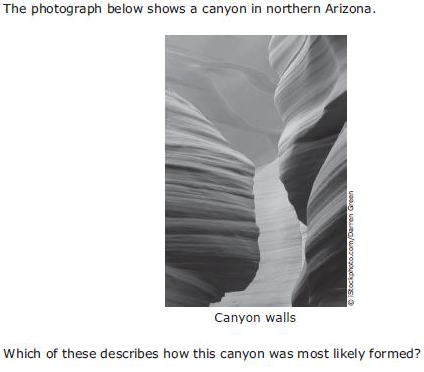
a)
Floods eroded the sandstone away from the canyon walls.
b)
Glaciers eroded the canyon rock as they melted and moved.
c)
Ice wedged into cracks in the rock and weathered the canyon walls.
d)
Wind blew large rocks that smashed against the canyon walls.
15.

What occurs when used engine oil is poured into the pit in the ground?

a)

The oil remains sealed in the small disposal pit and does not affect the groundwater.

b)

The oil seeps through the soil until it leaks into the groundwater

c)

The oil seeps through the soil but stops before it reaches the groundwater

d)

The oil creates a barrier in Mrs. Dyess' room

16.
What does the space suit provide protection against?
a)
Extreme temperatures
b)
Muscle loss
c)
Bone loss
d)
Excessive oxygen
17.

In order to survive, astronauts must do what with their water?

a)

Conserve

b)

Recycle

c)

Reuse

d)

All of these are correct

18.

Which of the following accommodations on the space station is used by astronauts to combat the effects of microgravity on their bones?

a)

special handles

b)

Velcro straps

c)

Exercise equipment

d)

oxygen system

19.
Which of the following elements is required in an organic compound?
a)
Nitrogen
b)
Oxygen
c)
Carbon
d)
Sodium
20.
Organic or Inorganic? 
a)
Organic
b)
Inorganic
21.
Is NaCl (table salt) an organic or inorganic compound?
a)
Inorganic
b)
Organic
22.

No work is done in a situation where a force is applied to an object and -

a)

the object does not move.

b)

friction acts on the object.

c)

the object changes shape.

d)

gravity pulls on the object.

23.

Which of the following is the best example of work being done?

a)

doing homework

b)

lifting a box

c)

pushing a stationary box

d)

holding a box

24.
What landforms are created by moving water?
a)
Canyons and deltas
b)
Valleys and deltas
c)
Sanddune and valley
d)
Sanddune and canyon
25.
A triangle-shaped (deposit) landform at the mouth of a river as it empties into a body of water is
a)
weather
b)
delta
c)
landform
