

wayground logo

Free Printable Worksheets

NEW

Font size

S
M
L
XL
Worksheets

Gravity, Air Resistance, and Newton's Laws of Motion Test

Total questions: 15

Worksheet time: 10mins
Name
Class
Date
1.
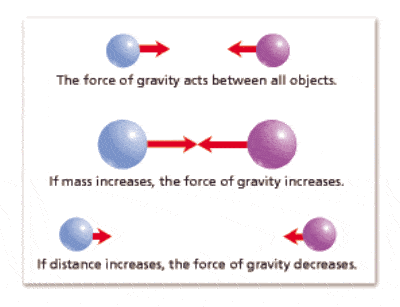
The closer two objects are to each other
a)
the harder they will land
b)
have no gravitational force
c)
have a stronger gravitational force
d)
yep
2.
As mass increases, what happens to gravitational force?
a)
increases
b)
decreases
c)
stays the same
d)
i don't know
3.

The resistance of an object to a change in its motion is

a)

circumference

b)

inertia

c)

air resistance

d)

weight

4.

The upward force which is exerted against a falling object is

a)

gravity

b)

terminal velocity

c)

air resistance

d)

intertia

5.

A physical influence that acts to change the position of an object is

a)

force

b)

newton

c)

mass

d)

law

6.

When a falling object stops accelerating and falls at a constant speed, it is

a)

fluency

b)

constant velocity

c)

acceleration

d)

terminal velocity

7.

Units used to measure force are

a)

pounds

b)

newtons

c)

isaacs

d)

mass

8.

Mass times acceleration equals

a)

inertia

b)

newtons

c)

weight

d)

air resistance

9.

A force which causes objects to fall is

a)

weight

b)

gravity

c)

air resistance

d)

absorbency

10.
Objects at rest remain at rest and objects traveling at a steady rate in a straight line continue that way until a _________acts on them.  
a)
force
b)
velocity
c)
inertia
d)
acceleration 
11.
What is Newton's First Law
a)
F=ma
b)
Every action has an equal and opposite reaction
c)
An object at rest stays at rest, an object in motion stays in motion. 
d)
Friction 
12.
"If we apply a ___________ to an object, its __________________ will change and it will  ______________."
a)
force, accelerate, gravity
b)
accelerate, inertia, gravity
c)
force, velocity, accelerate
d)
velocity, gravity, inertia
13.
Newton's third law states that any action will have a(n) _______ and ______ reaction
a)
Equal and similar
b)
Equal and opposite
c)
Equal and different
d)
Greater and opposite
14.

Newton's first law states that an object at rest

a)

moves invisibly

b)

moves occasionally

c)

stays at rest unless acted upon by any force

d)

stays at rest unless acted upon by an unbalanced force

15.

Newton's second law states that the greater the mass of an object, the __________________ the amount of force needed to accelerate the object.

a)

greater

b)

lesser

c)

same
