
 Worksheets
Plate Tectonics
Total questions: 44
Worksheet time: 36mins
Name
Class
Date
1.
Which of the following causes Earth's tectonic plates to move?
a)
Energy from the Sun
b)
Magnetic Pole Reversal
c)
Convection currents in the mantle
d)
Faults in Mountain Ranges
2.
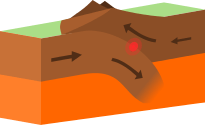
What type of plate boundary is this?
a)
Plate
b)
Divergent
c)
Convergent
d)
Transform
3.

What type of event will occur at this boundary?
a)
Earthquake
b)
Volcano Eruption
c)
Tornado
d)
Mountain Building
4.
A divergent boundary occurs when plates ....
a)
Pull apart
b)
Come together
c)
Slide past each other
d)
subducting
5.
Which of the following is the name of the ancient supercontinent formed 28 Million Years ago.
a)
Pangea
b)
Gondwanda
c)
Laurasia
d)
Neverland
6.
Which of the following is NOT evidence to support the theory of plate tectonics?
a)
Fossils
b)
Mountains
c)
Glaciers
d)
Sand Erosion
7.
A fault is formed by the movement of a __________ plate boundary
a)
Transform
b)
Convergent
c)
Divergent
8.
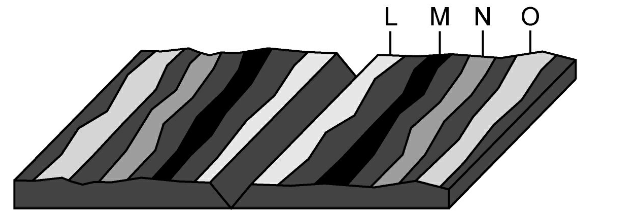
Where would the oldest rock be found?
a)
L
b)
M
c)
N
d)
O
9.
How is it possible for new crust to be formed without increasing the surface area of the Earth?
a)
Crust is destroyed at the same time it is created
b)
New crust is underwater where it sinks
c)
New crust breaks more easily than old crust
10.
Mountains are created when....
a)
Two continental plates collide
b)
Two oceanic plates pull apart
c)
An Oceanic plate subducts under a Continental Plate
d)
Two continental plates pull apart
11.
The Great Rift Valley in Africa and the Mid-Ocean Ridge were all created by this boundary
a)
Divergent
b)
Convergent
c)
Reform
d)
Transform
12.
What are the two types of crust
a)
continental and oceanic
b)
ocean and upper
c)
lower and upper
d)
pizza and subway
13.
Which layer has convection currents?
a)
Inner Core
b)
Outer Core
c)
Mantle
d)
Crust
14.
subduction zones in the ocean can create which features?
a)
islands
b)
volcanoes
c)
earthquakes
d)
all of the above
15.
Earthquakes and volcanoes are most likely found in which locations?
a)
At plate boundaries
b)
in oceans
c)
in the middle of continents
d)
in the middle of plates
16.
When one plate sides under neath another, it _________ and the magma _________.
a)
hardens, sinks
b)
melts, sinks
c)
hardens, rises
d)
melts, rises
17.
The Himalayas in Asia are an example of what type of plate boundary?
a)
divergent
b)
continent-to-continent convergent
c)
ocean-to-continent convergent
d)
transform
18.
This landform can occur at a divergent plate boundary.
a)
ocean trench
b)
mid-ocean ridge
c)
tall mountains
d)
transform fault
19.
A continental rift valley can be formed from stretching continental crust at...
a)
transform plate boundaries
b)
convergent plate boundaries
c)
divergent plate boundaries
d)
all plate boundaries
20.

What type of boundary is the SAN ANDREAS FAULT on?
a)
Covergent
b)
Transformers
c)
Divergent
d)
Transform
21.
The tectonic plates float on the
a)
lithosphere
b)
lower mantle
c)
outer core
d)
asthenosphere
22.
Supporting Evidence: subduction, earthquakes, volcanoes, Mid-Atlantic Ridge, older theories
a)
Continental Drift
b)
Seafloor Spreading
c)
Plate Tectonics
23.
Supporting Evidence: discovery of Mid-Atlantic Ridge, core rock samples showing older rocks the farther that you get from the mid ocean ridge
a)
Continental Drift
b)
Seafloor Spreading
c)
Plate Tectonics
24.
The theory stating the continents were once joined in a large mass that broke apart.
a)
Continental Drift
b)
Seafloor Spreading
c)
Plate Tectonics
d)
Pangaea
25.
The circular pattern of heating, rising, cooling, sinking of magma in the mantle causing tectonic plates to move.
a)
Plate Tectonics
b)
Convection Currents
c)
Pangaea
d)
Subduction
26.
Hot spots are volcanically active areas that are not near tectonic plate boundaries.
a)
True
b)
False
27.
A fossil's location in the Earth's strata can help us know if it is older or younger than other fossils found in the strata.
a)
True
b)
False
28.

The youngest material of the ocean floor is found at mid-ocean _________.
a)
ridges
b)
trenches
c)
basins
d)
rifts
29.

The presence of the same ________ on several continents supports the idea of continental drift.
a)
rocks
b)
fossils
c)
both fossils and rocks
d)
neither fossils nor rocks
30.

A lack of evidence for continental drift prevented many scientists from believing a single supercontinent called _________ existed.
a)
Glossopteris
b)
Pangaea
c)
Gondwanaland
d)
Mesosaurus
31.

The theory of continental drift was first proposed by __________.
a)
Thomas Edison
b)
Alfred Wegener
c)
Benjamin Franklin
d)
Harry Hess
32.

The theory of seafloor spreading was first proposed by __________.
a)
Thomas Edison
b)
Harry Hess
c)
Benjamin Franklin
d)
Alfred Wegener
33.

Which type of plate boundary occurs at B?
a)
convergent
b)
divergent
c)
transform
d)
country
34.

The feature labeled C represents some of the deepest spots on the ocean floor. These areas are called ___.
a)
mid-ocean ridge
b)
trenches
c)
deep-sea vent
d)
abyssal plain
35.

The feature labeled D is part of the continuous underwater mountain range that circles Earth. It is called ___.
a)
mid-ocean ridge
b)
trenches
c)
deep-sea vent
d)
abyssal plain
36.

Which type of plate boundary is shown at A?
a)
transform boundary
b)
convergent boundary
c)
divergent boundary
d)
fractured boundary
37.
Why did no one believe Wegener's thoery?
a)
He could not explain HOW the continents moved
b)
He didn't have evidence
c)
His data was wrong
d)
He didn't use the right technology to gather data
38.
True or False : Sea-floor Spreading adds new material to the ocean floor?
a)
True
b)
False
39.
When one tectonic plate __________ under another at a convergent boundary it sinks back in the mantle.
a)
subducts
b)
falls
c)
sinks
40.
What technology was used during WWII to detect enemy submarines and produce the first map of the seafloor?
a)
Sonar
b)
Radar
c)
GPS
41.
Which is NOT evidence of sea-floor spreading?
a)
Molten magma constantly erupting
b)
Drilling samples of rock
c)
Magnetic stripes
d)
Fossil evidence
42.
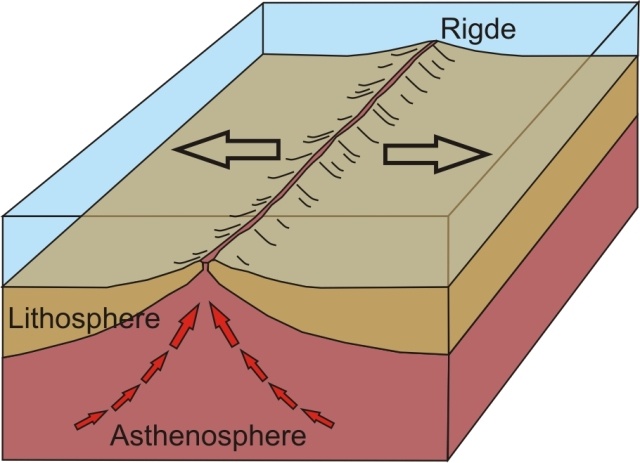
What kind of plate boundary is shown here?
a)
divergent
b)
convergent
c)
transform
d)
subducting
43.

What kind of plate boundary is shown here?
a)
divergent
b)
convergent
c)
transform
d)
submergent
44.

What kind of plate boundary is shown here?
a)
divergent
b)
convergent
c)
transform
d)
strike slip
100 %

