
 Worksheets
STAAR SCIENCE REVIEW
Total questions: 94
Worksheet time: 1hrs 12mins
Name
Class
Date
1.
This is the branch of science that studies how living things interact with one another and with their environment.
a)
Ecosystem
b)
Biome
c)
Ecology
d)
Habitat
2.
Which major biome is home to cacti, brittle bushes, small reptiles, and coyotes?
a)
Desert
b)
Taiga
c)
Tundra
d)
Grassland
3.

What is this called?
a)
Food Web
b)
Food Chain
c)
Abiotic Factors
4.
Which biome, because of its climate and amount of rainfall, has the largest number of species of plants and animals?
a)
Tundra
b)
Rainforest
c)
Desert
d)
Pineforest
5.
What Biome do we live in?
a)
Deciduous Forest
b)
Tropical Rain Forest
c)
Taiga
d)
Grasslands
6.

What is this called?
a)
Food Web
b)
Food Chain
c)
Abiotic Factors
7.
What is an example of a decomposer?
a)
Tree
b)
Dog
c)
Grasshopper
d)
Bacteria
8.
The place where an organism lives is its _________.
a)
habitat
b)
abiotic
c)
ecosystem
d)
community
9.
An individual living thing is a/an __________.
a)
habitat
b)
ecosystem
c)
organism
d)
population
10.
All of the living parts of an ecosystem are _________.
a)
biology
b)
biotic
c)
abiotic
d)
biography
11.
All of the nonliving parts of an ecosystem are _______.
a)
biography
b)
biotic
c)
abiotic
d)
biology
12.
A group of organisms of the same species living in the same area are called a/an ________.
a)
community
b)
habitat
c)
population
d)
ecosystem
13.
All of the living and nonliving things in an area that interact with each other are called a/an ______.
a)
community
b)
habitat
c)
population
d)
ecosystem
14.
A group of different species that live together and interact in an environment are called a/an ________.
a)
community
b)
habitat
c)
population
d)
ecosystem
15.
If the population of prey increases, the population of predators will ________because of the availability of food.
a)
decrease
b)
stay the same
c)
increase
16.

Students propped up one end of a tray of sand. They also set up a jar of water and a rubber hose so that water flowed over the sand. They observed how the moving water carried the sand downhill and made a small pile of sand at the bottom of the tray. When the students created the small pile of sand at the end of the flow of water, they modeled the formation of which of the following?
a)
A. Dunes
b)
B. Canyon
c)
C. Plain
d)
D. Delta
17.
A farmer notices that soil on the farm has been decreasing over the past few months. What environmental factor is most likely related to the loss of soil?
a)
A. Recent heavy rains
b)
B. Steady increase in temperatures
c)
C. Abundant crop yields
d)
D. Decrease in temperatures
18.

This rock formation formed over many millions of years. What force most likely created it?
a)
A. A glacier pushing rocks ahead of it
b)
B. A river bringing rocks down a mountain
c)
C. Wind-blown sand carving large rocks
d)
D. A volcano blasting rocks great distances
19.

1. What process is responsible for creating a delta?
a)
weathering
b)
erosion
c)
deposition
d)
water
20.
What term describes the movement of rock materials from one place to another?
a)
erosion
b)
flooding
c)
deposition
d)
weathering
21.
Which term best describes the mechanical processes that break down rock?
a)
gravity
b)
deposition
c)
weathering
d)
erosion
22.

Over many years the bottom of a lake gets higher and higher. What could cause this slow change?
a)
A. The climate in the area gets warmer.
b)
B. Sediments are deposited in the lake.
c)
C. The Sun evaporates the water.
d)
D. The area around the lake experiences a drought.
23.

a)
A
b)
B
c)
C
d)
D
24.
What is sediment?
a)
the process of rocks being broken down and carried away
b)
bits of rock, sand, and silt caused by the weathering of rocks
c)
the top layer of the soil
d)
decaying plant or animal material
25.
This is the day to day change in temperature, precipitation, wind and air pressure
a)
climate
b)
weather
c)
atmosphere
d)
wind
26.
Which process changes water from a liquid to a gas?
a)
precipitation
b)
cooling
c)
evaporation
d)
condensation
27.
This is the long term patterns over a period of time in an area
a)
weather
b)
climate
c)
atmosphere
d)
wind
28.
What is transpiration???
a)
the process by which plants give off moisture into the atmosphere
b)
the force of gravity pulling mass towards the center of the earth
c)
Liquid to gas
d)
The transfer of heat in a gas or liquid ,warmer material rises and cooler falls causing an cycle
29.
What happens when you leave an bottle of water out in the sun???
a)
Evaporation happens
b)
Precipitation happens
c)
Transpiration happens
d)
Condensation happens
30.
What follows evaporation during the water cycle? How does this occur?
a)
Water evaporates into water vapor
b)
Water vapor condenses and forms a cloud
c)
Water precipitates to the ground
d)
Water runs down into the hydrosphere
31.

Does evaporation happen before or after condensation?
a)
before
b)
after
c)
during
32.
Which best explains why runoff is important?
a)
It returns water to other locations on Earth
b)
It increases the chance of flooding
c)
It makes evaporation occur faster
d)
It increases condensation
33.

What part of the water cycle does this picture show?
a)
condensation
b)
precipitation
c)
evaporation
34.

Which arrow shows evaporation?
a)
A
b)
B
c)
C
d)
D
35.
In the water cycle on Earth, water is in which form?
a)
solid
b)
liquid
c)
gas
d)
all of these
36.

What letter represents condensation?
a)
A
b)
B
c)
C
d)
D
37.
The sun drives the water cycle by doing what?
a)
Rotating on it's axis
b)
Giving off light for plants
c)
Providing gravity to keep the Earth in orbit
d)
Providing heat for evaporation
38.

What is D representing in the water cycle?
a)
Evaporation
b)
Condensation
c)
Precipitation
d)
Runoff
39.

What is C representing in the water cycle?
a)
Evaporation
b)
Condensation
c)
Precipitation
d)
Runoff
40.
Heat from the Sun causes water to rise into the sky. This water vapor collects in the sky in the form of clouds.
a)
Evaporation
b)
Transpiration
c)
Condensation
d)
Precipitation
41.
The movement of water between the atmosphere, land, oceans and living things
a)
water cycle
b)
evaporation
c)
precipitation
d)
condensation
42.
This release of water vapor in the air by plants is called
a)
evaporation
b)
transpiration
c)
sublimation
d)
condensation
43.
Evaporation of water comes mostly from
a)
oceans
b)
lakes
c)
people using it
d)
hydrosphere
44.

What is water that flows in rivers and streams into the oceans and lakes?
a)
evaporating
b)
condensing
c)
precipitating
d)
runoff
45.

Decide whether image demonstrates reflection or refraction.
a)
Reflection
b)
Refraction
46.

Decide whether image demonstrates reflection or refraction.
a)
Reflection
b)
Refraction
47.

Decide whether image demonstrates reflection or refraction.
a)
Reflection
b)
Refraction
48.

Decide whether image demonstrates reflection or refraction.
a)
Reflection
b)
Refraction
49.

Decide whether image demonstrates reflection or refraction.
a)
Reflection
b)
Refraction
50.

Decide whether image demonstrates reflection or refraction.
a)
Reflection
b)
Refraction
51.

a)
1000
b)
100
c)
385
d)
485
52.

a)
Geothermal and natural gas
b)
Hydroelectric and geothermal
c)
Solar and petroleum
d)
Wind and coal
53.

a)
F
b)
G
c)
H
d)
J
54.

a)
fossil fuels
b)
biofuels
c)
solar energy
d)
geothermal energy
55.

a)
Hydroelectric Energy
b)
Geothermal Energy
c)
Wind Energy
d)
Solar Energy
56.

a)
Rocks are broken into smaller pieces that remain in the same location.
b)
Pressure compacts layers of sediment and turns them into rock.
c)
Pieces of rock or soil are carried from one place to another.
d)
Sediment grains fall to the bottom of a lake to form sedimentary layers.
57.

a)
The dead plants sink to the bottom of the pond and get
buried by sediment for millions of years.
buried by sediment for millions of years.
b)
The dead plants get buried for millions of years and form fossils that attract carbon.
c)
The dead plants sink to the bottom of the pond and are consumed by decomposers.
d)
The dead plants produce carbon that is consumed by fish, which form fossils.
58.

a)
Mostly sand and a few small bits of wood
b)
Mostly decaying organisms
c)
Mostly lava and a few sedimentary rocks
d)
Mostly metal minerals
59.

a)
Sedimentary rock is made of layers.
b)
Sedimentary rock is cemented bits of rock.
c)
Sedimentary rock is often limestone.
d)
Sedimentary rock is common in Texas.
60.

a)
Sand in the sediment melts and turns into rock.
b)
The weight of the water compacts the sediment into rock.
c)
Changing water temperatures turn sand in the sediment into rock.
d)
Pollution caused by humans turns the sediment into rock.
61.

What process changes liquid water into vapor?
a)
1 - sun's radiation
b)
2 - condensation
c)
3 - evaporation
d)
4 - precipitation
62.

This picture shows the earth's uneven heating. What direction will the air most likely move?
a)
straight down over the land
b)
from the land to the sea
c)
from the sea to the land
d)
straight up over the sea
63.
A city has a temperature of 75 degrees with partly cloudy skies. The forecast says the air pressure and temperature will drop later in the day. What type of weather might happen later in the afternoon?
a)
rainy
b)
sunny
c)
snowing
d)
hailing
64.

Where in the diagram would the air pressure be the greatest?
a)
at the beach by the ocean
b)
on top of the mountain
c)
at the clouds
d)
above the atmosphere
65.

True or False
The Earth is the center of the solar system.
The Earth is the center of the solar system.
a)
True
b)
False
66.

The order of the planets is:
a)
Mars,Venus,Earth,
Mercury,Saturn
Jupiter, Uranus, Neptune
Mercury,Saturn
Jupiter, Uranus, Neptune
b)
Earth,Venus,Mars
Jupiter, Neptune,
Mercury,Saturn,
Uranus
Jupiter, Neptune,
Mercury,Saturn,
Uranus
c)
Mercury,Venus,Earth
Mars,Jupiter,
Saturn,Uranus
Neptune
Mars,Jupiter,
Saturn,Uranus
Neptune
67.

What is NOT a common characteristic of the outer planets?
a)
Gaseous
b)
Giant
c)
Rings
d)
Smaller than Earth
68.

What is a common characteristic of the inner planets?
a)
Large
b)
Gaseous
c)
Rings
d)
Rocky Surface
69.

True or False
The planets are not lined up in a perfectly straight line
The planets are not lined up in a perfectly straight line
a)
True
b)
False
70.

Which planet has a thick atmosphere and is the hottest planet?
a)
Mercury
b)
Venus
c)
Earth
d)
Mars
71.

Which planet is covered in water?
a)
Mercury
b)
Venus
c)
Earth
d)
Mars
72.

Which planet has iron in its soil and is the red planet?
a)
Mercury
b)
Venus
c)
Earth
d)
Mars
73.

Which planet is the smallest?
a)
Mercury
b)
Venus
c)
Earth
d)
Mars
74.

Which planet is Earth's sister planet?
a)
Mercury
b)
Venus
c)
Earth
d)
Mars
75.

Which planet rotates to give day/night every 24 hours?
a)
Mercury
b)
Venus
c)
Earth
d)
Mars
76.

What is in between the inner planets and the outer planets?
a)
Asteroid belt
b)
Kuiper belt
c)
Sun
d)
Moon
77.

Which planet is the largest?
a)
Jupiter
b)
Saturn
c)
Uranus
d)
Neptune
78.

Which planet has hurricanes and one large one that makes up the Great Red Spot?
a)
Jupiter
b)
Saturn
c)
Uranus
d)
Neptune
79.
Which of the following is a characteristic of both the Earth and the Moon?
a)
Atmosphere containing oxygen
b)
Rocky surface covered with landforms
c)
Flowing water in oceans and rivers
d)
Fossils and fossil fuels under the surface
80.
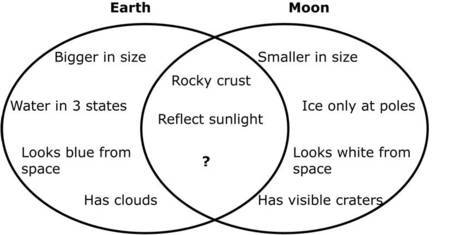
A student created a diagram to compare the characteristics of the Earth and the Moon.
Which of the following characteristics could be placed in the center part of the diagram?
Which of the following characteristics could be placed in the center part of the diagram?
a)
orbits another object
b)
strong gravitational pull
c)
rotates every 24 hours
d)
has an atmosphere
81.

This model can be used to show some relationships between the Earth, Sun, and Moon.
The model shows all of the following EXCEPT –
The model shows all of the following EXCEPT –
a)
the relative sizes of the Moon and Earth
b)
the way the Moon revolves around the Earth
c)
the composition of the Moon, Earth, and Sun
d)
how the Moon and the Earth revolve around the Sun
82.
Of the Earth, Sun, and Moon, which ones orbit another object?
a)
the Sun and the Earth
b)
the Sun and the Moon
c)
the Moon and the Sun
d)
the Moon and the Earth
83.
to spin on an axis
a)
orbit
b)
rotate
c)
axis
d)
atmosphere
84.

How many days does it take for the Earth to revolve around the Sun one time?
a)
24
b)
1
c)
365
85.

How many hours does it take for the Earth to rotate on its axis one time?
a)
24
b)
365
c)
1
86.
What is the boiling point of water
a)
0 C
b)
100 F
c)
50 C
d)
100 C
87.
What is happening at the boiling point?
a)
liquid to gas
b)
gas to liquid
c)
solid to liquid
d)
liquid to solid
88.
What is water's freezing point?
a)
0 F
b)
32 C
c)
50 C
d)
0 C
89.
What is water's melting point?
a)
32 C
b)
0 C
c)
32 F
d)
0 F
90.
What is happening at water melting point?
a)
liquid to gas
b)
solid to liquid
c)
gas to liquid
d)
liquid to soild
91.
When does condensation happen?
a)
solid to liquid
b)
liquid to gas
c)
gas to liquid
d)
solid to gas
92.
When does evaporation happen?
a)
gas to liquid
b)
liquid to solid
c)
solid to liquid
d)
liquid to gas
93.
How can you describe matter?
a)
properties
b)
traits
c)
characterisctics
d)
how, when, what, and who
94.
Do all matter have the same boiling, melting, and freezing points
a)
Yes
b)
No
100 %

