wayground logo

Free Printable Worksheets

NEW

Font size

S
M
L
XL
Worksheets

5th Grade Science STAAR Review 8

Total questions: 28

Worksheet time: 55mins
Name
Class
Date
1.
Which of the following is a characteristic of both the Earth and the Moon?
a)
Atmosphere containing oxygen
b)
Rocky surface covered with landforms
c)
Flowing water in oceans and rivers
d)
Fossils and fossil fuels under the surface
2.
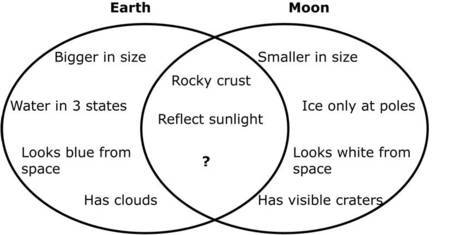
A student created a diagram to compare the characteristics of the Earth and the Moon.
Which of the following characteristics could be placed in the center part of the diagram?
a)
orbits another object
b)
strong gravitational pull
c)
rotates every 24 hours
d)
has an atmosphere
3.
to spin on an axis
a)
orbit
b)
rotate
c)
axis
d)
atmosphere
4.
How many days does it take for the Earth to revolve around the Sun one time?
a)
24
b)
1
c)
365
5.
The moon’s surface has many more craters than the Earth’s. What best explains the difference in the number of craters on the surface of the Moon and the Earth?
a)
The Moon rarely gets impacted by meteorites.
b)
The Earth’s atmosphere protects it from impacts.
c)
The Moon’s gravity attracts more meteorites than Earth's.
d)
The Earth rotates on its axis more quickly than the Moon.
6.
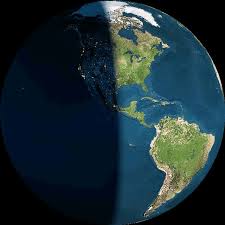
Day and night is caused by the . . .
a)
revolution of Earth around the Sun
b)
orbit of Earth around the Moon
c)
rotation of earth on its axis.
d)
rotation of the Moon on it's axis
7.
Which has changes due to weathering?
a)
Only the Sun
b)
Sun and Moon
c)
Earth and Sun
d)
Only Earth
8.
Which statement correctly describes the Sun's apparent movement across the sky?
a)
As Earth spins on its axis, it makes the Sun appear to move across the sky.
b)
As the Sun spins around Earth, it moves across the sky.
c)
Earth rotates around the Sun every 24 hours, making the Sun appear to move across the sky. 
d)
The Sun rotates around Earth every 12 hours, making the Sun appear to move across the sky. 
9.
The Moon rotates around the Earth once, about every -
a)
year
b)
week
c)
month
d)
180 days
10.
Which of these physical characteristics are found on the Earth but NOT on the Moon? 
a)
mountains
b)
valleys
c)
lakes
d)
plains
11.
The Earth rotates ____ to _____. This causes the sun, moon, and stars to rise in the ____, appear to move across the sky,and set in the ____.
a)
west, east  west, east
b)
east, west  east, west
c)
west, east  east, west
d)
east, west   north, south
12.
Seasons are a results of_______________.
a)
The Earth's rotation on its axis
b)
The tilt of the Earth on its axis and the revolution  of Earth around the Sun.
c)
The moon blocking the sunlight from the Earth.
d)
The Earth's distance from the Sun.
13.
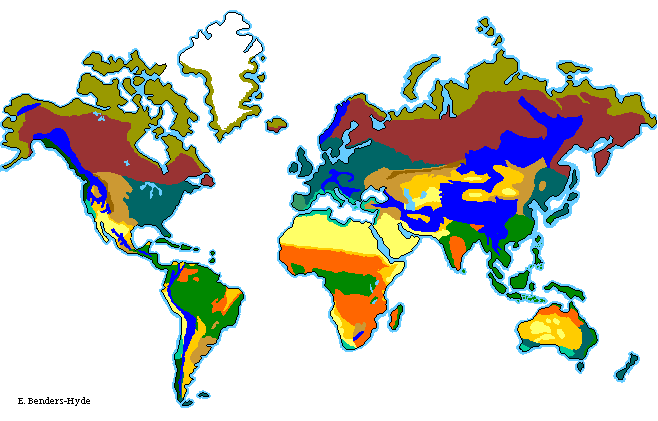
A large ecosystem is called a ______
a)
Ecosystem
b)
Habitat
c)
Biome
d)
Niche
14.
What is the main factor that separates the biomes?
a)
Land
b)
Water
c)
Climate
d)
Longitude
15.
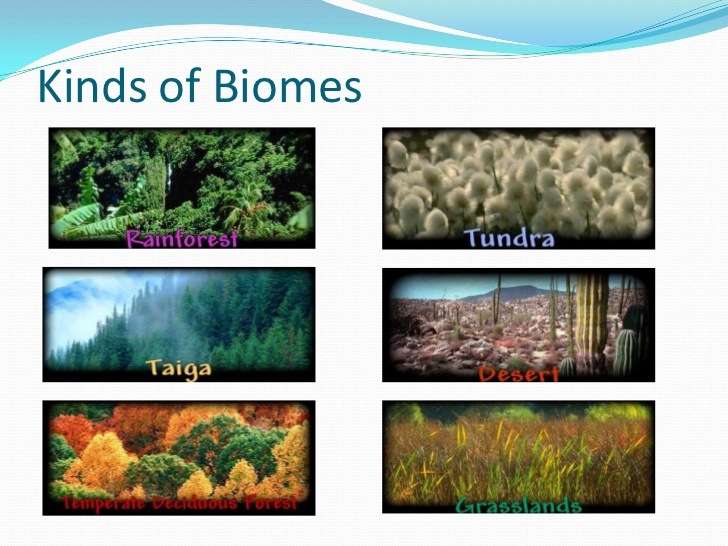
Which biome has the most variety of plants and animals?
a)
Temperate Forest
b)
Rainforest
c)
Tundra
d)
Grasslands
16.
The area between the high-tide line and the low-tide line.
a)
nekton
b)
intertidal zone
c)
chaparral
d)
estuary
17.
a)
Samples 1 and 2
b)
Samples 3 and 4
c)
Samples 1 and 3
d)
Samples 2 and 3
18.
a)
Container 1
b)
Container 2
c)
Container 3
d)
Container 4
19.

What makes food in a plant cell?

a)

chloroplast

b)

cytoplasm

c)

nucleus

d)

mitochondria

20.

Grasslands have very few trees while forests have many trees. Why is this statement true?

a)

Grasslands receive less rain than forests.

b)

Grasslands receive less sunlight than the forests.

c)

The animals of the grasslands eat small trees before they can grow.

21.

Which best explains the adaptations needed for organisms living in an estuary ecosystem?

a)

Organisms must be adapted to live in salt water.

b)

Organisms must be adapted to live in fresh water.

c)

Organisms must be adapted to live in both fresh water and salt water.

22.

Which part of a pond ecosystem gives small fish shelter?

a)

rocks

b)

water

c)

frogs

d)

soil

23.

Which two ecosystems are terrestrial?

a)

ponds and lakes

b)

forests and estuaries

c)

oceans and grasslands

d)

forests and grasslands

24.

Which statement best describes producers?

a)

Producers in water ecosystems are mainly algae.

b)

Producers in land ecosystems are mainly grasses.

c)

Producers in both water and land ecosystems are mainly trees.

d)

Producers in both water and land ecosystems are mainly green plants.

25.

A pond has become overgrown with algae. The fish and plants in the pond are beginning to die. Which human activity would most likely be responsible for the decrease in pond life?

a)

people throwing garbage near a road

b)

farmers using excess fertilizers on crops

c)

logging companies cutting trees in forests

d)

factories producing smoke that pollutes the air

26.

A rabbit eats a variety of plants in an ecosystem. Which best describes the effect a drought would have on both rabbits and plants in an ecosystem?

a)

Both populations would increase.

b)

Both populations would decrease.

c)

Plant life would decrease and the rabbit population would increase.

27.

In a grassland ecosystem, lions prey on wildebeest. The population of lions has declined steadily because of illegal hunting. What will most likely happen to the population of wildebeest?

a)

The wildebeest population will increase.

b)

The wildebeest population will decrease.

c)

The wildebeest population will remain the same.

28.

Which is most likely responsible for the pollutants that enter a wetland ecosystem after a heavy rain?

a)

animal waste

b)

human chemical use

c)

atmospheric conditions

d)

changes in daily temperatures