wayground logo

Free Printable Worksheets

Font size

S
M
L
XL
Worksheets

5th grade review test

Total questions: 89

Worksheet time: 2hrs 43mins

Name
Class
Date
1.
Two wires carrying electricity can create a spark if they come too close together. This spark can start a fire. Wires carrying electricity are usuallly covered  with plastic to keep them from starting a fire. Why does the plastic keep electricity from starting a fire?
a)
Plastic is a good insulator.
b)
Plastic can melt when heated.
c)
Plastic is softer than wire.
d)
Plastic conducts electricity.
2.
Erosion is one of the processes involved in the formation of sedimentary rock. Which of these best describes the process of erosion?
a)
Rocks are broken into smaller pieces that remain in the same location.
b)
Pressure compacts layers of sediment and turns them into rock.
c)
Pieces of rock or soil are carried from one place to another.
d)
Sediment grains fall to the bottom of a lake to form sedimentary layers.
3.
A student observing birds in a park records some ways that birds interact with living and nonliving parts of their environment. All the following  observations are was that a bird interacts with nonliving parts of its environment except______
a)
reacting to morning sunlight by singing
b)
drinking and taking a bath in a puddle of water
c)
responding to cold temperatures by fluffing its feathers
d)
feeding insects to its chicks
4.
A student made a list of activities that involve energy.  
-
1. Sharks chasing a school of fish
2. A toaster heating bread
3. A cell phone charging
4. A tree limb falling to the ground
5. Tomato plants absorbing sunlight
6. A canoe floating down a river
-
Which activities on the list are examples of the use of mechanical energy? 
a)
Activities 1, 4, and 6 
b)
Activities 2, 4, and 5
c)
Activities 1 and 2 
d)
Activities 3, 5, and 6 
6.
A student combined powdered paint with water to make a small amount of a blue liquid paint mixture. The student left the paint mixture in an open container. Several days later the student found the container and observed that changes had occurred. What most likely happened to the mixture?
a)
The container was empty after the mixture evaporated into the air.  
b)
The paint evaporated, leaving only clear water in the container.
c)
The water evaporated, leaving only a dry blue solid in the container.  
d)
The liquid paint mixture was lighter in color after some water evaporated.  
6.
A student combined powdered paint with water to make a small amount of a blue liquid paint mixture. The student left the paint mixture in an open container. Several days later the student found the container and observed that changes had occurred. What most likely happened to the mixture?
a)
The container was empty after the mixture evaporated into the air.  
b)
The paint evaporated, leaving only clear water in the container.
c)
The water evaporated, leaving only a dry blue solid in the container.  
d)
The liquid paint mixture was lighter in color after some water evaporated.  
7.
Tropical climates have warm temperatures and abundant sunlight all year. What must be available for plants in these climates to make their own food throughout the year?
a)
Bacteria 
b)
Birds  
c)
Shade
d)
Water
8.
A student puts four objects in a bucket filled with water. The objects are listed below. 
-
 Plastic ball
Glass marble
Metal paper clip
Wood block 
-
Which two objects are most likely less dense than the water?
a)
Wood block and metal paper clip
b)
Plastic ball and glass marble
c)
Metal paper clip and glass marble
d)
Wood block and plastic ball
9.
What would most likely happen to the carbon dioxide–oxygen cycle if Earth’s large forests were all cut down?
a)
 There would be more carbon dioxide in the atmosphere because fewer plants would be using it to produce their own food.
b)
The remaining plants would stop producing carbon dioxide, and animals would use less oxygen.
c)
The remaining plants would produce more oxygen, and animals would produce less carbon dioxide.
d)
There would be more oxygen in the atmosphere because fewer plants would be using it to produce their own food.
10.
Which of these is not soluble in water?
a)
Oil
b)
Salt
c)
Honey
d)
Sugar
11.
What is Matter?
a)
The amount of space an object takes up.
b)
Anything that has mass or takes up space.
c)
The pull of gravity on an object. 
d)
A solid, liquid or gas.
12.
What is solubility?
a)
A combination of two or more substances.
b)
The ability of a solid to dissolve in a liquid.
c)
The ability to attract to a magnet.
d)
To classify an item as solid, liquid and gas.
13.
If an item floats on top of water it is...
a)
Less dense than water.
b)
More dense than water
c)
The same density as water.
d)
A gas.
14.
What is a conductor?
a)
Something that stops heat and electricity.
b)
Something that creates power.
c)
Something that allows heat or electricity to flow through it.
d)
Something that dissolves in water.
15.
What does MELTS stand for?
a)
Mechanical. Energy, Light, Thermal, Solar
b)
Magnetism, Electrical, Light, Thermal, Sound
c)
Mechanical, Electrical, Liquid, Thermal, Solid
d)
Mechanical, Electrical, Light, Thermal, Sound
16.
This is an example of a ______ circuit
a)
Series
b)
Parallel
c)
Open
d)
Dihexihedral
17.
The Smiths notice a bird flying into a window.  The bird flies into the window because light - 
a)
travels through the window
b)
reflects from the window
c)
refracts around the window
d)
reflects around the window
18.
Which statement describes weather, rather than climate?
a)
The weather is usually hot and humid year around
b)
The destination has hot summers and cold winters
c)
The summer temperatures average between 29 and 35 degrees
d)
The humidity level on Tuesday was 30%
19.
A class learns about fossil fuels.  They learn that coal, oil and natural gas are classified as nonrenewable resources because they take so long to form.  How can the class conserve fossil fuels?
a)
Use both sides of notebook paper
b)
Arrange a car pool to and from school
c)
Create a backyard compost pile
d)
Plant flowers in front of the school
20.
Students conduct an investigation to observe the Sun's movement.   Which safety procedure should students following during this investigation?
a)
Wear gloves and goggles
b)
Keep loose hair tied back
c)
Never look directly at the Sun
d)
Record all data in science notebooks
21.
Which testable question could be used to investigate the effects of force on an object?
a)
Why do toy cars move?
b)
Which type of battery lasts the longest?
c)
Where can magnets be purchased?
d)
Do balls roll faster on rough or smooth surfaces?
22.
A bear receives the energy it needs to survive after it -
a)
drinks plenty of water
b)
eats fish and berries
c)
takes a nap
d)
rests in the sunlight
23.
All of the following are poor insulators of electricity EXCEPT -
a)
penny
b)
nail
c)
eraser
d)
paperclip
24.
Which mixture can be separated using a coffee filter?
a)
rocks and sand
b)
sand and water
c)
lemon juice and water
d)
sand and iron filings
25.
Plants are known as producers because they produce their own food.  How do producers receive the energy for this process?
a)
By consuming soil nutrients
b)
By absorbing sunlight
c)
By releasing water
d)
By producing oxygen
26.
What physical property of matter can be measured using the triple beam balance?
a)
length
b)
height
c)
volume
d)
mass
27.
Coal, oil and natural gas are examples of ____________.
a)
non-renewable resources
b)
renewable resources
c)
alternative energy resources
d)
non-usable resources
28.
The breaking down of rock into pieces (sediments) is called ___________.
a)
deposition
b)
weathering
c)
erosion
d)
rock formation
29.
Which of these would NOT be attracted to a magnet?
a)
another magnet
b)
marshmallow
c)
iron nail
d)
steel paper clip
30.
How many of these things are liquids
+ lemonade
+ air
+ pickle juice
+ water vapor
+ cooking oil
a)
1
b)
2
c)
3
d)
4
31.
Which of these is a good conductor of thermal energy?
a)
penny
b)
oven mitt
c)
wool coat
d)
polar bear fur
32.
Mrs. Fairbanks has a container that appears empty.  What state of matter is most likely in the container?
a)
liquid
b)
gas
c)
solid
d)
fossil fuel
33.
A student notices an ice cube is melting.  What temperature celsius would a thermometer show if it was placed on the ice cube?
a)
0
b)
32
c)
100
d)
212
34.
A student mixed salt, kool aid mix and sand into different beakers of water.  What physical property could the student have been testing?
a)
mass
b)
solubility
c)
magnetism
d)
gravity
35.

Ms. Robinson wants to put tile around her rectangular pool. The pool has a length of 9.2 yards and a width of 4.8 yards. What is the perimeter of the pool?

a)

14 yards

b)

28 yards

c)

44.16 yards

d)

4.4 yards

36.

Use the comparison symbols to make the statement true 5.5____5.05

a)

>

b)

<

c)

=

d)


37.

(9×100) + (5×1) + (4×0.1) + (3×0.01) + (8×0.001) = What number in standard form?

a)

95.438

b)

954.38

c)

905.438

d)

95438

38.

Johanna's bakery made 3,672 cookies this weekend. Her team needs to split them evenly into boxes that hold 24 cookies each. How many boxes of cookies will they assemble?

a)

153

b)

150

c)

157

d)

149

39.

Round 15.483 to the nearest tenths place.

a)

15.4

b)

15.5

c)

15.48

d)

15

40.

Round 254.367 to the nearest hundredths place.

a)

254

b)

254.4

c)

254.6

d)

254.7

41.
What is the volume of Object X?
a)
10.0 cm3
b)
15.0 cm3
c)
20.0 cm3
d)
25.0 cm3
42.
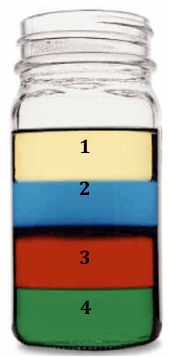
Put the liquids in order from most dense to least dense?
a)
4, 3, 2, 1
b)
1, 2, 3, 4
c)
3, 4, 2, 1, 
d)
4, 3, 1, 2
43.
What form of energy?
a)
Mechanical (kinetic) energy
b)
Chemical (kinetic) energy
c)
Sound (potential) energy
d)
Sound (kinetic) energy
44.
What kind of energy?
a)
Thermal (kinetic) energy
b)
Thermal (potential) energy
c)
Nuclear (kinetic) energy
d)
Mechanical (kinetic) energy
45.
What form of energy?
a)
Thermal
b)
Electrical
c)
Mechanical
d)
Radiant
46.
What kind of energy?
a)
Thermal (kinetic) energy
b)
Chemical (kinetic) energy
c)
Chemical (potential) energy
d)
Mechanical (kinetic) energy
47.
Stored energy that results from the position or shape of an object is called...
a)
Thermal
b)
Potential
c)
Kinetic
d)
Gravitational
48.
When the Earth is between the moon and sun, it is most likely a:
a)
new moon
b)
full moon
c)
waxing crescent
d)
waxing gibbous
49.
A shadow is the longest ________ .
a)
at midday
b)
in the morning
c)
in the evening
d)
in the morning and the evening
50.

How does a bird changes its environment?

a)

It looks for food

b)

it flies from tree to tree

c)

It catches bugs

d)

It builds a nest

51.

Beavers build lodges in which to live and raise their young in quiet ponds. Sometimes they fin a stream and not a pond. What do beavers do then to make a home for themselves?

a)

They travel great distance to find a pond.

b)

They learn to live on the land

c)

They dig burrows near the stream.

d)

They cut down small trees and build a dam to make a pond.

52.
a)
complete
b)
incomplete
53.
3 stages.
a)
incomplete metamorphosis
b)
complete metamorphosis
54.
a)
complete
b)
incomplete
55.
List the four stages of the complete metamorphosis life cycles in the correct order. 
a)
egg, pupa, larva, adult
b)
egg, larva, pupa, adult
c)
adult, egg, larva, pupa
d)
adult, egg, pupa, larva
56.
List the correct order of the three stages in an incomplete life cycle. 
a)
egg, nymph, adult
b)
adult, nymph, egg
c)
egg, adult, nymph
d)
nymph, egg, adult
57.
Which of these is an example of visible light?
a)
X-rays
b)
rainbow
c)
microwaves
d)
radio waves
58.
Through which objects does light pass MORE?
a)
Transparent objects, like glass windows
b)
Opaque objects (not transparent), like a plant
59.
Things make shadows because they ______ light.
a)
BLOCK
b)
PASS
60.
Refraction makes objects look different.
a)
TRUE
b)
FALSE
61.
If students could rotate the globe quickly or slowly and the globe could rotate only at the rate that Earth actually rotates, about how long would each complete rotation take?
a)
30 Days
b)
60 Minutes
c)
24 Hours
d)
365 Days
62.
A student observes ice forming on the edge of a school building. At what temperature did the water outside the school building most likely begin to change to ice? 
a)
100 C.
b)
32 C.
c)
25 C.
d)
0 C.
63.
Animals and plants use substances that cycle through the environment. Which substance is needed by plants to survive and is released into the environment by animals?
a)
Carbon dioxide
b)
Salt
c)
Sugar
d)
Oxygen
64.
When a powdered drink mix was added to water, the liquid turned orange. A student decided the taste was too strong, so he poured out half of the liquid and added more water. Which of the following most likely occurred when more water was added?
a)
The physical state changed.
b)
The orange color became lighter.
c)
The liquid had a sweeter taste.
d)
None of the above
65.
Each school year for 30 years, the amount of rain that fell at a school was measure and recorded. Tracking rainfall over a long period provides the most information about which characteristic of an area?
a)
Climate
b)
Temperature of the day
c)
Weather
d)
Type of soil
66.
The roots of the prickly pear cactus spread out in a wide underground network. How does this type of root system benefit a prickly pear cactus?
a)
By producing fruit and storing water
b)
By capturing sunlight and getting rid of waste materials
c)
By absorbing water and supporting the plant in loose, sandy soil
d)
By releasing nutrients into the sandy soil and taking in oxygen
67.
Prairie dogs eat plants and dig underground tunnels. Prairie dog tunnels help breakup hard prairie soils, and the animals’ waste adds nutrients to the soil. In the past,large groups of prairie dogs lived in many parts of the U.S. Great Plains, but people have destroyed most of these colonies.  Which of these will most likely happen when prairie dogs are removed from an area?
a)
The population of predators that eat prairie dogs will decrease.
b)
The population of plants that prairie dogs eat will decrease.
c)
The nutrients in the soil will increase.
d)
The number of underground tunnels will increase.
68.
A group of students built the circuit shown below. The light bulb does not glow. Which statement explains this observation?
a)
The bell uses most of the energy from the battery.
b)
The light bulb is not part of a complete circuit.
c)
The battery is not charged.
d)
The circuit does not have a switch.
69.
In a food chain, energy does NOT flow directly from —
a)
Producer to decomposer
b)
Producer to consumer
c)
Consumer to decomposer
d)
Consumer to producer
70.
The photograph below shows a canyon in northern Arizona. Which of these describes how this canyon was most likely formed?
a)
Floods eroded the sandstone away from the canyon walls.
b)
Glaciers eroded the canyon rock as they melted and moved.
c)
Ice wedged into cracks in the rock and weathered the canyon walls.
d)
Wind blew large rocks that smashed against the canyon walls.
71.
Resources can be classified as renewable or nonrenewable. Which of these resources is classified in the same category as coal?
a)
Wood
b)
Wind
c)
Corn oil
d)
Petroleum
72.
Cracks in the seafloor called hydrothermal vents send streams of hot water into the ocean. The water from a vent is 387°C. How many degrees above the boiling point of water is this temperature?
a)
175 C.
b)
287 C.
c)
387 C.
d)
Not Here
73.
Which property of light makes it possible to produce hand shadows?
a)
Light travels in straight lines.
b)
Light is a form of energy.
c)
Light can be refracted.
d)
Light can be separated into different colors.
74.
A group of fifth-grade students was researching alternative energy resources in the school library. Each student made a list of resources. Which list contains only alternative energy resources?
a)
F
b)
G
c)
H
d)
J
75.
a)
Arrow 1, because it shows the rotation of the sun
b)
Arrow 2, because it shows the orbit of Earth around the sun
c)
Arrow 3, because it shows the orbit of the moon around Earth 
d)
Arrow 4, because it shows the rotation of Earth 
76.
a)
Decomposers 
b)
Producers 
c)
Predators 
d)
Consumers 
77.
a)
1 learned behavior, 7 inherited traits 
b)
2 learned behaviors, 6 inherited traits 
c)
3 learned behaviors, 5 inherited traits 
d)
4 learned behaviors, 4 inherited traits 
78.
a)
Removing Wire 1  
b)
Removing Wires 2 and 4  
c)
Removing Wires 2 and 5 
d)
Removing Wires 3 and 4  
79.
a)
In which location does the caramel candy change state the fastest? 
b)
What causes the caramel candy to keep its shape?  
c)
Why does the caramel candy change state? 
d)
At what temperature does the caramel candy melt?  
80.
A student observing birds in a park records some ways that birds interact with living and nonliving parts of their environment. All the following observations are ways that a bird interacts with nonliving parts of its environment except — 
a)
reacting to morning sunlight by singing  
b)
drinking and taking a bath in a puddle of water
c)
responding to cold temperatures by fluffing its feathers 
d)
feeding insects to its chicks  
81.
a)
Activities 1, 4, and 6 
b)
Activities 2, 4, and 5 
c)
Activities 1 and 2 
d)
Activities 3, 5, and 6 
82.
a)
dig deep holes for their eggs
b)
swim and dive easily
c)
blend into their surroundings
d)
hold their breath for several minutes
83.
a)
Both students are doing work even if only one student is changing position.
b)
Student 1 is changing position because work is being done on the swing.
c)
Work done by Earth’s gravity prevents Student 2 from changing position.
d)
Work is being done on both students by the swings because one swing is changing position.
84.
a)
A method for removing fossil fuels from hills
b)
The formation of caves in hills
c)
The formation of plains
d)
A method for separating minerals
85.
Tropical climates have warm temperatures and abundant sunlight all year. What must be available for plants in these climates to make their own food throughout the year?
a)
Bacteria 
b)
Birds 
c)
Shade 
d)
Water
86.
a)
The Thomson’s gazelle has a body shape that allows it to run faster when chasing prey.
b)
The Thomson’s gazelle has horns that can be used to move tree branches out of the way to reach food.
c)
The gerenuk has a sharp, pointed nose for detecting the scent of predators.
d)
The gerenuk has a long neck that allows it to reach high to eat from trees.
87.
a)
Only the white bulb will operate.
b)
None of the bulbs will operate.
c)
Only the white and yellow bulbs will operate.
d)
Only the red and blue bulbs will operate.
88.
a)
Samples 1 and 2 
b)
Samples 3 and 4 
c)
Samples 1 and 3 
d)
Samples 2 and 3 
89.
a)
Uranus
b)
Neptune
c)
Saturn
d)
Jupiter