
 Worksheets
Conner 8th Grade STAAR Review #5
Total questions: 54
Worksheet time: 38mins
Name
Class
Date
1.
The spinning of an object on its axis is called______
a)
orbit
b)
rotation
c)
revolution
d)
tide
2.
Day and night is caused by the _____________ of earth on its axis.
a)
revolution
b)
orbit
c)
rotation
3.
The earth orbits around...
a)
the sun.
b)
the moon
c)
other planets
d)
the Milky Way
4.
What are the reasons for the seasons?
a)
Earth's tilt and rotation.
b)
Earth's rotation and revolution.
c)
Earth's tilt and revolution.
d)
Earth's tilt and resolution
5.

When the Northern Hemisphere of Earth is Leaning away from the Sun, What season is the Southern Hemisphere experiencing?
a)
Summer
b)
Winter
c)
Spring
d)
Fall
6.
How long does it take the Earth to make one REVOLUTION around the Sun?
a)
12 hours
b)
24 hours
c)
365 days
d)
29.5 days
7.

What season is letter A?
a)
Winter
b)
Summer
c)
Spring
d)
Fall
8.

What is letter B's Equinox date?
a)
June 21
b)
December 21
c)
March 21
d)
September 21
9.
When the Northern Hemisphere is pointing towards the sun, what season is the Southern Hemisphere?
a)
Winter
b)
Spring
c)
Fall
d)
Summer
10.
The SUN REVOLVES around the:
a)
Moon
b)
Earth
c)
The Sun doesn't revolve
11.
The AXIS is an imaginary line that goes THROUGH the North and South Poles of Earth.
a)
True
b)
False
12.
What does ROTATION mean?
a)
To SPIN
b)
To ORBIT or GO AROUND
13.
This is the reason we experience day and night
a)
rotation
b)
revolution
14.
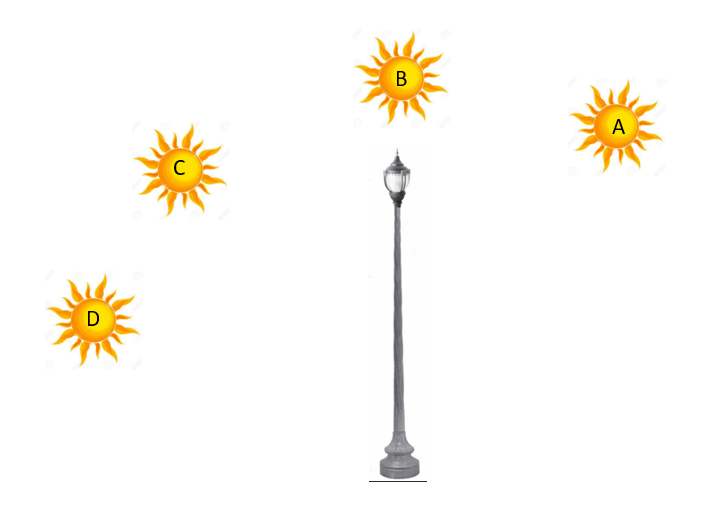
At which location of the sun would the shadow of the lamp post be the shortest?
a)
A
b)
B
c)
C
d)
D
15.
The earth's tilt is ______________degrees.
a)
0
b)
90
c)
23.5
d)
41
16.

If the earth rotated slower, how would that affect the length of the day?
a)
longer day
b)
shorter day
c)
same time, 24 hours
17.
During which season is the northern hemisphere tilted toward the sun?
a)
Summer
b)
Fall
c)
Winter
d)
Spring
18.
What causes day/night on the Earth?
a)
Earth's rotation on its axis
b)
the Sun's revolution around Earth
c)
Earth's revolution around the Sun
d)
The Sun's rotation on its axis
19.
A[n] ______________ tide occurs when the sun is at right angles to the line between Earth and the moon.
a)
high
b)
neap
c)
low
d)
spring
20.
A[n] ___________ tide occurs when the sun, Earth, and the moon are nearly in a line.
a)
spring
b)
high
c)
low
d)
neap
21.
What do we call a tide that has largest range; highest high and lowest low?
a)
gravity
b)
wind
c)
spring
d)
neap
22.
In general, tides occur...
a)
each hour
b)
2 times a day
c)
each month
d)
twice a month
23.

What type of tides would this arrangement of earth-moon-sun create?
a)
neap tide
b)
spring tide
c)
new moon tide
d)
full moon tide
24.

Which phase of the moon is represented in this diagram?
a)
new moon
b)
first quarter
c)
full moon
d)
last quarter/third quarter
25.
Waning phases are when the light is being:
a)
Gained
b)
Lost
26.
Waxing phases are when the light is being:
a)
Gained
b)
Lost
c)
Staying the same
d)
Neither
27.

What is it called when you are able to see half the moon and the light on the moon is decreasing?
a)
New moon
b)
1st quarter
c)
Full Moon
d)
3rd quarter
28.

What is it called when more than half of the moon is lit on the right side and light is increasing?
a)
Waxing cresent
b)
Waxing gibbous
c)
Waning gibbous
d)
Waning cresent
29.
What phase of the moon does a solar eclipse occur?
a)
New moon
b)
1st quarter
c)
Full moon
d)
3rd quarter
30.
What moon phases do spring tides occur?
a)
new and full
b)
1st & 3rd quarters
31.

Does this picture represent a waxing or waning moon?
a)
waxing
b)
waning
32.

The hemisphere where you live
a)
equator
b)
southern
c)
northern
d)
eastern
33.

In winter, the axis of the earth is pointed away or toward the sun?
a)
towards
b)
up
c)
down
d)
away
34.

Which season is taking place in the Northern Hemisphere in Position 1?
a)
Winter
b)
Spring
c)
Summer
d)
Fall
35.

Which body has the greater effect on Earth's tides?
a)
Sun
b)
Saturn
c)
Moon
d)
Venus
36.

What is a difference between spring and neap tides?
a)
Spring tides occur when the earth and sun are IN LINE with the new or full moon.
b)
Spring tides occur when moon in 3rd or 1st quarter phases
c)
Spring tides are LOWER than neap tides
37.

Wha type of tide would this arrangement of earth-moon-sun create?
a)
full moon tide
b)
new moon tide
c)
neap tide
d)
spring tide
38.

What type of tides would this arrangement of earth-moon-sun create?
a)
neap tide
b)
spring tide
c)
new moon tide
d)
full moon tide
39.
What happens when there is a spring tide
a)
high tides
b)
really high tides
c)
low tides
40.
Spring tides and neap tides occur in patterns governed by the
a)
phases of the moon
b)
seasons (fall, winter, etc.)
c)
surface currents
d)
deep sea currents
41.
What are tides?
a)
More water filling up the ocean
b)
The rising and falling of the water on the earth surface
c)
Jupiter orbiting the moon
d)
Waves in the oceans
42.
Which of the following is not an accepted use of an H-R diagram?
a)
Visual way to “graph” and categorize stars based on their characteristics
b)
Allows astronomers to recognize patterns in types of stars
c)
Allows us to track the life cycle of stars as they change over time
d)
Allows us to determine the distance of stars with great accuracy
43.
Absolute magnitude is defined as...
a)
the brightness of an object in space, measured as if you’re 10 parsecs away from the object.
b)
Total energy emitted by a space object per unit time.
c)
the brightness of an object in space, as it appears from Earth
d)
the color of an object in space, described on a number scale.
44.
The effective temperature of a star is related to its...
a)
solar system
b)
luminosity
c)
absolute magnitude
d)
color
45.
The color index of a star provides information about that star’s
a)
age
b)
luminosity
c)
absolute magnitude
d)
temperature
46.
An open cluster has ___________ stars.
a)
less than 100
b)
more than 100,000
c)
less than 50
d)
more than 500
47.

This is an H-R Diagram of a star cluster. Which of the following is true about the stars in Area 1 (bound by the red box)
a)
These stars are red giants.
b)
These stars are white dwarfs.
c)
These stars are main sequence stars.
d)
These stars are in the first half of their life span.
48.

This is an H-R Diagram of a star cluster. The stars that are not in Area 1 or Area 2 are part of the...
a)
main sequence
b)
white dwarf group
c)
blue giant group
d)
instability strip
49.

In which region of the H-R Diagram would you be likely to find Blue Giants?
a)
W
b)
X
c)
Y
d)
Z
50.

In which region of the H-R Diagram would you be likely to find stars that are in hydrostatic equilibrium?
a)
W
b)
X
c)
Y
d)
The orange dashed line
51.
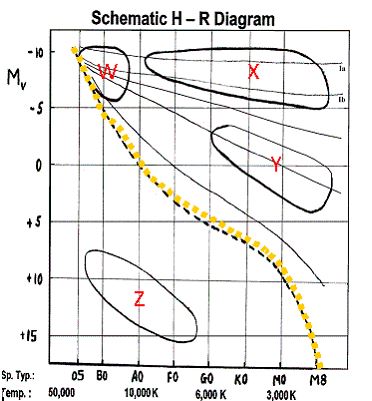
In which region of the H-R Diagram would you be likely to find stars fusing hydrogen to make helium in their cores?
a)
W
b)
X
c)
Y
d)
The orange dashed line
52.

Use the Hertzsprung-Russell Diagram to answer the following question. Betelgeuse is a _____
a)
Hot and Bright Star
b)
Cool and Bright Star
c)
Hot and Dim Star
d)
Cool and Dim Star
53.
Use the Hertzsprung-Russell Diagram to answer the following question. Spica is a _____
a)
Hot and Bright Star
b)
Cool and Bright Star
c)
Hot and Dim Star
d)
Cool and Dim Star
54.
Use the Hertzsprung-Russell Diagram to answer the following question. Sirius B is a _____
a)
Hot and Bright Star
b)
Cool and Bright Star
c)
Hot and Dim Star
d)
Cool and Dim Star
100 %

